

























































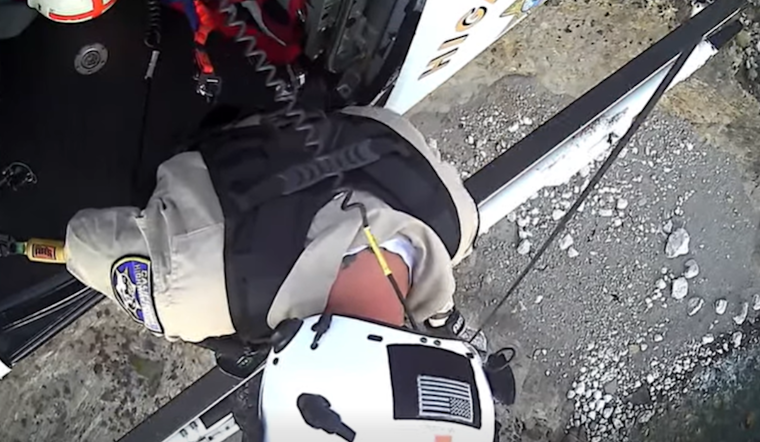
Two climbers stranded on a steep chute roughly 600 feet below Highway 1 near Hurricane Point were hoisted to safety last Saturday after Big Sur Fire called in state helicopter support for a technical rescue that ground crews couldn't attempt alone. The stranded pair was found clinging to the exposed terrain with no safe way to climb back up, prompting a rescue effort that unfolded in stages as a CHP crew worked one climber at a time off the cliffside.
According to CBS News, Big Sur Fire called the Paso Robles Air Unit of the California Highway Patrol for assistance, and the helicopter crew found the two climbers stranded on the steep chute below the highway. Big Sur Fire requested the aerial support at approximately 6:24 PM, dispatching helicopter H-70 after determining a ground dismount was impossible along the steep chute, as reported by Paso Robles Daily News.
How the Double Extraction Worked
A CHP helicopter rescue technician was lowered to assist the first climber, securing that person in a rescue harness before both were extracted together to a staging area, per CBS News. The helicopter then returned to the scene to pull out the second climber using the same procedure. Cal Coast News reports that crews performed a double extraction using a Pelican rescue harness, allowing the rescue technician to stay tethered to the hoist hook while hoisting the technician and first climber simultaneously — a method that lets rescuers secure victims in steep terrain without multiple separate trips down the cable, according to Cal Coast News.
Officials said additional details about the climbers, including their identities and how they came to be stranded in the chute, were not immediately available, per CBS News. CHP air operations personnel continuously train for these kinds of high-risk, low-frequency rescues, the outlet notes, underscoring how specialized the maneuver is even for an experienced crew.
Why Hurricane Point Is So Treacherous
Hurricane Point sits about 20 miles south of Monterey and reaches roughly 560 feet above sea level, a stretch of Highway 1 known for sheer ocean bluffs and punishing wind exposure that makes cliffside rescues especially dangerous for ground crews. The CHP's Coastal Division Air Operations unit, based at Paso Robles Airport, flies an Airbus AS350 B3 helicopter equipped with a 165-foot hoist cable rated to lift up to 500 pounds, giving it the reach needed for rescues far below the roadway. Big Sur Fire, meanwhile, is an all-volunteer department responsible for first-responder duties and technical rescues along a 60-mile stretch of Highway 1, meaning the coordination between local volunteers and the state air unit is a routine but critical part of keeping the remote corridor covered.
This is not the first time crews have had to pull someone off the terrain near Hurricane Point. In February 2024, emergency crews rescued a motorist who survived two days stranded on a cliff after his vehicle plunged 450 feet down an embankment near the same landmark, a case in which a CHP plane first spotted his makeshift flag before a helicopter hoisted him out. And in April 2025, helicopter H-70 — the same call sign dispatched Saturday — deployed its full 164-foot cable to extract an injured hiker from a cliffside canyon along Big Sur's Pine Ridge Trail, maneuvering between tall trees to reach the victim.
Rescue Comes at No Cost to Victims
Because CHP helicopter extractions and search operations are funded through state tax revenues and vehicle registration fees, rescued individuals do not receive a bill for air rescue services, as Hoodline has previously reported. California's public safety agencies do not charge victims directly for search-and-rescue helicopter flights, regardless of how complex the operation.
Last Saturday's rescue also played out against the backdrop of the Timber Fire, which, as of today, has burned more than 12,000 acres and reached about 25 percent containment since igniting in the Los Padres National Forest on August 8. Hurricane Point itself sits outside the fire's evacuation zone, per CBS News, and yesterday, the blaze had pushed into the Ventana Wilderness of Los Padres National Forest while firefighters held containment lines protecting homes along Highway 1. An earlier Hoodline coverage of the fire's spread detailed how evacuation warnings had widened even as containment ticked upward. Earlier in August, a 16-mile stretch of Highway 1 was closed as crews worked to hold containment lines along the roadway, a reminder of how quickly the region's sole coastal artery can become a bottleneck for both residents and emergency responders.





