

























































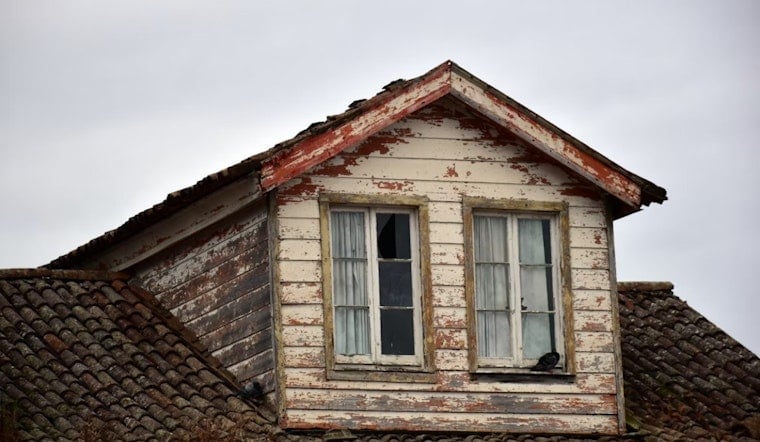
Angelo Merendino bought his Old Brooklyn home in 2020, and two years ago he was picked to move forward in Cleveland's home repair lottery, funded by $10 million in federal pandemic relief dollars. He is still waiting. In that time, Merendino has replaced his own air conditioning system and water heater, fixed his plumbing, and installed a fence — all without help from the program he was told he had won.
Cleveland's home repair lottery drew around 1,600 applicants when it opened in August 2024, and the city selected nine applicants from each of its 17 wards, totaling 153 people, according to Signal Cleveland. Merendino was one of them. Of those 153 lottery winners, 149 were funneled to CHN Housing Partners, the nonprofit tasked with carrying out most of the repairs — but CHN has said most lottery applicants landed behind an existing waitlist the organization was already working through before it started serving new winners.
“Somebody at the city needs to be held accountable for this $10 million of taxpayer money,” Merendino said, according to the same report. He added that what bothers him most isn't the wait itself, but that no one seems to be doing anything about his application in the meantime.
A Program Moving in Pieces
Cleveland City Council originally split the $10 million ARPA allocation among four nonprofit partners in 2023: $4 million to CHN Housing Partners, $3 million to Cleveland Restoration Society, $1.5 million to Greater Cleveland Habitat for Humanity, and $1.5 million to Local Initiatives Support Corporation, or LISC. The city distributes the grants on a reimbursement basis, and as of the latest accounting, the program has spent at least $2.3 million of the total, per Signal Cleveland's reporting.
The rollout has progressed piecemeal, and each nonprofit partner has faced its own setbacks. CHN Housing Partners has received about $834,000 from the city so far and currently has 12 homes in progress, with 37 completed to date; the group limits its repairs to $30,000 per home and requires homeowners to earn below 60% of the area median income. Habitat for Humanity, which limits its work to $15,000 per home and serves people earning below 80% of area median income, has repaired 126 homes and used other funding sources to complete 29 additional repairs, spending all of its original $1.5 million allocation.
LISC, which had planned to offer grants and 10-year no-interest loans to people earning up to 80% of area median income, ran into challenges involving lead paint remediation rules and currently has its ARPA-funded home repair work on hold. The organization plans to relaunch a revised version of its program later this fall. Together, Habitat for Humanity and CHN have repaired around 160 houses combined so far.
A Reallocation and a Missed Target
Cleveland Restoration Society had proposed using its ARPA allocation to run a revolving loan fund and said it could have carried out that program, but the city pulled the nonprofit's $3 million allocation in 2025 and reallocated it — along with other adjustments — to Habitat for Humanity, which signed a new city contract in June 2026 for the additional money. As of the latest reporting, Habitat has not yet begun spending that additional $3 million, and it plans to complete repairs for its currently approved applicants through the rest of this year and all of 2027.
The gap between ambition and delivery has been stark from the start. When Cleveland City Council first authorized the $10 million in ARPA home repair funding in late 2022 and 2023, city projections anticipated leveraging nonprofit capital to repair 440 homes by 2026 — but less than $1 million had been spent by the end of 2024, according to Signal Cleveland's earlier reporting on the program.
A Citywide Pattern of Slipped Deadlines
Cleveland's community development director has acknowledged that the city needs to reevaluate its home repair approach, saying homeowners should ideally receive repairs within one year of applying — a benchmark Merendino and many others have long since blown past. Mayor Justin Bibb has said his administration is committed to accelerating housing repairs, though the pace so far tells a different story for residents still on waitlists.
The delays fit a broader pattern of missed federal spending deadlines across Cleveland's ARPA-funded housing efforts. Federal Treasury guidelines require municipalities to fully spend their pandemic relief dollars by December 31, 2026, or forfeit them back to the federal government, according to the U.S. Department of the Treasury. That hard deadline has already cost the city money: in February, the State of Ohio clawed back $3.28 million of a $4.9 million federal lead hazard grant after Cleveland spent only $1.6 million before the cutoff, as reported by WKYC.
Cuyahoga County has faced a similar reckoning. The county surrendered $1.2 million in federal lead hazard mitigation funds this year, including $639,000 left unspent by CHN Housing Partners after county program approvals were delayed until mid-2024, Hoodline previously reported in its coverage of the county's lead removal funding shortfall. Cleveland's own lead safety emergency relocation pilot, run by Environmental Health Watch to house nearly 90 families fleeing lead hazards, faced its own federal spending expiration in June, having spent more than $640,000 of its $800,000 budget by spring, as Hoodline reported in an earlier story on the city's lead safety lifeline.
An Aging Housing Stock Outpaces the Fixes
The scale of the underlying problem helps explain why the money hasn't moved fast enough. A citywide property inventory conducted by the City of Cleveland and Western Reserve Land Conservancy in 2023, which visually evaluated more than 162,000 parcels, found that 75% of Cleveland's housing stock was built before 1978, leaving tens of thousands of occupied homes exposed to lead paint hazards and years of deferred maintenance. That backlog has strained every nonprofit partner tasked with turning ARPA dollars into finished repairs, even as Cleveland City Council tried to direct additional resources toward the hardest-hit areas — including $5 million set aside for the Southeast Side neighborhoods of Union-Miles, Mount Pleasant, and Lee-Harvard under Mayor Bibb's Southeast Side Promise initiative, which aimed to repair between 200 and 250 houses.
Separately, a $2.5 million philanthropic grant from KeyBank and the KeyBank Foundation was meant to supplement the city's broader $15 million housing repair investment, working alongside nonprofit vendors including CHN Housing Partners and LISC Cleveland. And in March, with the federal deadline looming, City Council redirected $1 million in remaining ARPA funds toward a new Receivership Program for neglected properties and another $500,000 toward Legal Aid housing retention, as part of a $17.5 million budget amendment package. For homeowners like Merendino, those efforts have so far amounted to programs and press releases rather than a contractor showing up at the door.




