

























































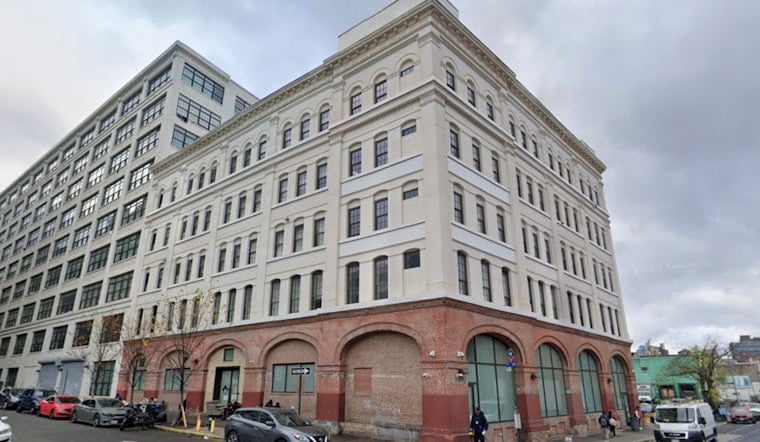
The sprawling Hall Street complex in Clinton Hill, once one of New York City's largest emergency shelters for asylum seekers, is now on track to become a mix of apartments, office space, and a synagogue with separate men's and women's shuls. Developer YS Developers has filed new plans for the 2.6-acre site that call for as many as 425 units across three ground-up buildings, along with the demolition of six existing structures on the property.
The filings, first reported by Bisnow, mark the latest chapter for a property that has cycled through several identities in less than a decade. Bisnow reporter Sasha Jones detailed plans for 1 Hall Street, an 84-unit, 208,000-square-foot mixed-use building that would include commercial space, a lobby, a package room, bike storage, and an underground parking garage with 48 spaces. A separate building at 33 Hall Street is planned to include a 159,000-square-foot, 13-story office building along with the synagogue and terraces on the seventh and 13th floors.
From Linotype Factory to Migrant Shelter to Housing
The Hall Street complex has deep industrial roots. The 10-building campus was constructed between 1895 and 1927 as the manufacturing home of the Mergenthaler Linotype Company, with several buildings designed by noted industrial architect Albert Kahn, according to 6sqft. RXR Realty later purchased the site for $160 million in 2016, per Bisnow, and poured roughly $100 million more into converting the old factory buildings into a modern office campus branded The Hall.
That office bet did not pay off. As the commercial market cratered after the pandemic, the 650,000-square-foot conversion sat roughly 95 percent vacant, prompting RXR to refinance the property with a $118.16 million loan from Starwood Property Trust in March 2024, according to the Commercial Observer. With office demand still weak, RXR pivoted, leasing the complex to NYC Health + Hospitals, which operated it as a Humanitarian Emergency Response and Relief Center starting in July 2023. At its peak, the shelter housed up to 3,000 asylum seekers at a time, making it one of the largest such facilities in the city, second only to Midtown's Row Hotel, per Patch.
Shelter Operations Drew Health Concerns and Community Pushback
The shelter's scale brought its own complications. In July 2024, city health officials identified two confirmed measles cases at the site, triggering emergency testing by NYC Health + Hospitals and a mandatory 21-day quarantine for residents without immunity, as reported by CBS News. The high-density congregate setting created operational challenges for healthcare providers throughout the shelter's operation.
Community friction followed the shelter almost from the start. The opening of the 3,000-person Hall Street facility, alongside a second 700-person emergency shelter that quietly opened at 29 Ryerson Street in April 2024, prompted public town halls led by Council Member Crystal Hudson over strains on neighborhood services and safety concerns, according to BKReader. Neighbors raised quality-of-life issues around local park access and sanitation during that period. The shelter closed in March, leaving the site vacant, per Bisnow's reporting.
New Owner Reworks RXR's Approved Redevelopment
Before selling, RXR had already secured New York City Council zoning approval for a nine-building, 933,000-square-foot mixed-use redevelopment that would have delivered 620 rental units, including between 150 and 183 designated affordable units under Mandatory Inclusionary Housing, according to New York YIMBY. That approved plan called for demolishing two industrial structures to make way for a 21-story residential tower while converting eight other buildings to residential use, and it secured zoning approval for 650,000 square feet of new housing.
YS Developers, led by Yitzchok Schwartz, purchased the 550,000-square-foot site from RXR for $121.4 million in April, a discount of roughly $40 million against what RXR had spent to acquire it. The new owner's latest filings depart from RXR's blueprint, with the current application showing as many as 425 proposed units and site plans that add the office building and synagogue at 33 Hall Street rather than sticking strictly to the earlier residential-only tower concept. Earlier permits tied to the broader assemblage had placed the total closer to 974 proposed units across the developer's various Brooklyn filings, according to Bisnow's review of the records.
Demolition Plans Include a Historic Warehouse
Some of the six buildings slated for demolition carry their own history. Environmental review documents authorized tearing down a five-story 1890s Romanesque Revival brick structure at 248-252 Flushing Avenue, originally designed by architect Theobald Engelhardt for the B.A. Jurgens grocery warehouse. While seven of the industrial Linotype-era buildings are being preserved for conversion, the older standalone masonry building along Flushing Avenue is approved for razing.
Schwartz's Broader Brooklyn Development Push
The Hall Street project is one piece of a rapidly expanding Brooklyn portfolio for Schwartz and YS Developers. The firm has filed plans to convert 14 Ryerson Street into 89 units and to build a 15-story, 84-unit building at 4 Ryerson Street. Additional filings cover a five-story, 10-unit building at 599 Willoughby Avenue, a 20-unit building at 25 Marcus Garvey Boulevard, and conversion of the first floor of 313 Park Avenue into six units.
Schwartz has also been active in Crown Heights, where he purchased 960 Franklin Avenue for $64 million in May 2024 to build a seven-story, 300-unit market-rate condominium, according to The Real Deal. He later acquired the neighboring parcel at 970 Franklin Avenue from Continuum Company for $54.3 million in September 2025, following a prolonged municipal dispute over building shadows affecting the adjacent Brooklyn Botanic Garden. Community groups had opposed earlier proposals at that site over concerns the towers would cast harmful shadows on the garden's greenhouse plant collections, and YS Developers now has a 300-unit condominium development planned there as well.
Most recently, in August, YS Developers partnered with Rabsky Group, a major Brooklyn developer known for large-scale residential projects, to purchase 1150 Broadway, a residential development site in Bedford-Stuyvesant, for $23.5 million. The acquisition underscores how aggressively Schwartz has been assembling Brooklyn parcels, several of which arrived with histories of land-use disputes or stalled development before he stepped in.
What remains unclear is whether YS Developers will preserve the affordable housing commitments RXR negotiated under Mandatory Inclusionary Housing as part of the earlier city approval, and how Clinton Hill residents will respond to the site's transition from a controversial emergency shelter back to permanent private housing. Those questions are likely to surface as the new filings move through the city's land-use review process.





