

























































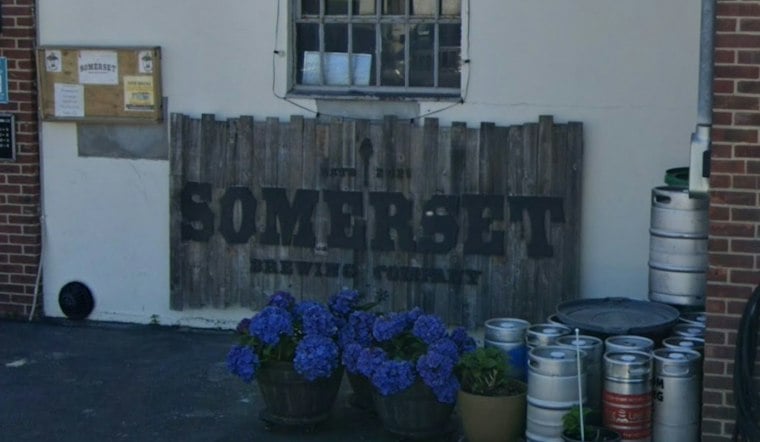
Somerset Brewing is leaving its cramped industrial space on Cherry Valley Avenue for a 5,000-square-foot building across the parking lot, bringing a full restaurant, a 10-barrel brewhouse and a 35-seat bar to a hamlet that has watched the brewery grow from a backyard hobby into a neighborhood fixture. The new taproom and restaurant are set to open this month, four years after Somerset first opened its doors in a small industrial space near Cherry Valley Avenue.
The expansion, first detailed by Long Island Press, has Somerset signing a lease on the 5,000-square-foot building fronting Cherry Valley Avenue in early 2025, more than twice the size of its current brewery and taproom. The new address, 116 Cherry Valley Ave., sits just across the parking lot from the original 94C Cherry Valley Avenue location where founder Manny Fajardo got his start. The building itself has stood since 1940, part of a stretch of Cherry Valley Avenue commercial stock that largely dates to the mid-20th century, according to PropertyShark.
Fajardo told the outlet that renovating the aging structure meant tearing out three layers of flooring and installing new electric and plumbing systems from scratch. It is the kind of hands-on project that draws on his pre-medicine background — he worked in construction in Miami for five years after college before eventually becoming an attending physician in Manhattan.
From a Garage in Garden City to a 10-Barrel Brewhouse
Fajardo, who grew up in nearby Garden City, homebrewed for about a decade before founding Somerset, starting with a one-barrel system he installed in his brother Michael's garage. He and his wife and co-owners his brother and brother-in-law Brendan Trillhaase eventually scaled that hobby into a commercial operation, and the new building represents the biggest jump yet: a 10-barrel brewhouse replacing the four-barrel system currently in use, plus 16 brite serving tanks that Fajardo said can hold 40 times the beer currently served on tap.
That upgrade is meant to solve a practical problem as much as a growth one. Per the Long Island Press report, Somerset plans to pipe beer directly into brite tanks after brewing, cutting down kegging time and keeping what's on tap fresher. The brewery will also be able to can more beer for patrons to take home, a revenue stream increasingly important across the industry — craft brewing contributed $71.8 billion to the U.S. economy in 2025, with taproom sales, hospitality and merchandise driving much of that growth, according to the Brewers Association.
A Full Restaurant Joins the Taproom
The new space will also mark Somerset's first foray into full restaurant service, headed by Howard “Howie” Fuchs of Smokin' Sandy Pineapple. Fuchs got his start catering and running a food truck at Ted's Fishing Station in Point Lookout back in 2017, before launching his own smashburger and barbecue truck in 2020. At Somerset's new kitchen, he plans to serve burgers, barbecue, bratwursts and Bavarian-style pretzels with beer cheese, along with a weekend brunch menu.
“I am excited to join Manny at the new restaurant and serve food that complements the beers,” Fuchs said, according to the same report. The new 35-seat bar will pour from Somerset's existing lineup, which includes Harmon, a hazy summer kolsch; Memphis, a German-style festbier; Millie, a single dry-hopped IPA brewed with Amarillo, Galaxy and Mosaic hops; and Perceus, a double dry-hopped IPA.
Farm Brewery Rules Shape What's on Tap
Somerset operates under a farm brewery license, which under New York's Alcoholic Beverage Control Law § 51-a requires license holders to source at least 60% of their hops and other agricultural ingredients by weight from New York growers — a threshold set to climb to 90% by January 1, 2029, per New York State law. That license is also what has allowed the brewery to serve New York State-made spirits, wines and ciders by the glass without a full retail liquor license, a privilege granted to farm brewery holders producing up to 75,000 barrels annually, according to the New York State Liquor Authority. The new restaurant, however, will carry its own full liquor license, expanding what Somerset can pour beyond state-labeled products.
The new building will add a 3,000-square-foot outdoor patio available for private parties and special events, plus a sound system for live music and an indoor game room. Somerset has also made a point of supporting local community organizations, part of the family-oriented identity Fajardo says he wanted for the brewery from the start.
“I wanted the area where I grew up to have a family-friendly place to relax and have a beer,” Fajardo said, per the Long Island Press account.
Part of a Broader Long Island Beer Boom
Somerset's growth fits into a wider pattern in New York's craft beer industry. The state is home to more than 500 active craft breweries, ranking second nationwide and generating roughly $4.8 billion in annual economic impact, according to the New York State Brewers Association. That resilience stands out nationally: while craft beer volume sales nationwide were flat or slightly negative in 2023 and 2024, New York held steady on brewery counts thanks to strong local taproom demand and favorable state beverage policies, per the Cornell Chronicle.
Nassau County's craft beer scene remains comparatively small, with about 10 breweries countywide — a group that traces back to Oceanside's Barrier Brewing Company, established in 2009 as the county's first craft brewery, according to Nassau County Tourism. West Hempstead itself has deep roots as a light industrial and transit hub, having been officially named in 1891 by Long Island Rail Road president Austin Corbin and built up around the West Hempstead LIRR branch line.





