

























































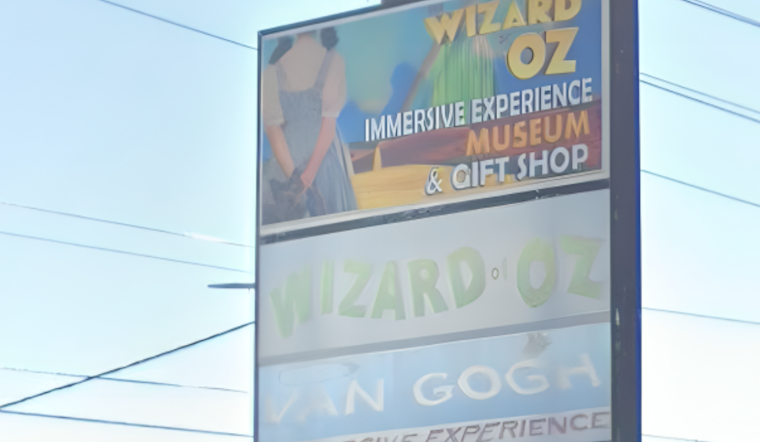
The Wizard of Oz Museum has left its original Cape Canaveral storefront behind for a much bigger home in Cocoa Beach, where founder Fred Trust has packed more than 2,000 artifacts into a converted trio of former medical office buildings just off the causeway. Visitors can now see a Dorothy dress worn by Judy Garland, ruby red slippers once displayed in the queue for Disney's Great Movie Ride, and a Winkie guard spear pulled straight from Oz lore. The move caps years of collecting by Trust and his wife, Palina, whose obsession with L. Frank Baum's fantasy world has grown from a personal hobby into a full-fledged Space Coast attraction.
According to the Orlando Sentinel, Trust bought three former medical office buildings in Cocoa Beach for $900,000 in November 2025 and has since invested nearly $1 million converting them into museum space at 333 W. Cocoa Beach Causeway. The museum, open daily from 9 a.m. to 5 p.m., now sits near the Ron Jon Surf Shop and the Museum of Dinosaurs and Ancient Cultures, drawing roughly 25,000 visitors a year at $29.99 for adults and $14.99 for children ages 3 to 12. It's already landed among TripAdvisor's top things to do in Cocoa Beach, per the Sentinel's reporting.
Fifty Cabinets of Oz History
Inside, 50 cabinets hold original movie scripts, miniature figurines, plates and board games spanning nearly a century of Oz merchandising, the Sentinel reports. There are gloves worn on-screen by Bert Lahr, who played the Cowardly Lion, an Emerald City townsman jacket, and items signed by Michael Jackson promoting his 1978 film “The Wiz.” A separate room pays tribute to the 1960s sitcom “I Dream of Jeannie” with a life-sized Jeannie bottle, and Muppets dressed as Oz characters round out a collection that ranges from high camp to serious literary history.
That literary side is where Trust's expertise runs deepest. He launched the reference site RareOzBooks.com in 2007 and published a price guide for Oz book collectors that has sold more than 10,000 copies, cataloging subtle typography errors and color variations across early editions, according to Florida Trend. The museum's prize piece is a pre-publication first known copy of “The Wonderful Wizard of Oz,” signed by Baum himself, which Trust bought at auction around 2010; the only comparable copy, per Space Coast Living Magazine, was one Baum gave to his own mother and now resides in the New York Public Library. Baum wrote the first 14 Wizard of Oz novels of what grew into a 40-book series that began in 1900.
A Childhood in Azerbaijan Sparked a Lifelong Obsession
Trust's connection to Oz goes back to his childhood in the former Soviet republic of Azerbaijan, where an elementary school teacher read Russian translations of Baum's book aloud to his class, Space Coast Living reports. After immigrating to the United States, Trust began reading the original English editions to his own children, a habit that eventually turned into serious book collecting. Trust has said he decided to open a museum after acquiring a series of unique Wizard of Oz pieces that outgrew a personal collection.
The idea for an immersive, tech-driven museum took shape after Trust visited the municipal Oz Museum in Wamego, Kansas — a town of about 4,000 people that pulls in 40,000 visitors a year — and later attended a Van Gogh immersive projection exhibit in Miami, according to Toy Tales. Drawing on his own graduate degree in computer science, Trust built custom projection software that puts visitors inside Oz scenes rather than simply displaying static exhibits. The result is an immersive Wizard of Oz and Van Gogh exhibition that projects images from the James Webb Space Telescope onto 18-foot-high walls and the floor, alongside a yellow brick road and exterior murals that Trust says he wants to eventually match the building's interior theming, per his comments to the Sentinel.
Why the Projections Skip the Movie Songs
Those projection shows are built from Baum's original 1900 book illustrations rather than footage or music from the 1939 MGM film, and that's not an aesthetic choice — it's a legal one. Metro-Goldwyn-Mayer holds tight copyright protections over cinematic elements created specifically for the film, meaning the museum is legally barred from screening original movie clips or playing songs like “Over the Rainbow,” according to the museum's own FAQ page. That restriction pushed Trust to lean harder into the book-based artwork that now defines the immersive experience.
A Real Estate Detour Through Kissimmee
The path to Cocoa Beach wasn't direct. The museum's original Cape Canaveral space, which opened in February 2022 on Atlantic Avenue, was lost when the landlord slated the property for demolition to build residential condominiums, Space Coast Living reported at the time. Trust then purchased a 4-acre property along U.S. Highway 192 across from Medieval Times for $1 million in 2024, planning to build a new museum in Kissimmee's theme-park corridor.
That plan fell apart after two years of trying to secure local approvals and permission to erect signage, according to the Osceola News-Gazette. Trust told the paper he paid taxes on the land the whole time without ever being allowed to break ground. He is now working on selling the Kissimmee property and instead put his money into the Cocoa Beach buildings.
Riding the Space Coast's Tourism Wave
Staying in Brevard County puts the museum within reach of a tourism engine that's setting records of its own. Port Canaveral, just minutes north, became the world's busiest cruise port in fiscal year 2025, handling more than 8.6 million passenger movements across 18 homeported ships — a 13 percent year-over-year jump that pushed it past PortMiami for the global title, according to Seatrade Cruise News. Space Coast tourism overall generates roughly $1.5 billion in annual economic impact for Brevard County and supports about 46,000 local jobs, per Space Coast Living Magazine.
That backdrop isn't uniformly rosy, though. Local tourist officials reported a softening hotel market late in 2025, with Cocoa Beach forward bookings running behind 2024 levels amid national economic uncertainty and federal shutdown concerns, according to Talk of Titusville. For a drive-to attraction built on cruise-day tourists and rocket-launch crowds rather than overnight hotel stays, that makes the museum's expansion a bet that foot traffic — not hotel occupancy — will keep the yellow brick road busy.





