

























































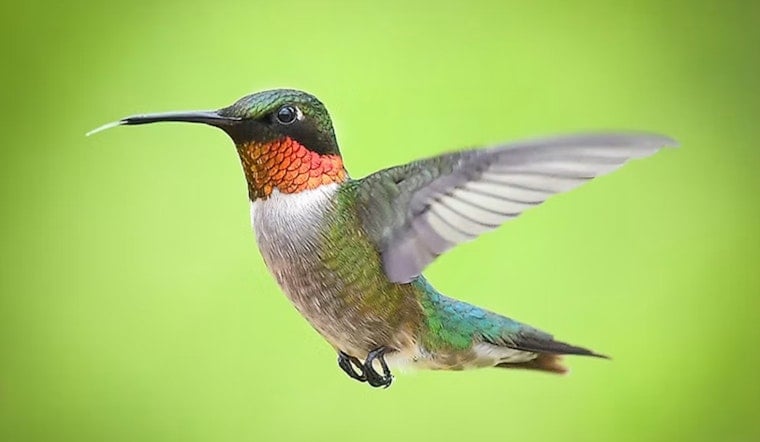
Across Colorado's mountain meadows and river valleys this month, hummingbirds are doing what they do every August: feeding almost constantly, dive-bombing rivals, and packing on fat before a flight that can carry some species more than 500 miles without stopping. It is peak hummingbird season in the state, and this year the spectacle comes with a new legal wrinkle for anyone who hangs a feeder in bear country.
Photojournalist Dean Krakel has spent time this season watching broad-tailed and ruby-throated hummingbirds feed on sugar water near Taylor Reservoir and hovering around feeding stations in the Sawatch Mountains near Tin Cup, according to The Colorado Sun. Krakel has also documented the birds in the Gunnison Valley, where the tiny fliers are already showing signs of preparing for their long migration south, per the same account. Hummingbirds weigh about as much as a nickel, yet the Sun reports they must consume roughly twice their body weight in nectar every day to survive, sipping around 20 times per second from flowering plants with their long beaks and specialized tongue tips.
A Legal Shift for Backyard Feeders
That same appetite is at the center of a new tension for mountain-town residents who like to feed hummingbirds at home. In May, Colorado Governor Jared Polis signed HB26-1342 into law, expanding state misdemeanor offenses for placing accessible bear attractants, including bird and hummingbird feeders, in bear-occupied areas, according to the Colorado State Legislature. Under the new law, wildlife officers no longer have to prove intent to lure a bear before enforcing the misdemeanor. Colorado Parks and Wildlife recommends residents in bear country switch to native nectar gardens or bird baths instead of sugar-water feeders between March and November.
The stakes for hummingbirds themselves are also rising on the conservation side. Colorado Parks and Wildlife added both the Broad-tailed Hummingbird and the Calliope Hummingbird to its official list of Species of Greatest Conservation Need in 2025, citing ongoing habitat loss and declining native nectar resources, as reported by KUNC. Wildlife biologists cited in that report attribute the population stress to cumulative impacts from land development, pesticide use, and climate-driven shifts in flowering schedules.
Only Two Species Actually Call Colorado Home
Twelve hummingbird species have been documented statewide, but only two, the Broad-tailed Hummingbird and the Black-chinned Hummingbird, regularly nest and breed in Colorado, according to the Colorado Virtual Library. Broad-tailed hummingbirds dominate mountain and Front Range habitats, while Black-chinned hummingbirds mostly occupy Western Slope river valleys, the same source notes. Species such as the Rufous and Calliope only pass through during late-summer migration. Per the Sun, Rufous Hummingbirds travel more than 3,000 miles from southern Mexico to Canada, the Pacific Northwest, and Alaska.
The Colorado Bird Records Committee's official checklist includes all 12 documented species statewide, featuring rare or accidental vagrants such as Rivoli's, Anna's, Costa's, Broad-billed, and Green Violetear hummingbirds, according to BirdWatching. Those vagrant species typically enter Colorado during unexpected weather events or seasonal migration shifts, often lingering near Front Range gardens.
Courtship Dives, Wing Whistles and Tetrachromatic Eyes
Male broad-tailed hummingbirds put on one of the more dramatic courtship displays in Colorado's skies, combining diving flight, loud wing trills, and iridescent neck-feather flashes to attract mates, the Sun reports. That signature metallic wing whistle is produced by aeroelastic flutter as air passes through a narrow slot at the tips of the birds' ninth and tenth primary wing feathers, according to research published in the Journal of Experimental Biology. As air friction wears down those specialized feathers over the summer, the trill gradually fades by midwinter.
Researchers at the Rocky Mountain Biological Laboratory near Gothic have conducted detailed studies of broad-tailed hummingbird courtship using high-speed video, acoustic analysis, and computational models of hummingbird color vision, per the Sun. Field experiments there found that broad-tailed hummingbirds possess tetrachromatic color vision with a specialized ultraviolet cone type, letting them perceive color combinations and floral cues invisible to human eyes, according to the Rocky Mountain Biological Laboratory. Scientists there used UV-sensitive cameras and visual models to approximate how the birds perceive bright throat patches and wildflower fields.
A Climate Mismatch Higher in the Mountains
Long-term ecological research at the same laboratory found that spring snowmelt has advanced by 2.4 days per decade since 1975, causing early nectar plants like glacier lilies to bloom up to 17 days earlier, according to Big Pivots. Because migratory broad-tailed hummingbirds time their travel based on cues from southern wintering grounds, warming mountain springs threaten to decouple the birds from the early floral food sources they depend on when they arrive.
The birds' physical demands during migration are extreme by any measure. A hummingbird's heart rate can reach up to 1,260 beats per minute during peak migration, with wingbeat frequencies of 15 to 80 beats per second, requiring the birds to gain 25% to 40% of their body weight in fat before undertaking long flights, according to the Denver Gazette. Those fat reserves allow the birds to sustain non-stop journeys of up to 500 miles across mountain ranges and open terrain, the same outlet reports.
Same Yard, Same Day, Year After Year
Banded hummingbirds often return to the same yards, meadows, and feeders on the same day every year, and some even nest in the same tree, according to the Sun. Long-term bird banding research conducted in Estes Park backs up that fidelity: female Broad-tailed Hummingbirds live significantly longer than males, with the oldest banded female reaching 11 years of age compared to a maximum recorded lifespan of five years for males, per the Colorado Avian Research and Rehabilitation Institute. That research also documented an Estes Park-banded Broad-tailed Hummingbird recaptured in Mexico, confirming a direct international migratory pathway between the two regions.
Hummingbirds are important pollinators, but their lives are fragile: they are harmed by cold weather and accidents, and face predators including cats, snakes, fish, other birds, and insects, the Sun notes. Despite the odds, hummingbirds can live up to four years, migrating between the high mountain meadows of the Rocky Mountains and the highlands of southern and central Mexico, and eating insects in addition to nectar along the way.
All hummingbird species native to North America, including every bird described in Krakel's photographs, are protected under the federal Migratory Bird Treaty Act, according to the U.S. Fish and Wildlife Service. That federal law makes it illegal to capture, trap, possess, or disturb hummingbirds, their nests, or their eggs without federal authorization, with specialized master permits required for any trapping or handling and civil or criminal fines for unauthorized possession. Groups of hummingbirds, fittingly, have their own collective names: a charm, a glitter, or a bouquet, the Sun reports, a fitting description for a season when Colorado's skies are, for a few more weeks, full of them.





