

























































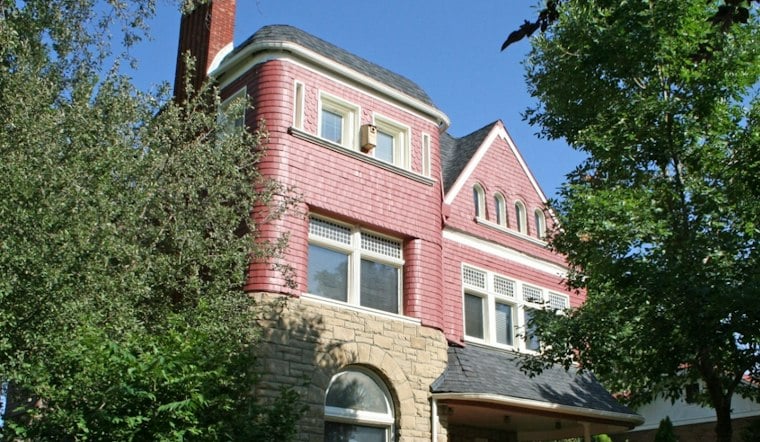
A 136-year-old stone-and-shingle house in Denver's Sloan's Lake neighborhood is on the market in two pieces, with the three-bedroom side at 1444 Stuart Street listed for $825,000 and the four-bedroom side at 1442 Stuart Street listed for a little over $1 million. Known as the Spangler House, the building was split into two separate residences following a renovation that preserved much of its original character.
According to Westword, the 1444 Stuart side has three bedrooms and three bathrooms, while the 1442 side has four bedrooms and four bathrooms. The outlet reports that the restoration kept original details intact, including stained glass windows and emblems etched into archways, before the structure was divided into its current two-home configuration.
The house carries the name of its original owner, Jane Spangler, who lived there as a widow, Westword reports. She moved to Stuart Street to be near her sister, who was married to Ralph Voorhees — a figure in his own right in Denver history, credited with introducing the bill that established Flag Day in Colorado, helping found Colorado Woman's College, and financing the trestle that brought cable cars to Denver's west side, per the same account.
The Architect Behind the Design
The Spangler House was designed by William Lang, the architect also behind the Molly Brown House — now a museum in Denver's Capitol Hill neighborhood — and St. Mark's Parish, a building later used as the Church nightclub, according to the article. Lang, born in 1846 in Ohio and a Civil War veteran, moved to Denver around 1885 to become an architect and designed more than 250 buildings in the city between 1885 and 1893, the report states. His work is known for rusticated stone and large arches, a style visible in both halves of the Stuart Street property.
Lang also designed Castle Marne, now a historic hotel near City Park, and partnered with Marshall Pugh in 1891 on homes for developer Ralph Voorhees in the West Colfax subdivision, a six-block area, per the article. Of six homes built on Stuart Street from that era, five survived. Daxon McInnis, a real estate agent with Obsidian Real Estate Advisors, called the surviving homes one of the best study groups of Lang's work in the city, the outlet reports.
A History Tied to Law Enforcement and Landmark Status
Jane Spangler's connection to the house also ties back to her husband, Michael Spangler, who served as Arapahoe County sheriff from 1880 to 1884 and, notably, appointed deputy Henry O. Wagoner as Colorado's first Black lawman, according to the article. The Spangler House was designated a historic landmark twice, in 1976 and 1980, Westword reports.
The house’s recognition extends beyond Denver’s local landmark program: a West Colfax historic-resources survey lists 1444 Stuart Street on the National Register of Historic Places and the Colorado State Register of Historic Properties, as well as as a Denver landmark. Those designations place the home among properties recognized at city, state and national levels for their historical significance. The West Colfax survey’s preservation inventory records all three statuses for the Spangler House.
McInnis said the homes are designated historic and have a good history, the outlet notes. The renovation that preceded the current listings kept the building's original character intact, McInnis said, even as it was split into two separately sold residences.
Landmark status also shapes what future owners can change. In Denver, exterior work on an individual landmark that requires a building, zoning, curb-cut or encroachment permit must go through Landmark Preservation review; the city says a Certificate of Appropriateness is required before certain permits are issued. The process does not bar improvements, but it puts proposed exterior changes through design review intended to account for the property’s historic character. Denver’s landmark-review rules outline when that review applies.





