

























































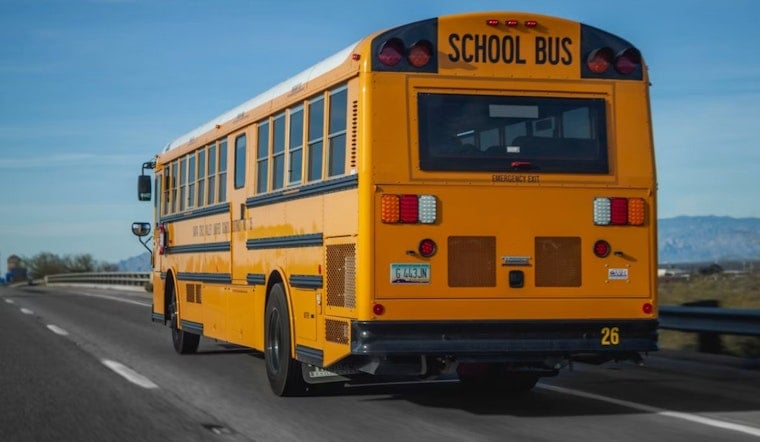
Hundreds of Columbus City Schools bus drivers and aides walked through active-threat scenarios at Whetstone High School Tuesday, rehearsing responses to situations like an armed intruder, a custody dispute gone wrong, or a student carrying a weapon onto a bus. Superintendent Angela Chapman attended the training session, which came just weeks before students return for the 2026-2027 school year and amid a wave of bus route cuts that have upended transportation for thousands of families.
The training, which drew about 600 participants, was led with help from the Ohio Department of Public Safety and the Ohio School Safety Center, according to WSYX. Emily Torok described the range of incidents drivers rehearsed, including an active assailant on board, a parent involved in a custody dispute, and a student with a weapon. The safety center's Mobile Training Officers, created under Ohio House Bill 99, deliver this kind of active threat response and threat assessment curriculum to bus drivers statewide, according to the Ohio School Safety Center.
Curtis Broady, who has driven for the district for seven years, said the session gave drivers and aides useful tools heading into the school year. Chapman echoed that sentiment, saying the training matters both for preparing drivers to handle active threats and for their ongoing professional development, per the station's report. The sessions covered a range of situations drivers and staff could realistically face during the school year, from emergencies on board to security threats at pickup and drop-off.
Route Cuts Reshape Who Gets a Yellow Bus
The safety drills landed against a backdrop of sweeping transportation cuts. Columbus City Schools eliminated more than 70 bus routes as part of its budget reductions, and the district has contacted families of roughly 4,000 students affected by those changes, the same account notes. Students affected by the reductions can either choose a school closer to home that still has yellow-bus service, or attend a school outside their neighborhood if they arrange their own transportation.
The route eliminations trace back to a December 2025 vote by the Columbus City Schools Board of Education to end yellow bus service for K-8 students attending non-home or non-100%-lottery schools, a move that saved $8.7 million as part of a broader $50.4 million budget reduction package, according to 10TV. A month earlier, in October 2025, the board had already shifted its transportation policy for high schoolers from mandatory to discretionary language, partnering with the Central Ohio Transit Authority to issue Student Success Cards giving high school students free, unlimited public transit rides in place of yellow buses.
A District Under Deepening Financial Strain
The bus cuts are one piece of a much larger fiscal reckoning. In May, the school board voted to eliminate 299 positions, resulting in 112 direct layoffs, most of them full-time building substitute teachers, to complete the district's $50 million in cuts, according to WOSU Public Media. Personnel costs make up roughly 81% of the district's operating spending, which helps explain why staffing reductions accompanied the transportation cuts.
Transportation itself consumes about 6% of the district's $1.8 billion operating budget, with costs pushed upward in recent years by driver shortages and higher payments to third-party transit contractors, WOSU has reported. Fewer routes have at least helped ease that continuing driver shortage, even as the district said it is still actively recruiting bus drivers. Then, this month, district leaders disclosed a fresh complication: an unexpected $40 million overspend in health insurance costs, adding pressure to a deficit that superintendent leadership has estimated at more than $100 million, according to WSYX ABC 6.
Legal Fight Over Busing Obligations Ends in Dismissal
The transportation cuts also became the subject of a high-profile legal battle. Ohio Attorney General Dave Yost sued Columbus City Schools in 2024, arguing the district failed to provide legally required transportation to nearly 1,380 private and charter school students after declaring their busing impractical, a dispute Hoodline first reported. In May 2026, the Ohio Supreme Court dismissed Yost's writ of mandamus, ruling the attorney general lacked legal standing under the parens patriae doctrine to bring the challenge.
Ohio law generally requires districts to bus K-8 students who live more than two miles from their assigned school, along with resident private and charter school students if the direct travel time by bus stays under 30 minutes, under Ohio Revised Code Section 3327.01. A separate provision, Section 3327.02, lets school boards declare transportation impractical based on six statutory factors — including time, distance, cost, and personnel availability — and offer payment in lieu of busing, subject to state administrative review and mediation.
Columbus City Schools remains the state's largest public school transit operation, running a network across 220 square miles with roughly 1,000 drivers, supervisors, and mechanics moving about 44,000 students each school day. Tuesday's training at Whetstone High School was framed by district leaders as part of preparing that workforce for the 2026-2027 school year, even as the district continues to recruit new drivers and absorb the financial pressures reshaping its bus system.





