

























































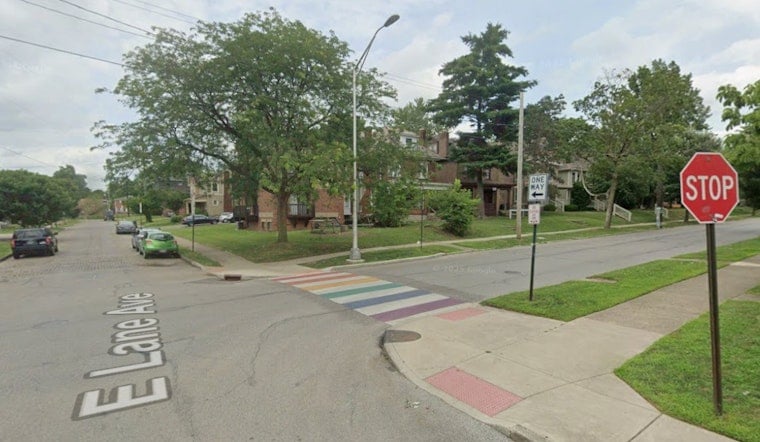
Columbus city crews have scraped the rainbow paint off a crosswalk at Lane and Waldeck avenues in the University District, leaving behind a plain zebra-striped crossing that still bears faint traces of its old colors and the black paint splatters left by vandals months earlier. The federal government had asked Columbus to remove the rainbow markings following a study, and the removal marks the end of a crossing that had weathered both vandalism and a shift in national transportation policy.
The crosswalk was never simply a Pride art installation. It was installed in September 2024 as part of a Federal Highway Administration research study examining how non-traditional pavement markings affect pedestrian and driver behavior, according to Metro Weekly. That detail complicates a story that, at first glance, looks like another culture-war flashpoint over LGBTQ+ street art — the crosswalk's origins were rooted in formal traffic engineering research, not a municipal Pride project.
Columbus wasn't testing just one design. The city installed five sites for the federal study, including rainbow stripes at both Lane/Waldeck and West Third/Hunter avenues, a brick pattern at Indianola Avenue and East Tompkins Street, and linear white markings at Dennison and Wilber avenues, per the same outlet's reporting. Those test locations were chosen alongside partner cities including Raleigh, Austin, and Washington, D.C., as federal researchers tried to determine whether unconventional crosswalk designs changed how drivers and pedestrians behaved at intersections.
Vandalism Preceded the Federal Removal Request
According to The Columbus Dispatch, the crosswalk cleanup that led to its final removal came months after the rainbow painting had already been scraped at and damaged. In August 2025, an unknown vandal poured a black tar-like substance across the crosswalk's colored panels, and city officials looked into whether graffiti removal tools could restore the surface, the outlet notes. Columbus dispatched a crew to clean up the vandalized crossing after being alerted through 311 calls and public Reddit posts, per the same account.
That vandalism wasn't an isolated incident in Ohio. Rainbow crosswalks and Pride sidewalk installations in other Ohio communities — including Cincinnati, Cleveland Heights, and Whitehall — faced vandalism or threats to installation crews during 2024, the report states. In Whitehall, workers reportedly received threats in June 2024 while installing rainbow sidewalks for Pride Month.
A National Push Against Street Art on Roadways
The Lane and Waldeck removal did not happen in a vacuum. In July 2025, U.S. Transportation Secretary Sean Duffy launched the Safe Arterials for Everyone through Reliable Operations and Distraction-Reducing Strategies initiative, sending letters to all 50 governors urging the removal of artwork, political messages, and rainbow crosswalks from public streets. The directive warned that roadway funding should be limited strictly to standard safety features, the outlet reports.
Federal officials leaned on safety statistics to justify the crackdown. USDOT data cited in federal directives found that more than half of the estimated 39,345 U.S. traffic fatalities in 2024 occurred on non-freeway arterial roads and intersections — a figure federal officials pointed to as justification for eliminating intersection distractions, even as total traffic fatalities declined 3.8 percent that year compared to the year before.
Those numbers sit alongside Federal Highway Administration guidelines under the Manual on Uniform Traffic Control Devices, which limit colored pavement for traffic control to specific standard designations — green for bicycle lanes, red for transit, purple for toll lanes — and stipulate that non-standard fills must not interfere with transverse white crosswalk contrast. Not everyone agrees the policy rests on solid evidence. Transportation and pedestrian safety advocates pointed out in 2025 that the FHWA has acknowledged a lack of direct empirical research proving that aesthetic or rainbow crosswalks cause crashes, according to Advocate.com, with some advocates arguing colorful crosswalks actually increase driver awareness and pedestrian visibility.
What's Left at Lane and Waldeck
What remains at the University District intersection today is a zebra-striped crosswalk, the standard federal design, with a few traces of rainbow paint and black splatters from the earlier vandalism still visible beneath it, according to the Dispatch. The scraping effort didn't fully erase the crossing's colorful and turbulent history — just covered most of it.
Columbus is far from the only city navigating this fight. Multiple Florida cities, including Orlando, Miami Beach, and Fort Lauderdale, faced state and federal deadlines in August and September 2025 that forced them to sandblast or repaint rainbow crosswalks under threat of losing transportation funding, according to CBS News. In Texas, transportation officials ordered rainbow crosswalks removed in 2025, prompting San Antonio to shift its Pride artwork off the street entirely and unveil new rainbow sidewalks outside active travel lanes.
Whether Columbus or other Ohio communities pursue a similar workaround — moving Pride-colored art onto sidewalks rather than roadways — remains to be seen. For now, the Lane and Waldeck crossing stands as a faded, scraped-over record of a federal safety experiment that became caught up in a much larger national fight over what belongs on America's streets.





