

























































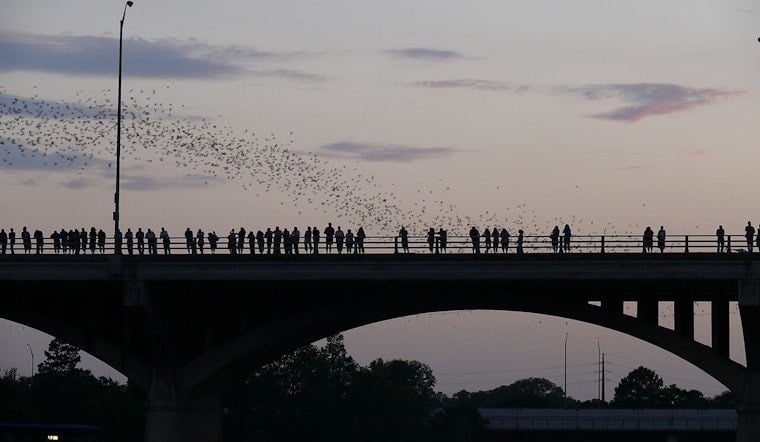
Every summer evening, crowds gather along Austin's Congress Avenue Bridge and wait, sometimes for an hour or more, to watch roughly 1.5 million Mexican free-tailed bats pour out from beneath the roadway at dusk. Starting Wednesday, that wait comes with a lesson attached: three new bilingual interpretive signs and six short films will turn the popular sunset ritual into a full-fledged educational experience.
The new exhibit, called the Bat City experience, was installed by The Trail Conservancy along the bridge's south shore viewing area, according to KXAN Austin. The English-and-Spanish signs include QR codes that link to six short-form films produced by Skip Hobbie Productions in collaboration with The Trail Conservancy, Merlin Tuttle's Bat Conservation, Austin Bat Refuge, Bat Conservation International and the Texas Parks and Wildlife Foundation, per Seed&Spark. One of the videos walks visitors through where to look, when the bats emerge and the best spots to watch them, while others dig into the history of bat conservation and the work of longtime bat researcher Merlin Tuttle.
A Colony Four Decades in the Making
The videos go live Wednesday, a date organizers chose deliberately: it's Tuttle's 85th birthday and the anniversary of Merlin Tuttle Day, first proclaimed by former Austin Mayor Steve Adler in August 2021 to honor Tuttle's 80th birthday and his role in making Austin a model for living alongside urban wildlife, according to Merlin Tuttle's Bat Conservation. Tuttle worked directly with filmmaker Skip Hobbie on the new project, per the KXAN report.
Austin's bat colony has called the center of the city home for close to 40 years, per the same account, but it wasn't always welcome. The bridge's crevices were created by accident during a 1980 rehabilitation project, when Texas Department of Transportation engineers installed concrete box beams with expansion slots and deep crevices that unintentionally replicated natural cave roosts, according to 99% Invisible. When hundreds of thousands of bats first moved in, local news coverage fueled public hysteria with headlines like Bat Colony Sinks Teeth Into City, triggering petition drives demanding the roost be exterminated.
From Panic to Pride
The turning point came when Tuttle resigned his full-time museum curatorship in Milwaukee and relocated Bat Conservation International to Austin in 1986 specifically to educate city leaders and residents against wiping out the colony, according to Merlin Tuttle's Bat Conservation. Hobbie told KXAN that bats generally have a public-relations problem because people fear what is mysterious and unseen, and he added that Austin has the largest urban colony of bats in the world. Tuttle echoed that sentiment, telling KXAN that fear of the unknown remains one of the greatest threats to bats worldwide.
Hobbie and Tuttle said they hope the new exhibit reaches both longtime Austinites and first-time visitors, per KXAN, framing the colony as an invaluable and safe neighbor that has not attacked anyone or given disease to anyone. The bridge sits at the heart of one of Austin's most popular tourist attractions, and the colony has helped change public perceptions about bats over the decades, KXAN reports.
An Economic and Ecological Powerhouse
The stakes extend well beyond sunset photo ops. The bridge's bat-viewing site draws an estimated 100,000 to 140,000 visitors annually, generating up to $10 million in direct ecotourism revenue for local businesses and tour boat operators, according to the Guide to Austin Architecture. The colony is a seasonal maternity roost made up mostly of female Mexican free-tailed bats, which give birth to single pups each June and raise an estimated 750,000 young before migrating south to Mexico in late autumn.
Statewide, insect-eating bats save Texas agricultural producers an estimated $1.4 billion annually in reduced crop damage and pesticide costs by consuming thousands of pounds of night-flying pests like corn earworm moths each night, according to Seed&Spark. The Texas Legislature recognized that value in 1995 when it designated the Mexican free-tailed bat as the state's official flying mammal, per Wikipedia. Central Texas hosts an estimated 100 million Mexican free-tailed bats each summer across 32 bat species native to the state, including the world's largest overall bat colony of more than 15 million bats at Bracken Cave Preserve in nearby Comal County, as Hoodline has previously reported.
The new Congress Avenue exhibit arrives as other Central Texas bat roosts face uncertainty elsewhere. Hoodline recently reported that I-35 widening between Round Rock and Georgetown could displace a bat colony, underscoring how highway infrastructure continues to shape where these bats can safely roost. For now, Austin's most famous colony has a permanent home under the bridge, and starting Wednesday, the crowds who gather to watch it emerge will have a clearer picture of exactly what they're seeing.





