

























































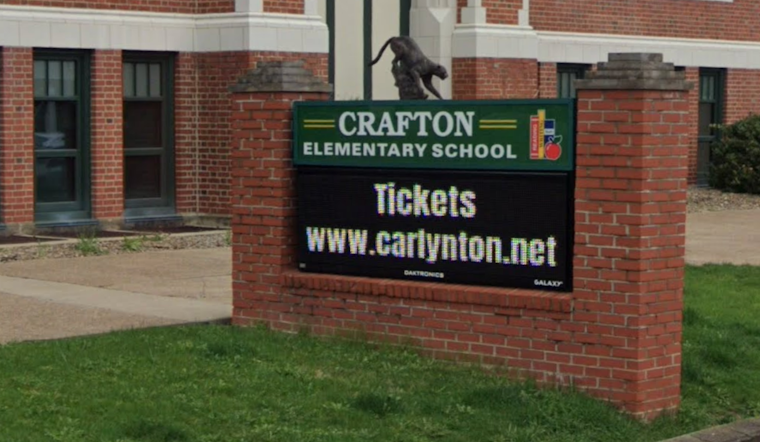
Most students at Crafton Elementary School headed back to class this week, but four classrooms stayed sealed off as crews continued mold remediation work, and at least one father decided the building still wasn't safe enough for his daughter. Cody Sheets kept his daughter Olivia, who was set to start second grade, home from Carlynton School District's Crafton Elementary on Monday rather than send her into a building where remediation was still underway.
Elevated concentrations of Penicillium and Aspergillus group mold spores were confirmed in Rooms 101 through 104 at Crafton Elementary, according to air testing conducted by environmental consultant Intertek-PSI on August 20, as reported by TribLIVE. Other parts of the building, including the cafeteria and second-floor library, tested within normal ranges. Relative humidity in the affected classrooms had measured around 60% earlier in the week before dropping to between 41% and 46% by August 20 following HVAC adjustments and the deployment of dehumidifiers.
Carlynton officials first reported elevated mold spore concentrations in Rooms 101 through 104 on August 17, according to a district statement, and identified a humidity-related concern at the school before beginning corrective action. As reported by WPXI, the district conducted several rounds of mold testing in multiple areas of the building, with the most recent round beginning Monday. District officials told the outlet they had not yet received those latest results as of Monday afternoon.
Cleanup Crews Isolate Four Classrooms
Remediation contractor Firewater Restoration, LLC performed ultra-low volume antimicrobial cleaning at Crafton Elementary on August 21, along with HEPA-filtered vacuuming, air washing, and removal of contaminated porous materials from Rooms 101 through 104, according to a post from the Carlynton School District Facebook page. Intertek-PSI certified the rest of the elementary school as safe for student occupancy that same day while the four classrooms remained isolated from the rest of the building.
Crafton Elementary serves roughly 290 students across kindergarten through sixth grade, drawing families from the boroughs of Crafton, Carnegie, and Rosslyn Farms about six miles southwest of Pittsburgh, per the district. It is one of two elementary schools in Carlynton School District, which broke ground in June on an $18 million renovation project at its other primary building, Carnegie Elementary School, aimed at upgrading classroom spaces, accessibility, and safety infrastructure, per the same TribLIVE report.
A Father Pushes for a Delay
Sheets asked the district to publish its mold testing data findings directly, but the district has said it believes laboratory findings are most useful when communicated through qualified environmental professionals' interpretations rather than raw data, per WPXI's report. Sheets said he was not satisfied with the information provided and pushed for Carlynton to delay Crafton students' first day until the situation was fully resolved. The district determined, through its environmental consultant, that the rest of the building was safe for students to occupy.
Pennsylvania has no statutory threshold or department regulation setting mandatory indoor mold spore limits for public school classrooms, leaving air quality management up to voluntary EPA guidelines and local school board discretion under Act 14 of 2002, as Hoodline reported in an earlier story on a neighboring district's mold testing. That regulatory gap is a central source of friction in cases like Crafton's, where parents want raw data and districts prefer interpreted summaries from certified consultants.
Other Western Pennsylvania Districts Hit Harder
Crafton's isolated-classroom approach stands in contrast to how some neighboring districts have handled similar discoveries this month. Monessen City School District in Westmoreland County pushed back the start of its 2026–2027 school year from August 25 to September 8 after finding widespread fungal growth behind water-damaged restroom and concession stand walls, with remediation costs estimated to approach $1 million, according to the Pittsburgh Post-Gazette. That district was still awaiting official environmental test results for the impacted areas at its elementary center and has said it plans to publish a full public summary once those results are evaluated.
Homer-Center School District in Indiana County likewise delayed its academic calendar to September 1 after custodial staff discovered elevated Aspergillus spores in several elementary classrooms, traced to high summer humidity and a chiller equipment failure, as Hoodline reported in its coverage of that district's delay. Unlike Carlynton, which kept Crafton Elementary open while sealing off four rooms, Homer-Center chose to delay instruction for all K-12 grades entirely.
Laurel Highlands School District took an even more cautious route, closing its affected school until restoration was complete. Superintendent Dr. Robert Motte said complete, data-backed results would guide swift decisions on next steps while prioritizing student and staff safety, and the district worked to reopen the building as safely and rapidly as possible. That process required restoration, sanitization, and eradication of unsuitable ceiling tile and pipe insulation. Dr. Jesse Wallace III, also with the district, said the school atmosphere must be safe for all occupants.
A Regional Pattern Tied to Summer Heat
Southwestern Pennsylvania school districts saw a widespread surge in summer mold disruptions ahead of the 2026–2027 school year, as prolonged heatwaves combined with high humidity to build up moisture inside buildings that sat unconditioned or dormant over break, per Hoodline's earlier reporting. Inhaling elevated Penicillium and Aspergillus spores can trigger allergic reactions, asthma flare-ups, persistent coughing, and wheezing in children, and poses more severe risks for immunocompromised people, according to EPA and CDC guidelines cited in that report.
The state has offered some financial help for districts facing these costs. In 2024, the Pennsylvania Department of Education allocated up to $7.9 million through its Public School Environmental Repairs Grant Program to help remediate hazards like mold, lead, and asbestos, and followed that with a proposed $125 million facility improvement fund for 2025–2026, according to WHYY. Whether that funding reaches districts like Carlynton in time to fix the underlying humidity control problems, rather than just clean up after them, remains an open question as classrooms across the region deal with the same late-summer moisture buildup.



