

























































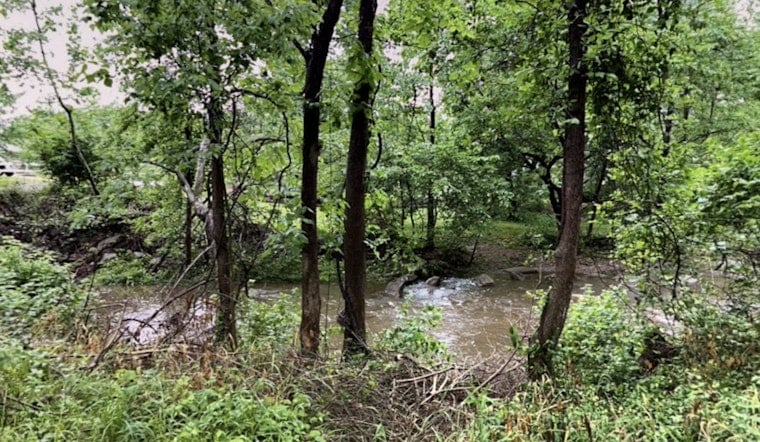
A water main break in Crestwood sent chlorinated drinking water into a tributary of Gravois Creek last year, killing 365 fish, and the utility responsible has now settled with state regulators over the damage. Missouri American Water agreed to pay the state for the incident, which occurred in a waterway on the south side of Lodge Pole Lane, about 1,000 feet upstream of Gravois Creek and northwest of Whitecliff Park.
The break was first documented by the Missouri Department of Natural Resources, which found dead fish floating downstream along the bank of the tributary, according to the Post-Dispatch. Water testing at the scene found that total residual chlorine exceeded the acceptable limit, and the discharge of chlorinated drinking water did not end until July 28, 2025. Missouri American Water completed repairs on the same day the main break occurred, but not before the chemical runoff had already reached the creek.
As part of the settlement, Missouri American Water agreed to abide by Missouri's Clean Water Law going forward. The state has since formalized the penalty: the Missouri Department of Natural Resources issued a formal Abatement Order on Consent, numbered 2026-WPCB-2025, to the utility on July 27, 2026, categorizing the fish kill as a wastewater environmental enforcement matter. Abatement Orders on Consent are the tool state regulators reach for when informal compliance efforts have failed to resolve a violation.
Why Even a Little Chlorine Is Lethal to Fish
Drinking water disinfected with chlorine is safe for people to consume, but it is a different story for the creatures living downstream of a broken pipe. Per the US EPA's aquatic life criteria, total residual chlorine concentrations in freshwater as low as 19 micrograms per liter — just 0.019 milligrams per liter — exceed acute safety thresholds and carry lethal toxicity risks for fish. Public drinking water is typically disinfected at levels far above that threshold, which is why even a brief main break can prove fatal to an urban stream's wildlife.
Gravois Creek itself is an urban tributary of the River des Peres that drains watershed runoff from municipalities including Crestwood and Kirkwood, and it supports species such as largemouth bass, green sunfish, and creek chub, according to onWater Fish. The creek offers some of the more accessible metropolitan fishing in the St. Louis area, making it exactly the kind of waterway vulnerable to the sort of chemical shock a ruptured main can deliver.
A Recurring Problem Across Missouri
This is not an isolated incident. The Missouri Department of Conservation responds to roughly 100 fish kills and water quality incidents statewide every year, and the agency reports that chlorinated drinking water, chemical spills, and municipal wastewater have been among the primary human-caused drivers going back to the 1940s. The agency estimates that about half of Missouri's annual fish kills stem from natural weather events, with the remainder tied to human causes like this one.
The Crestwood spill also follows a pattern seen elsewhere in the region and beyond. In June, an estimated 150,000 gallons of acidic wastewater from a Doe Run facility spilled into a West Fork Black River tributary in Reynolds County, killing more than 17,000 aquatic organisms and prompting state emergency response before pH levels stabilized. And in February, the city of Duluth, Minnesota, agreed to pay $202,000 in penalties and habitat restoration funding — including a $12,000 civil penalty and $190,000 for stream recovery — after a maintenance release of treated drinking water into Tischer Creek killed nearly 1,600 trout and other fish, as Hoodline reported at the time.
Utility's Billion-Dollar Upgrades Haven't Stopped Breaks
The penalty lands even as Missouri American Water has poured money into infrastructure. The utility reported completing more than $1.1 billion in statewide water and wastewater upgrades between 2023 and 2025, including the replacement of over 250 miles of aging pipe meant to reduce main breaks. In July, the Missouri Department of Natural Resources awarded the company a record $289 million low-interest loan to fully fund upgrades at its St. Louis Central Water Treatment Plant through December 2029, the largest drinking water financial assistance package in the agency's history.
The company has also seen its finances bolstered through rate increases tied to those capital investments. The Missouri Public Service Commission approved a settlement in May 2025 granting Missouri American Water a $63 million annualized revenue increase, and the utility — which serves roughly 1.6 million Missourians — proposed a further $179 million rate hike this summer, a bid Hoodline previously covered. Yet despite the spending, main breaks have continued to disrupt service and, in this case, local ecology; Hoodline reported in May on a separate incident involving three main breaks across St. Louis County that left residents with murky tap water.
The tension between heavy capital spending and persistent pipe failures is part of a broader statewide pattern. An August water quality report found that 85% of tested recreational swim sites in Missouri exceeded safe bacterial limits at least once over two years, with aging municipal and water piping infrastructure identified as a key driver, Hoodline reported. For a creek like Gravois, and the fish that live in it, the risk remains tied directly to the age and condition of the pipes running beneath Crestwood's streets.




