

























































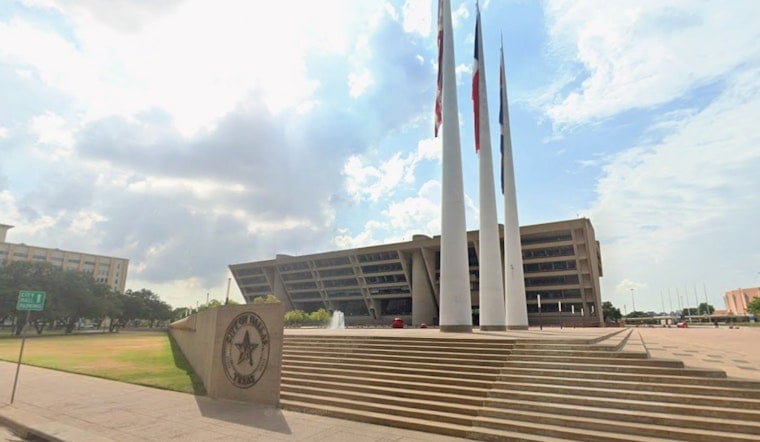
Dallas City Council voted 9-5 to authorize the city to apply for a share of nearly $300 million in federal public safety funding through the U.S. Department of Justice's Model Cities Initiative, even as five members warned the program could pull Dallas police deeper into federal immigration enforcement. The vote came after roughly an hour of debate over what obligations participation might place on local officers.
The program, which the Justice Department launched in June 2026, plans to award funding to two to four selected cities over three years, according to The Dallas Morning News. The Model Cities Initiative could fund police staffing, facilities and technology, along with license plate readers, drones and artificial intelligence systems, the outlet reports. It could also fund behavioral health care, victim assistance, and programs intended to prevent crime and reduce repeat offenses. Council member Maxie Johnson said submitting an application would not commit Dallas to accepting an award if selected.
Council opponents said the program's requirements could draw Dallas police into federal immigration operations, and Kevin Oden said the Justice Department grant remains ambiguous. City staff plan to seek clarity on the grant's requirements and report back to the council, per the same account. Voting against authorization were Adam Bazaldua, Paula Blackmon, Laura Cadena, Jesse Moreno and Jaime Resendez — five Latino council members who cast the dissenting votes. Cara Mendelsohn, who chairs the council's public safety committee and represents far north Dallas, was among those who ultimately supported the application; Zarin Gracey was absent from the dais for the vote.
The Immigration Strings Attached to Federal Dollars
The DOJ's own guidelines require participating jurisdictions to certify compliance with federal immigration communication statute 8 U.S.C. § 1373 and accept a condition requiring reimbursement to the federal government if federal law enforcement surges are deployed to address violent crime or public disorder, according to The Guardian. The Justice Department designed the initiative based on multi-agency enforcement surges in Memphis, Tennessee, and Washington, D.C., where federal officers deployed directly alongside local police. Federal officials have touted steep violent crime drops in those cities, while civil liberties groups have criticized the task-force model for heavy surveillance and aggressive street enforcement.
Unlike traditional Office of Community Oriented Policing Services grants evaluated through non-partisan peer review, Model Cities applications will be judged directly by senior political appointees inside the Justice Department, according to The Kicker. The selection criteria specifically evaluate whether city leadership — including mayors, city councils, prosecutors and sheriffs — demonstrates unified support for federal law-and-order priorities. That standard raises an open question for Dallas: whether a 9-5 split vote undermines the city's odds against rivals that apply with unanimous local backing.
Dallas Already Rewrote Its ICE Policy Once
This is not the first time Dallas immigration policy has collided with outside funding pressure. Governor Greg Abbott's office had threatened to withhold $32.1 million in state public safety grants and an additional $51.5 million in federal World Cup security funding unless Dallas Police Department revised its rules on cooperating with immigration agents, a threat Hoodline previously reported. Abbott's office later lifted the funding hold after determining Dallas's policy changes complied with state requirements.
Police Chief Daniel Comeaux has said Dallas police will not become federal agents, and he has pledged to prioritize public safety over immigration enforcement while confirming the department will continue cooperating with federal authorities as required. Comeaux rejected a $25 million offer in 2025 to join the federal 287(g) program, which would have authorized designated Dallas officers to perform certain immigration duties. The council separately shelved a local immigration-enforcement proposal in 2025, and department leadership has framed its mission as keeping residents safe rather than carrying out immigration enforcement.
A Staffing Mandate Driving the Search for Cash
The push for federal money is unfolding against a stark budget backdrop. Dallas voters approved Proposition U in November 2024, creating a charter mandate to maintain at least 4,000 sworn police officers, while the department currently employs roughly 3,200 to 3,215 officers, according to Police1. City staffing plans call for hiring 350 to 400 officers annually through 2029 to hit that target, though the council voted 12-2 to cap 2025 recruitment goals at 300 due to training constraints.
The city proposed an $823 million police budget for fiscal year 2027 — an $83 million increase over the prior year — forcing budget reductions across departments like libraries and the arts to balance the books amid sales tax shortfalls, per KERA News. City financial officials noted that public safety and street maintenance dominate municipal spending priorities under voter-mandated revenue allocation rules, since Proposition U requires at least half of excess city revenue growth to go toward public safety.
Dallas Joins a National Debate Over Federal Strings
Dallas is not alone in wrestling with the tradeoff. Council members in Charlotte, North Carolina, and New Orleans, Louisiana, voiced strong opposition in August to applying for the Model Cities Initiative over concerns about federal immigration requirements and what they called substantial DOJ operational oversight, according to ArcaMax. Local leaders in Charlotte said accepting the grant could surrender local policing authority to federal agencies and erode trust in immigrant neighborhoods.
The broader legal landscape in Texas adds another layer of pressure. The 5th U.S. Circuit Court of Appeals granted a stay in May 2026 allowing Texas Senate Bill 4 to take effect statewide, authorizing state and local police to arrest individuals suspected of entering Texas without legal authorization — a ruling Hoodline detailed that expanded municipal police authority to participate in civil immigration enforcement across the state. Dallas's own oversight board pressed the department for monthly logs of interactions with federal immigration agents earlier this year, following community concerns over officers' presence near ICE operations in Pleasant Grove.
For now, Dallas's application moves forward without a resolution to the underlying tension. Supporters on the council said the program could provide additional funding and expand violent-crime reduction strategies, while opponents remain wary that accepting the money could tie local police more tightly to federal immigration priorities. City staff are expected to report back to the council once they have more clarity on the grant's actual terms, with the application deadline set for September 1.





