

























































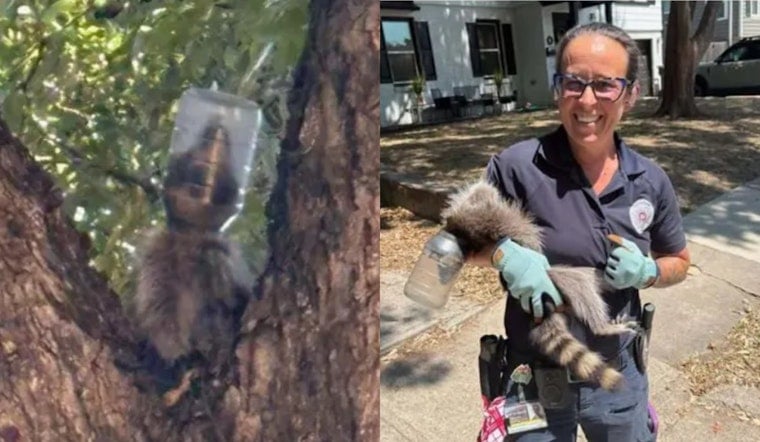
A young raccoon roamed a Dallas neighborhood for multiple days with a mayonnaise jar stuck over her head before animal control officers finally freed her near an abandoned house. The raccoon, since nicknamed Mayonesa, was dehydrated after going days without food or water, but she was otherwise in remarkably good condition by the time officers got her out of the jar.
According to NBC 5 Dallas-Fort Worth, Dallas Animal Services officers Miller and Southerland located Mayonesa in a tree near the abandoned house, but she evaded them and the pair had to wait for the right opportunity to make a move. That moment came when Mayonesa climbed down and walked right past the officers, allowing Southerland to capture her. She was lightly sedated during the rescue so crews could safely remove the jar from her head.
Local residents had reported multiple sightings of the raccoon over several days leading up to her capture, and Dallas Animal Services Officer Reames stayed in ongoing contact with those concerned neighbors throughout the weekend, coordinating updates with the agency's wildlife team, per the Dallas Animal Services and Adoption Center on the rescue. The sightings and earlier rescue attempts underscore just how long Mayonesa was stuck wandering the neighborhood before officers finally caught up with her.
From Dehydrated to Full of Energy
Once freed, Mayonesa was given fluids and medications to treat her dehydration, and Dallas Animal Services described her as full of energy despite her ordeal. Aside from the dehydration, the agency said she was in remarkably good condition.
Mayonesa is now in the care of Texas Metro Wildlife Rehabilitators, which will provide her with a few days of care before releasing her back into the wild. TMWR is a volunteer-led 501(c)(3) nonprofit founded in 2010 that serves 21 North Texas counties and treats hundreds of native wild animals a year entirely through public donations, without any municipal or government funding.
Why Raccoons Get Trapped in Household Waste
Dallas Animal Services reminded residents to dispose of jars, cans, and other containers responsibly, noting that everyday household items can become dangerous when they end up in the environment. The Humane Society has explained the mechanism behind incidents like Mayonesa's: animals stick their heads into discarded plastic jars and food containers to lick residue, then get wedged in place by rigid rims or narrow container shoulders, according to Humane World for Animals. Wildlife rehabilitation centers routinely treat raccoons and skunks for dehydration and skin abrasions caused by this exact scenario.
Animal protection groups, including the Ontario SPCA, recommend that residents rinse out food containers, crush plastic jars, and tightly latch trash bin lids before setting garbage outside to prevent these kinds of injuries. Because raccoons are among Texas's five designated high-risk rabies vector species, along with bats, skunks, foxes, and coyotes, state rules strictly govern how they can be captured, treated, and returned to the wild, per guidelines cited by the City of Dallas and the Texas Department of State Health Services.
Strict Rules Govern Rescue and Release
Because Mayonesa was captured without biting or otherwise exposing any humans, she remained eligible for rehabilitation and release rather than the euthanasia and testing protocols required for rabies vector species involved in bite exposures, according to Texas Parks and Wildlife Department regulations. Those same rules require state authorization and landowner consent before any wild animal can be relocated. The City of Dallas has said its broader urban wildlife strategy leans on public education, non-lethal deterrence, and partnerships with rehabilitation groups like TMWR rather than trapping healthy wild animals outright.
The scale of that work is substantial: Dallas Animal Services responded to more than 54,000 field service requests during fiscal year 2023–2024, including thousands of calls involving sick, injured, or confined animals. That volume tracks with national patterns identified in a 2025 report from the National Animal Care & Control Association and Shelter Animals Count, which found that 60 percent of field calls nationwide involve stray or contained animals, though only 19 percent result in shelter admission because so many are resolved on site or through specialized rescue partners, much like Mayonesa's case.
Residents in the Dallas-Fort Worth metroplex who encounter distressed or trapped wildlife can reach the DFW Wildlife Coalition hotline at 972-234-9453, which connects callers with state-permitted wildlife rehabilitators across the region. It remains unclear exactly where Mayonesa will be released once her recovery is complete, or how long her post-rescue monitoring will last.





