

























































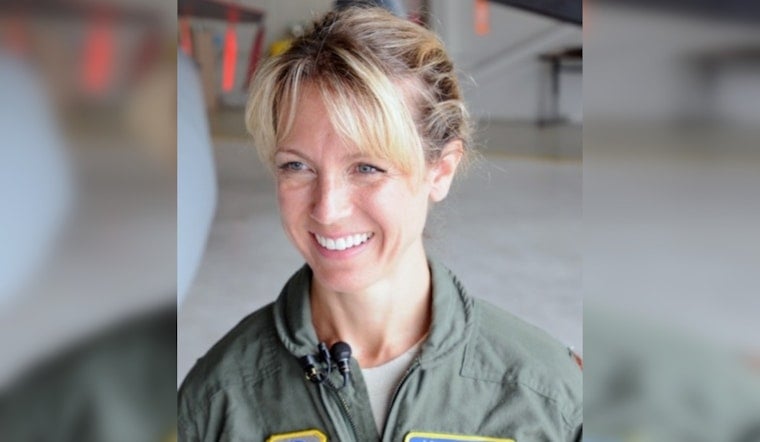
On the morning of September 11, 2001, Heather Penney climbed into a completely unarmed F-16 at Andrews Air Force Base with one plan in mind: ram United Airlines Flight 93 to keep it from reaching the U.S. Capitol. She and her flight commander, Marc Sasseville, had no missiles, no time to arm their jets properly, and no plan for how either of them would survive it.
Penney and Sasseville were scrambled to stop Flight 93 before it reached the nation's capital, according to KRON4. Both World Trade Center towers and the Pentagon had already been struck by the time Flight 93 was even in the air, and the two pilots were tasked with protecting Congress, the White House, civilians and the nation's leadership. Flight 93 had departed Newark International bound for San Francisco, carrying 40 passengers, and the Air Force determined using radar that it had likely been hijacked, with hijackers believed to have taken it over near Cleveland around 9:28 a.m.
Andrews Air Force Base, located in the District of Columbia, was home to Sasseville and Penney's unit, and neither of their jets was ready for combat. Arming an F-16 with live anti-aircraft missiles normally took 50 minutes to an hour, so the pair scrambled with standard preflight checks bypassed and only inert 20mm training rounds aboard, according to Smithsonian Magazine. With no live weapons available, ramming became the only option left.
A Plan With No Way Out
Sasseville planned to ram the front of Flight 93, while Penney intended to take out its tail, reasoning that an airplane without a tail tips over and dives straight into the ground. Neither plan included an ejection option. Penney has said the morning began as an ordinary one before it became anything but, and she has described herself simply as an ordinary American, a mother, a military service member and a community member.
Penney was the first female F-16 pilot in the history of the District of Columbia Air National Guard's 121st Fighter Squadron and was the only woman in her unit that day, according to a Wikipedia summary of her background. As she scrambled, Penney did not know whether her own father, John Penney, a retired Air Force colonel then flying commercial 757s for United Airlines, might be at the controls of the very airliner she had been ordered to intercept, according to Purdue University.
Searching the Skies Over Pennsylvania
Penney and Sasseville searched the air above Pennsylvania for Flight 93, but they were already too late. Passengers aboard the flight had fought back against the hijackers and stormed the cockpit, preventing the hijackers from reaching Washington, D.C. and changing the course of history. The hijackers ultimately crashed the plane into a rural field, and Penney has said that she and Sasseville learned of the crash only hours later.
United Airlines Flight 93 crashed in Stonycreek Township near Shanksville, Pennsylvania, at 10:03 a.m., roughly 20 minutes of flying time from Washington, according to the 9/11 Commission Report. The crew and passengers aboard Flight 93 became central to the history of that day and have since been portrayed in books, a movie and television shows. Penney has said she and Sasseville were simply too late, because the passengers had already brought the plane down themselves.
Why Andrews Had No Jets Ready
The absence of armed fighters at Andrews was not an isolated oversight. On September 11, 2001, NORAD maintained only seven active air defense alert bases across the entire continental United States, with just two in the Northeast — Otis Air National Guard Base in Massachusetts and Langley Air Force Base in Virginia — leaving Andrews without armed jets standing by, according to the Rutgers Law Review. Cold War-era air defense had been built to watch for external threats, not hijacked domestic airliners turned into weapons.
The mission's secrecy lasted almost a decade. Sasseville and Penney kept the ramming plan out of public view until 2011, when they first spoke about it for the 10th anniversary of the attacks, per Smithsonian Magazine. Sasseville went on to rise to the rank of Lieutenant General, serving as the 12th Vice Chief of the National Guard Bureau and a principal advisor to the Joint Chiefs of Staff, according to the 9/11 Memorial & Museum. Penney later flew two combat deployments in F-16s during Operation Iraqi Freedom before moving into defense policy work as a senior resident fellow at the Mitchell Institute for Aerospace Studies.
A Permanent Shift in Capital Airspace Defense
The attacks permanently reshaped how the skies over Washington are guarded. After 9/11, the 121st Fighter Squadron at Andrews was given a permanent Aerospace Control Alert mandate and became the nation's busiest air defense unit, averaging more than one scramble per day, according to Air & Space Forces Magazine. What had been an occasional Cold War posture turned into daily active patrols over the capital.
Near Shanksville, the Flight 93 National Memorial completed its 93-foot Tower of Voices in September 2018, featuring 40 wind chimes engineered to produce a distinct tone for each passenger and crew member who died there, according to the National Park Service. Penney herself has framed the mission not as a heroic success but as what she has called a failed mission — one in which it was the ordinary passengers of Flight 93, not the fighter pilots sent after them, who ultimately saved the Capitol.





