

























































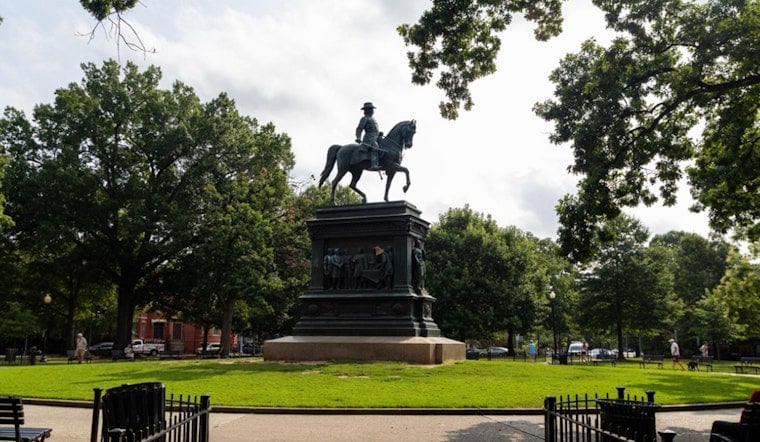
Logan Circle's ribbon got cut Wednesday morning in front of the park's century-old equestrian statue, as National Park Service officials and D.C. leaders marked the end of a restoration that had kept the historic Northwest traffic-circle park closed since March. The project brought a new public water fountain, a new irrigation system, repairs to the park's equestrian statue, new benches and lighting, repaved pedestrian walkways, and a fully replaced lawn.
Ward 2 Councilmember Brooke Pinto attended the ceremony and praised the results, according to WJLA. "I am thrilled that the National Park Service restored Logan Circle," Pinto said, adding that "Logan Circle is a beautiful park and gathering space for many in our community." Even with the ceremonial reopening, the outlet reported that temporary construction fencing will remain up around the park at least until October.
Most of the Park Still Sits Behind Fencing
National Park Service crews closed Logan Circle Park on March 30 to repave its aggregate concrete walkways, install new iron fencing around the inner circle, replace trash receptacles, restore the turf, and give the tree canopy arborist care, according to PoPville. Despite Wednesday's ribbon-cutting, roughly 90% of the park remained closed behind that same fencing on Tuesday, with newly laid sod showing widespread browning in neat rectangular patches, according to a separate PoPville report. The fencing is meant to protect the new lawn while it takes root.
New Fountain, Statue Repairs, and a Refreshed Lawn
Beyond the turf and walkway work, the finished project also delivered the new fountain, irrigation system, statue repairs, and benches and lighting mentioned above, per the same outlet's report on Wednesday's ceremony. Those upgrades round out months of closure that turned what's normally a neighborhood gathering spot into a construction zone.
A $3.63 Million Contract Inside a Federal Beautification Push
The rehabilitation work was carried out under a $3.63 million federal contract awarded March 18 to N&S Property Services LLC, a small minority-owned firm, under an 8(a) sole-source designation, according to records reviewed by GovTribe. The project traces back to President Trump's March 2025 executive order "Making the District of Columbia Safe and Beautiful," which directed Interior Secretary Doug Burgum to have the National Park Service restore public spaces and clean up federal parkland across the city, according to the U.S. Department of the Interior.
Logan Circle is just one piece of a much larger effort: the project sits inside an $866 million National Park Service overhaul of D.C. parks and monuments — including Meridian Hill Park and Freedom Plaza — ahead of America's 250th anniversary, as Washingtonian reported in June. Alongside the physical upgrades, U.S. Park Police have stepped up enforcement of quality-of-life offenses like open alcohol containers and public smoking in Logan Circle under the same federal mandate, according to The Washington Post.
DC's Parks Already Rank No. 1 Nationally
The federal spending spree comes as D.C. was named the nation's top city park system for the sixth consecutive year in May, with 99% of residents living within a 10-minute walk of a park and $449 spent per capita annually, according to NOTUS. Logan Circle itself holds a distinct place in that network: the National Park Service notes it is the only traffic-circle park in the city to retain the surrounding residential character Pierre L'Enfant envisioned in his 1791 plan for the federal capital, according to the National Park Service.
The General Who Gave Us Memorial Day
At the center of it all sits the equestrian statue of Major General John A. Logan, sculpted by Franklin Simmons atop a bronze and granite base designed by Richard Morris Hunt, the architect behind parts of the Metropolitan Museum of Art; the monument was dedicated in 1901 before President William McKinley, according to Wikipedia. Logan, a Union Civil War general and later U.S. Senator, issued General Orders No. 11 in May 1868 while commanding the Grand Army of the Republic, formally establishing Decoration Day — the observance that became modern Memorial Day, according to the U.S. Department of Veterans Affairs.





