

























































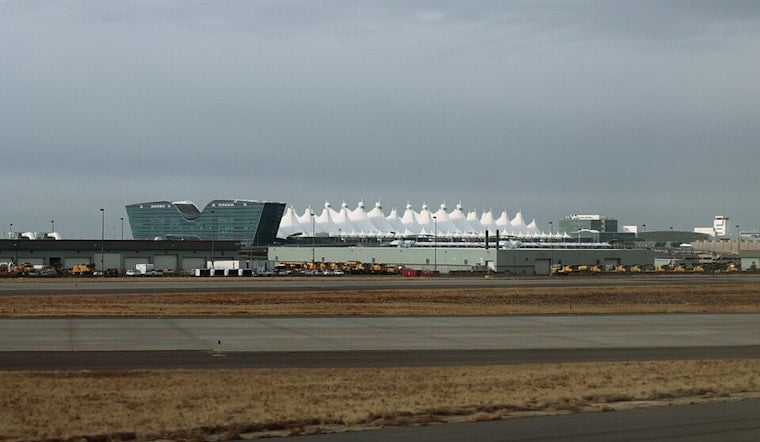
Heavy rain, hail and flooding swept across the Colorado Front Range on Friday, prompting federal aviation officials to order a ground stop at Denver International Airport that delayed or canceled more than 700 flights. The Federal Aviation Administration halted arrivals at 3:25 p.m. as severe thunderstorms rolled through the Denver metro area and Castle Rock, grounding planes at their origin airports rather than letting them circle overhead.
By the end of the day, FlightAware was tracking 689 delayed flights and 22 cancellations at DEN, according to The Denver Post. Weather-related delays averaged one hour and 44 minutes across the airport, a bruising stretch for travelers already dealing with a wave of monsoon storms that has repeatedly hammered Front Range flight schedules this summer.
United Airlines, which operates its second-largest hub at DEN, bore the brunt of the disruption with 216 delayed flights and four cancellations. Southwest Airlines logged 249 delays and three cancellations, while SkyWest recorded 157 delays and 10 cancellations. Frontier Airlines canceled eight flights amid the ground stop, per the same FlightAware data cited in the Post's report.
A Second Ground Delay in Three Days
Friday's ground stop wasn't an isolated event. Just two days earlier, on August 12, developing monsoon storms over the Denver area had already forced the FAA to issue a nationwide ground delay program for DEN-bound flights, pushing average arrival delays to 144 minutes, according to CBS Colorado. Together, the two incidents mark the second major FAA air-traffic disruption at DEN within roughly 48 hours.
The station's earlier coverage also detailed the storm system behind Friday's ground stop, describing a strong monsoon moisture surge that delivered some of Denver's heaviest single-day rainfall of the year alongside localized hail south of the city and flash flooding risks across the Front Range.
Why a 30-Minute Storm Can Snarl the Whole Country
A ground stop is the FAA's most restrictive traffic management tool, implemented with little or no warning when an airport's ability to accept flights drops sharply or hits zero because of severe weather, according to Simple Flying. Rather than let inbound aircraft stack up in holding patterns, controllers keep planes parked at their departure gates until conditions clear, which is why a single storm cell over Denver can ripple into flight delays coast to coast.
That ripple effect is amplified by just how much air traffic funnels through DEN. Three carriers, United, Southwest and Frontier, control 88% of all available seat capacity at the airport, according to Cirium schedule data reported by Simple Flying's sister outlet AirServiceOne. DEN is Southwest's single most-served airport and Frontier's second-busiest, meaning even a brief operational halt cascades quickly across those networks.
The stakes are especially high because Denver International Airport just set an all-time annual passenger record, serving more than 82.4 million travelers in 2025 to rank as the fourth-busiest airport in the country, according to figures released by the airport in January. United alone carried an all-time company record of over 41.4 million passengers through the hub last year, a 6.3% jump over 2024.
A Predictable Summer Pattern
Meteorologists point to the North American Monsoon as the recurring culprit. The seasonal pattern pushes subtropical moisture into Colorado from mid-July through August, routinely generating fast-forming afternoon thunderstorms over the High Plains, per research cited by BoulderCAST. Convective cells build along the foothills before sending strong outflow winds across DEN's runways.
Those storms have historically produced dangerous wind shear as well. In July 2022, 80 mph wind shear forced 51 flights to divert away from DEN to alternate airports including Cheyenne, Wyoming, according to 9News. Federal aviation officials classify DEN among the “Core 30” major U.S. airports most vulnerable to weather-driven ground stops and delay programs, a designation Hoodline has previously reported reflects the airport's high elevation and heavy exposure to convective storms.
Friday's disruption is only the latest in a string of similar events this summer. Hoodline reported a ground stop that delayed nearly 800 flights and led to 27 cancellations on July 29-30, another sudden ground stop tied to Front Range microbursts on July 10, and separate storm-driven delay events in June and May. The pattern underscores how, for a hub covering 53 square miles and generating an estimated $47.2 billion in annual economic impact for Colorado, a single afternoon storm cell can still bring national air travel to a temporary halt.





.jpg)