

























































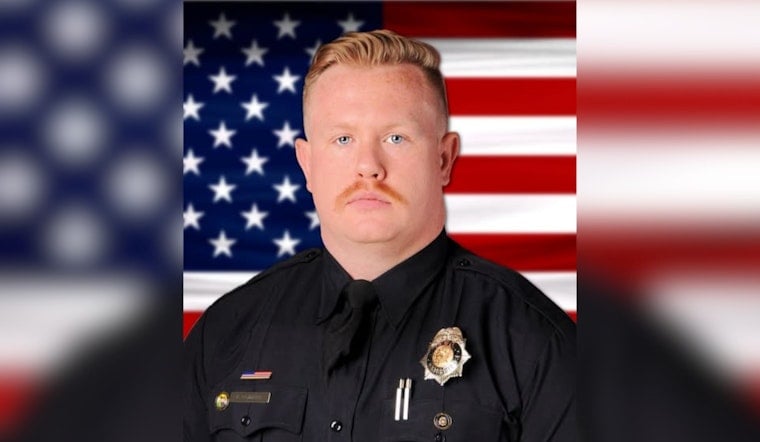
A man threatening to jump from the East Evans Avenue overpass onto Interstate 25 below was talked down from the edge last Friday by a Denver police officer whose calm, patient approach is now being credited with saving his life. Officer O'Connor persuaded the individual to step away from the ledge and move to a safe location, after which he was taken into protective custody and connected with mental health services for further support.
Denver police officers responded to a report of a man threatening to jump from the bridge onto the highway below on August 7, according to a Facebook post from the Denver Police Department. Officer O'Connor, who is assigned to Denver Police District 3, used calm communication, patience, empathy and de-escalation techniques to bring the encounter to a safe end. The department says his professionalism and compassion played a critical role in ensuring a safe outcome and saving the young man's life.
A High-Stakes Spot Above I-25
The East Evans Avenue overpass spans Interstate 25 at Exit 203 in southeast Denver, forming a high, densely trafficked elevated crossing above multiple lanes of highway traffic, according to city planning documents cited by the City and County of Denver. It sits within Denver Police District 3's territory, which covers southeast Denver neighborhoods including University Hills, Virginia Village, and Cherry Creek, along with major commercial corridors and heavy arterial traffic near the University of Denver area. The location's height and proximity to fast-moving highway lanes make any threat of a jump especially dangerous for both the person in crisis and the drivers below.
Once the man stepped back from the edge, he was taken into protective custody rather than placed under arrest. Colorado law allows officers to hold someone for an emergency 72-hour mental health evaluation when there is probable cause to believe the person poses an imminent danger to themselves or others, a civil procedure under state statute that explicitly bars placing that person in jail, per legal guidance published by Colorado State University's police department.
Training Built Into Every Denver Officer
Officer O'Connor's ability to defuse the situation reflects standards built into the entire department. Every sworn Denver police officer is certified in Crisis Intervention Team response, receiving specialized instruction in verbal de-escalation, active listening and managing acute psychological crises, according to Police1. Colorado law enforcement agencies began adopting that framework in 2002 specifically to reduce injuries and steer people experiencing mental health crises away from the justice system.
Denver has also built out response options beyond individual officer training. The department runs a Co-Responder program that embeds licensed mental health clinicians alongside officers on high-risk behavioral health calls, a network that has grown from four clinicians at its 2016 launch to dozens of full-time staff covering shifts citywide, according to the Urban Institute. That program works alongside the city's civilian-led Support Team Assisted Response, or STAR, van for nonviolent emergency calls.
What The Research Shows About Crisis Response
The investment in alternatives to traditional policing has measurable results. A Stanford University-led study found that Denver's STAR program reduced targeted low-level offenses in pilot areas by 34% while cutting the direct cost of responding to a call to $151, roughly four times cheaper than a traditional police-only dispatch at $646, according to the Stanford Institute for Economic Policy Research. Denver voters helped fund this infrastructure in November 2018 by approving the Caring for Denver ballot initiative, a 0.25% sales tax that generates roughly $35 million annually for local mental health and substance abuse services, with state law requiring at least 10% of that funding go toward public safety crisis response programs.
Most mental health crises never reach the point of an officer standing on a bridge. Nationwide, only about 2% of calls to the 988 Suicide & Crisis Lifeline require an emergency medical or law enforcement dispatch, according to data from the Colorado Behavioral Health Administration. Between the hotline's national launch in July 2022 and May 2024, 988 fielded more than 10.8 million calls, texts and chats across the country, per KFF. Colorado has since moved to streamline that system further, enacting legislation known as SB25-236 that consolidates the 988 Colorado Mental Health Line with Colorado Crisis Services into a single 24/7 point of contact for residents in crisis.
For the young man on the Evans Avenue overpass, the case ended not with an arrest but with a connection to care. Anyone struggling with depression, anxiety, emotional instability, or suicidal thoughts can reach the 988 Suicide & Crisis Lifeline for support.





