

























































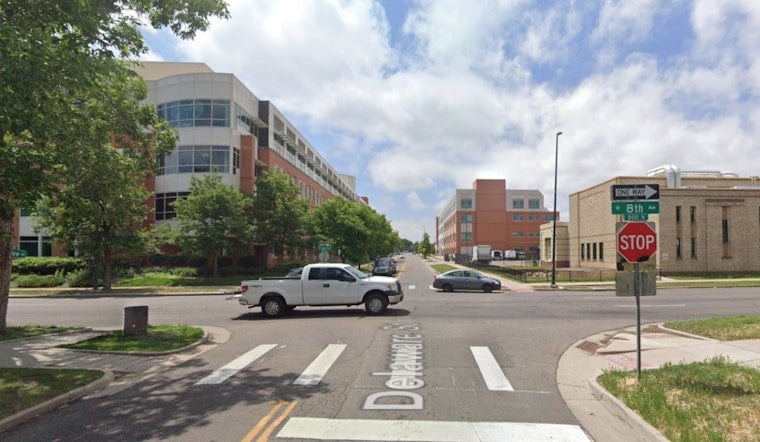
A driverless Waymo vehicle came to a stop to yield to a pedestrian waiting at the curb near West 8th Avenue and Delaware Street on Thursday afternoon, and within moments, three vehicles were tangled in a chain-reaction crash that left two drivers with minor injuries. The unoccupied robotaxi itself wasn't the vehicle that struck anything — it was struck after a rear-end collision behind it pushed a van into its back end.
According to CBS Colorado, the crash happened around 2:36 p.m. near Denver Health. Mark Kibler said he was driving directly behind the Waymo on 8th Avenue as it traveled slowly ahead of him, then steadily slowed further as it approached the intersection before coming to a complete stop. There was no traffic signal, no marked crosswalk, and no stop sign at the location where the vehicle halted, and Kibler said he didn't see anyone crossing the street at the time it stopped.
“This is my first time being near one,” Kibler told the outlet, describing his surprise at watching the car halt in the middle of the road with, from his vantage point, no visible traffic or pedestrians ahead of it. He said he initially thought someone was driving the Waymo. Kibler stopped his van behind the vehicle and honked his horn, and other vehicles simply passed the stopped Waymo to go around it.
The Rear-End That Started It All
Alfredo Arrieta approached from behind Kibler's van and struck the back of it, according to the CBS Colorado report. The impact pushed Kibler's van into the stopped, unoccupied Waymo ahead of it. Arrieta said his airbags deployed in the collision, and he told the outlet he was left questioning why the Waymo had stopped on a busy street in the first place.
Denver police cited Arrieta in connection with the crash and continued to investigate the cause of the initial collision, per the same report. Police described the impact between the van and the Waymo as a secondary collision. Vehicles involved sustained damage, and drivers sustained minor injuries, though the extent beyond that wasn't detailed.
Waymo Says Sensors Caught the Pedestrian
Waymo provided CBS Colorado with information about what its vehicle detected before the crash, saying the pedestrian waiting on the curb prompted the automated stop. The pedestrian ultimately crossed the street without incident. The company said it cooperated fully with Denver police at the scene, and police told the outlet they had no record of another crash involving a Waymo vehicle in Denver.
Colorado law offers a straightforward explanation for why the vehicle behaved the way it did. Under Colorado Revised Statutes § 42-4-802, drivers approaching any marked or unmarked crosswalk at an intersection must yield the right-of-way to a pedestrian crossing the street, and vehicles behind a stopped car are barred from passing it — a rule several drivers appear to have broken as they went around the halted Waymo. Denver police had not issued the Waymo any moving traffic citations during its pre-launch testing period in the city, according to The Colorado Sun.
A Company Scaling Up Fast
The crash lands at a pivotal moment for Waymo's Denver rollout. The company began testing autonomous vehicles in the city in 2026 with human safety specialists behind the wheel, and by July 2026 had announced plans to begin fully autonomous operations without anyone inside. Waymo's Denver testing zone covers central neighborhoods including RiNo, Baker, Cherry Creek, Washington Park, and the Arts District, while excluding freeways and Denver International Airport during this initial phase, per the Colorado Sun's mapping of the program.
Denver also serves as Waymo's primary cold-weather proving ground for its sixth-generation, all-electric “Ojai” vehicles, which come equipped with heated sensor pods, small wipers, and upgraded radar meant to hold up in snow and ice, according to Westword. Before expanding driverless employee testing to Denver, Las Vegas, San Diego, and Tampa this month, Waymo's driving system had already logged more than 100 million fully autonomous miles in markets including Phoenix, San Francisco, Los Angeles, and Austin, the company said in an August 26 blog post.
What the Law Says About Liability
State law also settles a question that might otherwise linger in a crash involving an empty car: who's responsible when there's no driver at all. Under Colorado Revised Statutes § 42-4-242, liability for a collision involving an automated driving system operating without human control falls to the automated system itself, not any human occupant — moot here, since police cited the human driver they say caused the initial impact. Colorado's 2017 autonomous vehicle law, Senate Bill 17-213, also bars city governments like Denver's from banning driverless testing or deployment outright, meaning local officials have limited power to restrict where or how Waymo operates so long as the company follows state traffic law.
The Colorado Public Utilities Commission requires Waymo to carry liability insurance and file a written report within 30 days of any crash causing bodily injury or more than $5,000 in property damage once commercial service begins, a requirement Hoodline reported when Waymo's Denver expansion was first announced.
Cautious Driving, Unfamiliar Territory
Whatever caution Waymo's programming showed toward the pedestrian, it caught the human drivers behind it off guard — a mismatch that may become more common as more of these vehicles hit Denver streets without anyone behind the wheel to explain their behavior to frustrated drivers in real time. National crash data suggests the vehicles are, overall, markedly safer than human-driven ones: a July 2026 study by the Insurance Institute for Highway Safety found Waymo vehicles were involved in 68% fewer police-reportable crashes per mile driven than human drivers across San Francisco, Phoenix, Los Angeles, and Austin between 2021 and 2024.
Pedestrian safety remains a serious concern on Colorado roads more broadly. The state's Department of Transportation documented 136 pedestrian fatalities statewide in 2023, a backdrop that helps explain why autonomous vehicles are engineered to yield conservatively rather than risk a pedestrian strike. Thursday's crash follows a separate incident just two days earlier in the Bay Area, where a Waymo robotaxi struck a minivan at a Costco parking lot, an episode Hoodline also covered amid ongoing public debate over autonomous braking behavior.





