

























































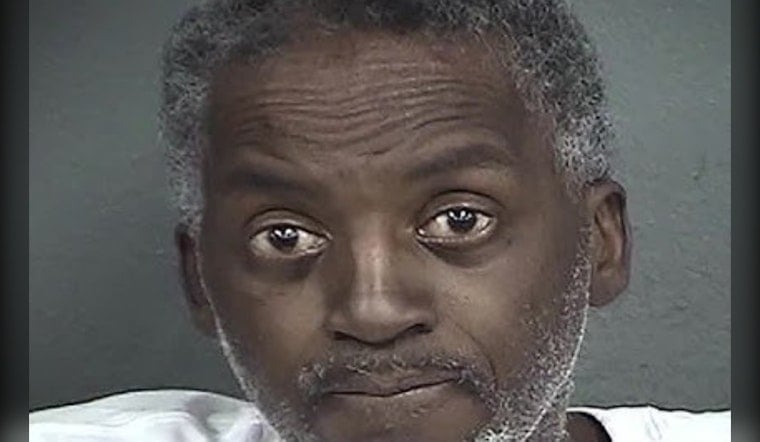
A Wyandotte County jail deputy knelt on the back of a 50-year-old detainee for more than a minute during a restraint that ended with the man's death, according to testimony given this week in a Wyandotte County district courtroom. Deputy Richard Fatherley appeared in court as prosecutors and his defense team cross-examined deputies who witnessed or took part in the altercation that preceded Charles Adair's death at the jail last July.
The testimony, detailed in a report from the Kansas City Star, described how five deputies placed Adair face-down on his cell bed and restrained him after an altercation with Charles Bunnell, the acting sergeant during the incident. Body camera footage reviewed in the case showed Adair throwing himself from his wheelchair and rolling away before deputies moved in, according to the Star's reporting. Deputy Samuel Yang, who had worked at the jail for two months at the time, testified that Adair grew aggressive, yelled and swung at deputies during the encounter.
A Minute Kneeling, Then Silence
According to the Star, Fatherley placed his knee on Adair's back and kept it there until Adair stopped speaking and moving, a restraint that court and police documents cited by The Guardian put at one minute and 26 seconds. Fatherley testified that he heard Adair call for help several times during the restraint and that deputies performed rounds of CPR once Adair became unresponsive. Adair had refused to let deputies remove his handcuffs, the Star reported, and deputies said they were attempting to restrain him and return him to his cell.
Christine Reglin testified that the Kansas Bureau of Investigation did not believe Fatherley's actions constituted a crime, according to the Star's account of the proceedings. That assessment lines up with the agency's own findings: the KBI concluded its probe in September 2025 and, per a bulletin from the Kansas Bureau of Investigation, submitted its findings without an affidavit recommending charges. The county coroner nonetheless ruled Adair's death a homicide caused by mechanical asphyxia, and Wyandotte County District Attorney Mark Dupree moved forward with charges against Fatherley regardless of the KBI's conclusion.
A Vulnerable Detainee, A Minor Charge
Adair had been booked into the Wyandotte County Detention Center on July 4, 2025, after his arrest on misdemeanor warrants tied to traffic violations he had failed to appear for in court, according to the Associated Press. He used a wheelchair while jailed, had an infection on one leg that he was being treated for in the jail's medical clinic, and had a pacemaker, per the Star's report. Court filings and law enforcement affidavits cited by The Guardian also state Adair had been diagnosed with schizophrenia and was experiencing a mental health breakdown, in addition to being treated for a severe bone infection in his left leg, at the time deputies moved to restrain him.
An autopsy found scrapes, hemorrhages on Adair's back, rib fractures and a sternal fracture, contributing factors that, along with hypertensive cardiovascular disease and cirrhosis due to alcoholism, were cited alongside the ruling of mechanical asphyxia as his cause of death. The medical unit ultimately declared Adair dead on July 5, 2025, the same day as the altercation, and his manner of death was ruled a homicide.
According to the National Institutes of Health's NCBI summary of BJS (2024a) data, U.S. federal law enforcement agencies reported 120 arrest-related deaths and 483 deaths in custody in FY 2022. According to the Bureau of Justice Statistics, 960 inmates died in U.S. jails in 2008, a mortality rate of 123 deaths per 100,000 jail inmates.
Expert Witness Faults Continued Kneeling
Use-of-force expert Ken Wallentine testified that he found no issue with Fatherley's initial decision to use force or restrain Adair, but called the deputy's continued kneeling after Adair appeared to stop resisting an exceptional departure from acceptable restraint practices, according to the Star. Wallentine said officers are trained to quickly assess whether a restrained person is conscious and breathing once that person goes quiet, and testified that Fatherley did not perform those checks when Adair gave up. Wallentine said he could not determine whether Adair would still have died had Fatherley reevaluated the level of force being used.
Wyandotte County's use-of-force policy requires that force serve a legitimate law enforcement purpose and that the degree of force be reasonable, trusting deputies to use well-reasoned discretion based on factors including the immediacy and severity of a threat, proximity to weapons, and a person's age, size, strength, health, and the number of deputies present. Law enforcement officers are generally taught to reduce force as resistance diminishes or control is regained, a standard Wallentine's testimony suggests Fatherley did not meet in the final moments of the restraint.
Charging Decision Draws Scrutiny
Fatherley is the only member of the restraint group who has been charged in Adair's death, facing second-degree murder or, alternatively, involuntary manslaughter from the Wyandotte County District Attorney's Office. The other deputies testified that they and their colleagues followed protocol and appropriately restrained Adair, per the Star's reporting.
When Fatherley was charged last September, he was issued a court summons rather than being arrested or booked into custody, a procedure that CBS News reported sparked public criticism over what critics called a two-tiered justice system. KCUR reported that a Wyandotte County Sheriff's Office spokesperson confirmed Fatherley had been employed at the detention center for slightly over a year and was not a state-certified law enforcement officer when the incident occurred.
Federal Lawsuit and Email Access Questions
Adair's family filed a federal wrongful death lawsuit in April naming Sheriff Daniel Soptic, Richard Fatherley, five unnamed deputies, and the Unified Government of Wyandotte County and Kansas City, Kansas, alleging deliberate indifference and a failure to train jail staff, according to KCUR's reporting. That case remains active. Adair's family viewed body camera footage of the incident, KCUR reported.
A local broadcast investigation revealed in March that Fatherley had retained access to his official county email while on paid administrative leave and used it to contact potential trial witnesses, according to a report from Samantha Boring of KCTV5 News. The county revoked his email access the following month after the report surfaced. Fatherley's preliminary hearing had already been delayed once, from April to May 20, after his defense team requested more time due to a scheduling conflict involving their expert forensic pathologist, per KCUR.
Reporting from Kendrick Calfee and Caroline Zimmerman contributed to the Kansas City Star's coverage of this week's testimony. The court is scheduled to reconvene at 9 a.m. Wednesday and Thursday, with two pre-trial hearings still on the calendar as the case moves toward resolution.




