

























































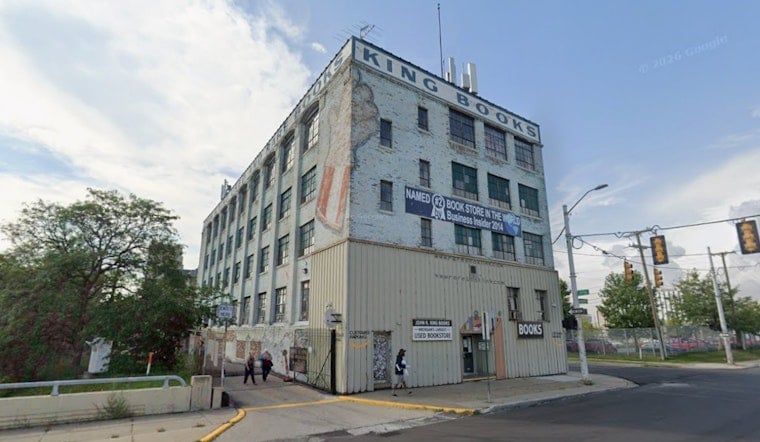
A bottle of crystallized picric acid sat inside Detroit's John K. King Used & Rare Books before an employee cleaning donated antiques recognized it as a potential explosive and carried it outside. The discovery yesterday triggered a bomb squad response, temporary street closures, and a brief closure of the four-story bookstore before operations resumed later that day.
According to MLive, the employee found the old bottle while doing some cleaning and recognized the crystallized substance inside as potentially unstable thanks to a background studying chemistry in college. She took the bottle outside rather than risk moving it further once she suspected what it might be, MLive reports, citing WDIV. Officials were then contacted about the bottle, and John K. King Books announced a temporary closure around 11 a.m. yesterday while authorities responded.
The bookstore, located at 901 W. Lafayette Blvd. in Detroit, is known for collecting antiques alongside its massive inventory, and the bottle had been acquired by the store at some point along with other donated items, per the same account. Officials closed off multiple streets in the area while the Detroit Fire Department, cited by WDIV, and police responded to assess the hazard.
Bomb Squad Retrieves Bottle, No Injuries Reported
Detroit Police Bomb Squad technicians and the Detroit Fire Department retrieved the picric acid bottle along with a second container of unspecified old chemicals, according to CBS News Detroit. That response allowed the surrounding street closures to be lifted and the bookstore to reopen around 12:15 p.m. yesterday. No one was hurt in the incident, according to WDIV, as cited by MLive.
CBS Detroit's report notes that the employee reported the suspected picric acid bottle at Detroit's Southwest Public Safety Center around 8:45 a.m. yesterday, explaining she had found the bottle over the weekend while cleaning donated antiques and had placed it outside due to safety concerns. First responders praised the collaboration that prevented injuries or property damage, the station reported.
Why Dried Picric Acid Is So Dangerous
Picric acid is commonly used as a laboratory stain and is harmless when kept hydrated, but the chemistry behind Sunday's scare explains why authorities treated it so seriously. According to University of Alabama Environmental Health and Safety guidelines, picric acid must be stored hydrated with at least 30% water, and drying below 10% water turns the compound into a secondary explosive sensitive to heat, shock, and friction.
Once dried, picric acid falls under a severe federal classification. Occupational Safety and Health Administration regulations under 29 CFR 1910.109 classify dry picric acid as a Class A explosive alongside dynamite and nitroglycerin due to its maximum detonation risk, per the Occupational Safety and Health Administration. U.S. Department of Transportation regulations similarly require special emergency exemptions and specialized bomb baskets or robotic equipment to transport aged picric acid containers because standard hazardous waste haulers are legally prohibited from moving the dry compound, according to the U.S. Department of Transportation.
The compound's destructive history stretches back more than a century. Picric acid was heavily manufactured during World War I as a primary artillery explosive, with an explosive force and shattering effect roughly ten times greater than dynamite, before TNT largely replaced it in military munitions, according to the Science History Institute.
Old Chemicals Turning Up in Antiques Isn't New
Yesterday's discovery fits a pattern of vintage items harboring dangerous historical compounds. In May 2020, Pittsburgh Police bomb technicians were forced to dig a pit and detonate picric acid-treated gauze on-site after an individual discovered the unstable material inside an antique military medical kit, per CBS News Pittsburgh. Decades earlier, in September 1986, an Orange County Sheriff's Department bomb squad removed and exploded 100 pounds of unstable picric acid discovered during an inspection of stored chemical containers in a commercial building in Huntington Beach, according to the Los Angeles Times.
A Landmark Building With Its Own Unusual History
The building housing John K. King Used & Rare Books has its own remarkable backstory. The four-story structure on Lafayette Boulevard originally operated as the Advance Glove factory in the early 1900s and was physically rolled 250 feet on wood rollers in 1948 to make room for the Lodge Freeway, according to Historic Detroit, which notes that owner John King purchased the abandoned factory in 1983.
Founded in 1965, the store spans four floors and contains over 1 million volumes, per MLive, operating intentionally without a computerized inventory database for its main floor stacks, according to Atlas Obscura. Customers are handed printed maps upon entry to navigate the sprawling collection, a browsing model that has made the shop a destination for book lovers well beyond Detroit.





