

























































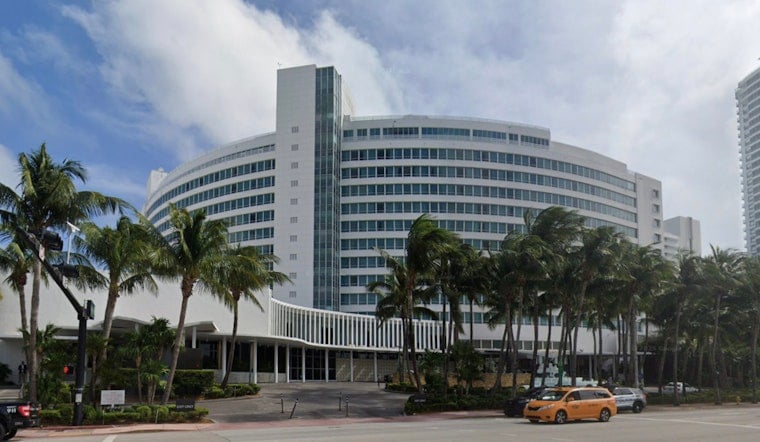
A Miami Beach homeowner who says he'll be stuck listening to a water park from his front porch has sued Jeffrey Soffer's Fontainebleau Miami Beach, arguing that a state law tailor-made for the resort illegally lets it bypass a city vote on its controversial 99-foot waterslide tower. Richard Simring filed the complaint in June, asking a court to strike the provision and claiming it violates the Florida Constitution.
Simring has lived in his La Gorce Drive home since 1999, according to the lawsuit, which is about one mile from the Fontainebleau property, as reported by The Real Deal. He raised concerns in the complaint about traffic, noise, crowds and changes to the neighborhood's character, and claimed the project would permanently alter his surroundings. Fontainebleau has disputed his claim that he lives across the street from the resort, and the company's attorneys argue his home is separated from the hotel by multiple bodies of water and structures.
The case centers on House Bill 399, which Governor Ron DeSantis signed into law on a Friday afternoon in March 2026 after it cleared the Florida Legislature earlier that month, according to CBS News. The law allows large destination resorts with more than 500 rooms on at least five acres — and an average occupancy rate of at least 70 percent over the past three years — to bypass local historic preservation board review. It requires cities to administratively approve development-rule modifications affecting up to 20 percent of the land occupied by qualifying resorts. Simring alleges in his complaint that the law orders Miami Beach to approve the Fontainebleau project and skip historic board review entirely.
A Resort Overhaul Years in the Making
Fontainebleau Miami Beach, which opened in 1954 with 1,593 guest rooms at 4441 Collins Avenue, was designed by Miami Modernist architect Morris Lapidus and added to the U.S. National Register of Historic Places on December 22, 2008, per background compiled by Docomomo US. When Fontainebleau Development first unveiled its outdoor overhaul in August 2025, the plan called for 11 waterslides, including a flagship 120-foot drop slide, and the reconfiguration of 10 existing pools into five pools and two hot tubs, according to Bucket Listers.
Since then, the developer has scaled back the design. Fontainebleau Development reduced the waterslide height from 131 feet to 99 feet and cut the cabana structure's height by 30 percent, the complaint states. The Miami Design Preservation League formally opposed the water park in February 2026, warning that even a 99-foot waterslide tower would visually dominate Lapidus's iconic design and disrupt historic shoreline views, and it urged the city's Historic Preservation Board to reject the required variances. The MidBeach Neighborhood Association reported that the project needed eight distinct zoning variances, including requests to build closer to the protected Beach Erosion Control Line and within a required 10-foot sand dune setback, citing proximity and noise concerns from neighboring condo residents.
City Threatened to Sue, Then Backed Down
Miami Beach's own resistance to HB 399 was loud before it was quiet. Mayor Steven Meiner and city leaders protested outside the Fontainebleau on the Beachwalk on March 10, 2026, declaring that Tallahassee is not the zoning board of Miami Beach, according to reporting cited from Florida Politics. Meiner also joined a grassroots coalition opposing the water park project. That same month, the city directed staff to potentially file a complaint against the state, but Miami Beach ultimately did not pursue litigation over the law.
The fight for local control found an unlikely ally within the governor's own party. Miami Beach Representative Fabian Basabe broke party lines in March 2026 to vote against HB 399, one of only three House Republicans to do so, arguing the legislation targeted a single local property and disregarded local traffic and infrastructure constraints, per CBS News. Doral-area Representative David Borrero told the Miami Herald that a Fontainebleau lobbyist helped draft the resort carveout in the bill.
Political Ties and a Disbarred Plaintiff
Critics have also pointed to Fontainebleau Development owner Jeffrey Soffer's relationship with the governor. Soffer donated $1 million to DeSantis's 2023 presidential campaign and repeatedly let DeSantis travel on his private plane before HB 399's enactment, according to Seeking Rents. In January 2026, Greater Miami Convention and Visitors Bureau President David Whitaker had submitted a letter supporting the project, arguing that family-friendly resort upgrades are necessary for Miami Beach to stay competitive in global tourism, with the Greater Miami and the Beaches Hotel Association also backing the plan.
Simring himself carries a complicated legal history. He is a former Stroock Stroock & Lavan partner and Florida Supreme Court clerk who pleaded guilty in 2008 to one count of conspiracy to commit mail fraud and money laundering, tied to billionaire Ed Okun's $132 million escrow embezzlement scheme, according to the ABA Journal. He was disbarred in 2009. He filed his complaint pro se, on his own behalf, in June 2026, and separately filed notice to the state regarding his constitutional challenge.
Standing, Ripeness and a Fight Over Who Should Be Sued
Fontainebleau has moved to dismiss Simring's complaint, arguing on multiple fronts that the case should not proceed. The company contends Simring lacks standing, that his claim is not ripe because Miami Beach has not yet issued a building permit, and that the law's provision is general and does not specifically reference Fontainebleau. Fontainebleau has also argued that Simring should have sued the state rather than the resort itself.
Simring has said he did not sue the state because Florida rules require constitutional challenges to statutes to be filed without naming the state as a defendant, per the complaint. He has said he will sue the state if the court directs him to do so, and that he will wait if the court instead directs him to hold off until Miami Beach issues a project permit. In the meantime, he plans to file an amended complaint. Attorney Sean Burstyn called Fontainebleau's dismissal motion conclusive, while the court has not yet ruled on the motion.
The legal wrangling comes after a Florida attorney general opinion issued in June 2026 found that Miami Beach could no longer require its own Historic Preservation Board to approve the project — a board that had already delayed voting on the Fontainebleau proposal back in February 2026. Separately, Doral Representative David Borrero, who represents Doral, Florida, has requested a state attorney general opinion on the project as well. Simring has said the project's effects, including congestion at 41st Street and Pine Tree Drive, will be unspeakable, and that his life, his children, his dog and his house will all be affected by the water park.
The dispute is one of several legal fights swirling around Soffer's properties in recent months. Hoodline has reported on sanctions sought against a rabbi in separate Fontainebleau litigation, while condo owners at Soffer's Turnberry Isle in Aventura have filed their own suit over towers built on tennis courts, and Fontainebleau unit owners sued the resort in April over new rental rules.





