

























































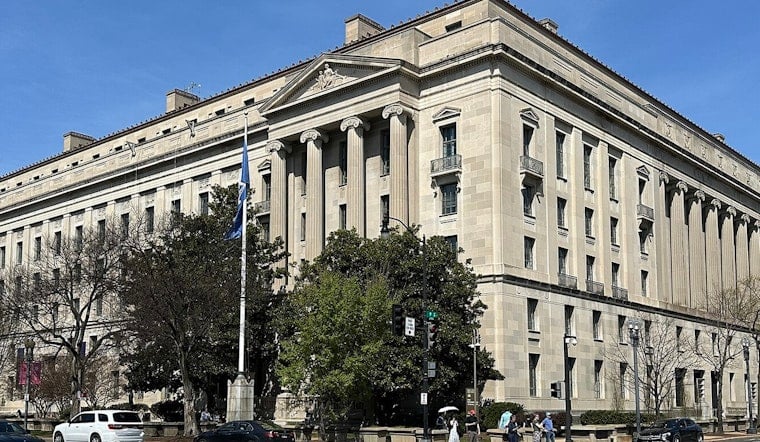
The Justice Department has filed federal lawsuits against Arizona, New Mexico, Oregon and Washington, accusing all four states of illegally offering in-state college tuition and financial aid to undocumented students. The new complaints, filed Thursday, push the total number of states sued in this ongoing campaign to 21.
Assistant Attorney General Stanley E. Woodward Jr. said the four states are “pushing citizens to the side and ignoring federal law,” according to KFOX. The Justice Department alleges that laws in New Mexico, Arizona, Oregon and Washington allow some undocumented students to qualify for reduced tuition rates or scholarships that are not available to all U.S. citizens, a status the department says violates federal law. In New Mexico specifically, the lawsuit seeks to block the state from enforcing tuition and financial-aid provisions that apply to undocumented students who maintain in-state residency, regardless of whether they are lawfully present in the country.
The Federal Statute at the Center of the Fight
The Justice Department's legal theory rests on Section 505 of the 1996 Illegal Immigration Reform and Immigrant Responsibility Act, codified at 8 U.S.C. § 1623, according to the Legal Information Institute. That provision bars states from granting postsecondary education benefits to undocumented immigrants based on state residency unless the same benefit is extended to all U.S. citizens regardless of where they live. Congress passed the restriction in 1996 specifically to limit state-level public benefits for noncitizens, per the Legal Information Institute.
This latest round of lawsuits carries out President Trump's Executive Order 14218, signed February 19, 2025, which directed the Justice Department to identify and challenge state laws granting in-state tuition or financial aid to noncitizens without offering the same access to out-of-state American citizens, according to the department's own court filing. The Justice Department has now sued 21 states under this directive, with additional lawsuits reportedly pending against Minnesota, Virginia, California, New Jersey, Kansas, Massachusetts, Rhode Island, Maryland, Colorado, New York, Connecticut and Vermont, per KFOX.
How Each State's Law Actually Works
Arizona's policy traces back to Proposition 308, a ballot measure voters approved in November 2022 that lets noncitizen students who attended an Arizona high school for at least two years and graduated pay in-state tuition and receive state-funded financial aid, according to the University of Arizona Office of the Registrar. That measure reversed a 2006 voter initiative that had banned in-state tuition for undocumented residents. Arizona Attorney General Kris Mayes issued a formal legal opinion in August 2025 arguing that Proposition 308 does not run afoul of federal law because eligibility hinges on high school attendance and graduation rather than residency, placing it outside the statute's reach.
New Mexico's law dates back further, originating from Senate Bill 582, passed in April 2005, which bars public colleges from denying admission based on immigration status and extends in-state rates to students who attended a state secondary school for one year and earned a diploma or GED, per 96.3 KKOB. Washington's framework began with House Bill 1079 in 2003 and was updated by Senate Bill 5194 in 2021, requiring students to earn a Washington high school diploma or GED, live in the state for 12 consecutive months for non-college purposes, and sign an affidavit pledging to pursue legal permanent residency when eligible, according to Whatcom Community College. Washington's 2014 Real Hope Act separately opened state grants to undocumented students.
Oregon's Tuition Equity Act, House Bill 2787, was signed by then-Governor John Kitzhaber in April 2013 after a decade-long legislative effort, exempting undocumented students from out-of-state tuition if they attended an Oregon high school for three years and studied in the United States for five years before graduating, according to the Oregon Historical Society's Archives West.
A Legal Fight Already Playing Out in Court
The Justice Department isn't going in blind. In July, a federal judge in the U.S. District Court for the Southern District of Illinois granted the department summary judgment, ruling that Illinois laws providing in-state tuition and financial aid to undocumented students were unconstitutional under federal preemption, as Hoodline reported. That court stayed its injunction for 14 days to give Illinois time to appeal, giving the federal government its first concrete courtroom win in the broader campaign.
The stakes extend well beyond these four states. According to data updated in July by the National Immigration Law Center, roughly 98,000 undocumented students graduate from U.S. high schools every year, and 20 states plus Washington, D.C., have enacted some form of tuition equity policy. States with these policies collectively encompass roughly 60% of the nation's foreign-born population, per the same data. With 21 states now facing lawsuits and at least one favorable ruling already on the books, university systems, financial aid offices and thousands of undocumented students are heading into the new academic year facing considerable uncertainty.
This wave of litigation follows a similar pattern to earlier suits Hoodline has tracked this year, including cases against three Second Circuit states, Colorado's ASSET Act, and Maryland's tuition law. The Justice Department first opened this front against California's Dream Act in late 2025, and it has continued adding states to the list ever since. Whether Arizona's high-school-based eligibility argument or similar defenses from New Mexico, Oregon and Washington hold up remains an open question the courts have yet to resolve.





