

























































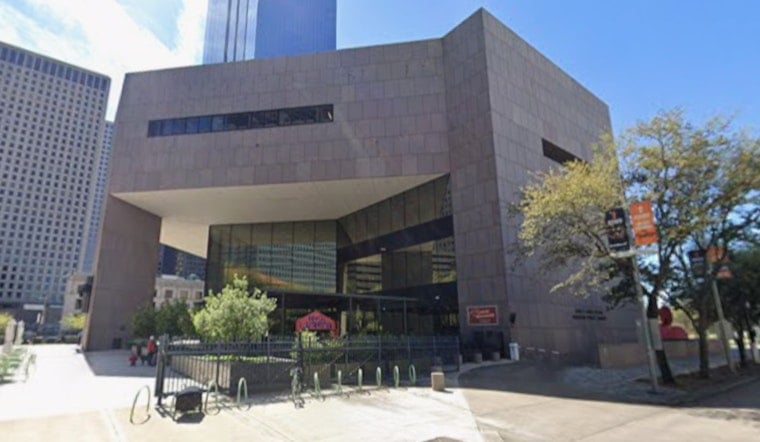
Houston Public Library marked the 100th birthday of its ornate downtown landmark, the Julia Ideson Building, with a free celebration Saturday running from noon to 4 p.m., packed with historic tours, an archival film screening, vintage fashion displays and hands-on activities for families. The first 200 registered guests to check in received a commemorative gift, and free Saturday garage parking was available with entry from Lamar Street.
The building opened in October 1926 as Houston's new main library, replacing the Houston Lyceum and Carnegie Library that had served the city from Travis and McKinney streets since 1904, according to Click2Houston. The city had purchased the Bagby family home site for the new library in 1922, and the following year the Houston Public Library Board of Trustees chose architect Ralph Adams Cram to design it. Cram, previously known primarily for Gothic Revival work, drew on a six-month trip to Spain to design the building in the Spanish Renaissance Revival style, collaborating with local architect William Ward Watkin, a former Cram employee and Rice Institute professor, according to the Houston Public Library.
Cram was already known for his work at West Point, Princeton, Rice University and Houston's Trinity Episcopal Church, per the same Click2Houston account. Construction of the building was overseen by Watkin along with W.A. Dowdy and J.M. Glover. The library's namesake, Julia Ideson, personally requested flexible rooms, good ventilation and plenty of windows for the new building — practical demands for a Houston summer decades before air conditioning. The city notes the finished structure was built with buff-colored brick, concrete, and decorative limestone and marble trim, a three-story L-shaped design meant to keep the building livable through cross-ventilation and large arched windows.
A Civic Center Plan That Never Fully Arrived
The building was originally envisioned as the flagship of a planned five-building municipal civic center, but it ended up the only structure completed under that master plan after the Great Depression halted municipal construction, according to the City of Houston. An archival wing envisioned in Cram's original blueprints went unbuilt for decades because funding ran out during the Depression, per Click2Houston. It would take until the 21st century for that piece of Cram's vision to be realized.
Julia Ideson herself was Houston's first professional librarian, serving in that role for 42 years between 1903 and 1945. Houston City Council voted in 1951 to name the main library in her honor. She died of a heart attack on her 65th birthday, July 15, 1945, while visiting Pennsylvania, and is buried in Houston's historic Hollywood Cemetery among other notable local pioneers, according to the Texas State Historical Association.
From Main Library to Archival Treasure House
The building served as Houston's main circulating library for 50 years until 1976, when primary operations moved next door to what is now the Jesse H. Jones Building, freeing the Ideson Building to become home to the Houston Metropolitan Research Center that same year. That research center preserves documents, photographs and stories about Houston's history, per Click2Houston's reporting. Today the building also connects to the Houston History Research Center, which the Academy of Certified Archivists says manages more than 4.5 million historic photographs, 150,000 architectural drawings, 40,000 Texas history volumes and rare books, including a 1520 edition of Homer's Odyssey.
A $32 million capital campaign launched in 2007 by the nonprofit Julia Ideson Library Preservation Partners funded a full restoration completed in December 2011, along with construction of a 21,500-square-foot archival wing finally built to match Cram's original plans. The restoration project covered both the original structure and the new wing, according to Click2Houston. The building is now listed on the National Register of Historic Places, is a recorded Texas historical landmark, a Texas State Archaeological Landmark, and a City of Houston protected landmark.
Depression-Era Murals And a Basement Legend
Inside, the building's walls carry eight federal Depression-era Public Works Administration murals, including 1934-1935 Texas history scenes painted by prominent Houston artist Emma Richardson Cherry, per the City of Houston. Those relief-program murals are part of what made Saturday's centennial exhibits, including one for the books: Julia Ideson Building at 100 and The Intrepid Julia Ideson, worth a stop for history buffs touring the galleries.
The building also carries a local legend: staff and visitors have periodically reported hearing distant violin music and the sound of dog paws in the halls, folklore tied to former caretaker Jacob Frank Cramer, who reportedly lived in a basement apartment with his German Shepherd, Petey, and played violin late at night until his death on site in 1936, according to Texas Standard.
What Was on Offer at the Centennial
Saturday's celebration included a screening of the documentary The Julia Ideson Building – Celebrating 100 Years, plus guided historic tours offered in English, Spanish and bilingual formats. Visitors could print postcards on a working letterpress, browse vintage fashion displays, snap photos in a themed booth, and try out vintage typewriters. Families were invited to enjoy crafts, giveaways and a vintage storytime featuring selections from the library's historic children's book collection.
The Julia Ideson Building's milestone comes as its parent system, the Houston Public Library, continues to serve roughly 2.3 million residents across a network of 44 public service units, ranking it among the largest public library systems in the nation, as Hoodline has previously reported. That scale traces back to the pioneering work of Ideson herself, whose insistence on light-filled, ventilated public space a century ago still shapes how Houstonians experience their downtown library campus today.





