

























































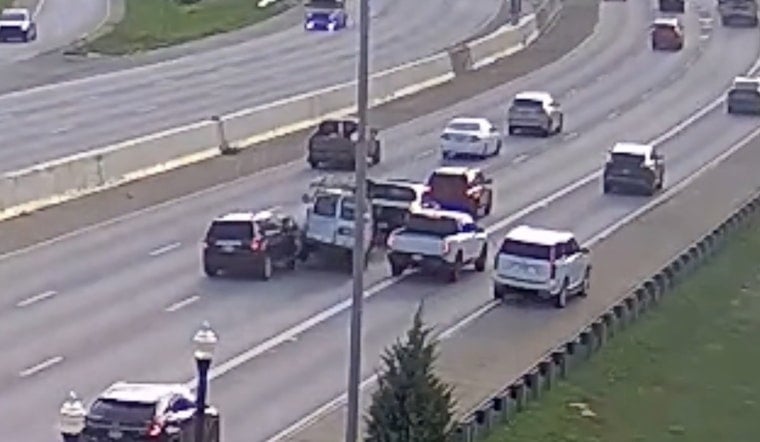
A red SUV came to a stop in the middle of the right lane on Interstate 670 near an exit in Columbus around 7 p.m. Tuesday, triggering a rear-end crash and several near-misses before driving away from the scene. Traffic-camera video captured the moment a following car slammed into the back of a vehicle stopped behind the SUV, while a tanker truck nearly collided with traffic trying to avoid the pileup.
The Ohio Department of Transportation shared the traffic-camera footage in a social media post, and as reported by NBC4 WCMH-TV, an ODOT spokesperson said the incident was another reminder not to stop on the freeway when a driver misses or is confused about an exit. The agency reminds motorists to use the next exit to turn around rather than stopping in a live lane. The crash happened at the I-670 and Neil Avenue interchange in downtown Columbus, according to the station's report.
Cause of the Stop Remains a Mystery
The ODOT spokesperson said the reason the driver stopped in the roadway was unknown, per the same account. What is clear is the outcome: the SUV drove away after causing the crash and the string of close calls caught on camera, the station notes.
The stretch of I-670 near Neil Avenue is no stranger to this kind of hazard. It was selected by ODOT back in 2018 as the state's first pilot site for radar systems built to detect stopped vehicles and wrong-way drivers, sending real-time alerts to the agency's Traffic Management Center whenever a vehicle stops or reverses on nearby ramps, according to 91.7 WVXU. Eastbound I-670 through Columbus also hosts Ohio's first SmartLane corridor, which opened in 2019 to turn the shoulder into an active travel lane during peak afternoon traffic, requiring constant camera monitoring to keep that shoulder clear.
A Pattern Along Columbus Interstates
This is not an isolated occurrence. The NBC4 WCMH-TV report notes that similar incidents happened along Interstate 71 earlier this year, with drivers stopping mid-lane after appearing to miss an exit and causing crashes before driving off. Traffic-camera video from one of those episodes showed several cars nearly colliding, and the ODOT spokesperson said the driver in that case also fled after causing a crash and close calls; one of those drivers had their license suspended as a result.
The danger of stopping in an active travel lane is written into state law. Ohio Revised Code Section 4511.66 prohibits stopping, parking, or leaving a vehicle standing on the main traveled portion of a highway outside business or residence districts, unless the vehicle is so disabled that stopping becomes unavoidable. A driver who causes a crash and then fails to remain at the scene faces separate exposure under Ohio Revised Code Section 4549.02, which makes fleeing after a collision a first-degree misdemeanor punishable by up to 180 days in jail, a $1,000 fine, and a license suspension of six months to three years — penalties that can climb to felony charges if the crash causes serious injury or death.
Deadly Stakes Near the Same Interchange
The risks of stopping in moving freeway lanes near this interchange have already proven fatal. In April 2025, a 22-year-old driver stopped his vehicle in the active lanes of Interstate 71 near the I-670 interchange at 1:39 a.m. and was struck from behind and killed by a semi-trailer truck, as Hoodline previously reported, investigators were unable to determine why that driver had stopped. Just weeks ago, a hit-and-run crash on westbound I-670 near the Neil Avenue exit severely injured a motorcyclist, forcing police to shut down multiple lanes and ramps overnight for reconstruction after a dark sedan forced another vehicle into the rider and fled.
Sudden stops in high-speed lanes also carry a secondary danger: swerving traffic. ODOT safety guidelines indicate that fixed-object impacts, such as vehicles striking guardrails, concrete barriers, or sign supports after swerving, account for roughly 26 percent of all studied crashes statewide. When one car stops unexpectedly, the driver behind is often forced into a split-second choice between a rear-end collision or a swerve toward the shoulder or median.
Finding a Fleeing Driver Is No Easy Task
Nationally, the hit-and-run problem has been worsening. Police-reported hit-and-run collisions across the United States topped 900,000 in 2023, causing more than 240,000 injuries and 2,872 deaths, according to a research brief from the AAA Foundation for Traffic Safety — the highest share of hit-and-run fatalities ever recorded in the country. Locally, Franklin County already logs heavy traffic-enforcement activity; it recorded more contacts than any of Ohio's 88 counties during the 2025-2026 New Year's holiday enforcement period, with 464 logged by state troopers.
Identifying drivers who stop and flee remains a persistent challenge for investigators, since ODOT's high-mounted traffic cameras are built to capture wide-angle traffic flow rather than sharp, readable license plates. That gap typically pushes law enforcement to lean on tips submitted through Central Ohio Crime Stoppers, which coordinates an anonymous reporting system across six central Ohio counties, including Franklin, offering cash rewards for information that leads to an arrest in hit-and-run cases. As of this report, it remains unknown whether the driver of the red SUV involved in Tuesday's crash has been identified.





