

























































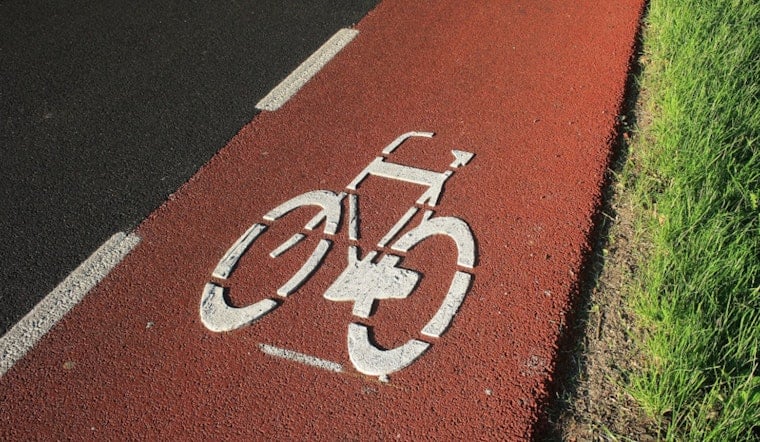
Durham cyclists riding along Martin Luther King Jr. Parkway and West Main Street are about to get a lot more protection than a few plastic sticks poking out of the pavement. The Durham City Council approved a contract on August 3 for concrete and vertical safety barriers covering nearly three miles of existing bike lanes, part of a construction push the city says will begin soon at locations across town.
The project covers 2.1 miles of Martin Luther King Jr. Parkway, running from Hope Valley Road to Fayetteville Street, and 0.6 miles of West Main Street between 9th Street and Buchanan Boulevard, according to INDY Week. The West Main Street segment runs directly along Duke University's East Campus. The City of Durham says the more than $1.4 million investment is meant to make biking safer and more comfortable for riders of all experience levels, with the upgrades including physical barriers, pavement markings, wayfinding signs, and traffic calming features. Residents can find more project details at durhamnc.gov/3034.
Why These Two Corridors Made the Cut
Martin Luther King Jr. Parkway and West Main Street both sit on Durham's “high-injury network,” a designation drawn from the city's Vision Zero Action Plan presented to the City Council in March 2025, per the same INDY Week report. Vision Zero is the city's effort to eliminate traffic deaths and severe injuries on its streets, and identifying which roads carry the most risk has shaped where the new barriers are going first.
Along MLK Jr. Parkway specifically, planned upgrades include concrete curbing, flexible posts, green pavement markings at driveways and intersections, and a redesigned protected intersection at South Roxboro Street, a spot city traffic planners have flagged as a high-risk crossing, the outlet reports. Those design choices target exactly the kind of conflict points where cars and cyclists most often collide.
Ditching the Flex Posts for Good
The new barriers amount to a quick-build pilot program meant to move Durham away from its longtime reliance on plastic reflective flex posts. City project documentation notes those posts came with high ongoing maintenance costs, offered only low physical protection, and were not particularly attractive to look at, according to the City of Durham. Design consultant AtkinsRéalis began engineering work on the pilot back in September 2024, well before Tuesday's council vote finalized the contract.
Bike Durham Executive Director John Tallmadge told INDY Week that physical concrete curbs increase the safety buffer against distracted drivers while giving hesitant residents the confidence to ride in dedicated lanes. Bike Durham is the city's leading active-transportation advocacy nonprofit, and Tallmadge's comments reflect a broader argument among safety advocates that painted lines alone do little to stop drivers from drifting into bike lanes.
A Bigger Push Beyond the Two Corridors
The $1.4 million investment doesn't stop at MLK Jr. Parkway and West Main Street. It also funds Phase II of Durham's Neighborhood Bike Routes project, which will build roughly 11 miles of bike boulevards on lower-speed streets starting this year, following Phase I's 7-mile completion in the summer of 2024, per the city. Phase I was funded through a federal CMAQ grant paired with a city match.
The city and Durham County also finalized the Durham Bike+Walk Plan 2026 for adoption this spring, updating a 2017 master plan that originally laid out 75 priority walking and cycling projects, according to Engage Durham. Durham currently holds a Silver Bicycle Friendly Community designation from the League of American Bicyclists, effective from 2023 through 2027, a national benchmark that evaluates community engineering, education, and encouragement efforts.
What's Still Ahead Downtown
Looking further out, Durham is designing protected bike lanes and traffic calming measures across three downtown corridors — Foster/Corcoran/Blackwell streets, Club Boulevard, and Chapel Hill Street — under its Durham Bike Facilities II project, targeting a 2027 construction start. Preliminary designs for that project were engineered by Mead & Hunt using local Capital Improvement Plan funds, the city notes.
The current round of barrier work builds on years of city spending toward street safety. In its proposed fiscal year 2025 budget, Durham allocated $500,000 to Vision Zero safety initiatives alongside $1.2 million from its Capital Improvement Plan to study converting Roxboro and Mangum streets, both major one-way corridors through central Durham, into two-way streets, according to INDY Week's earlier reporting. Hoodline previously covered public input sessions on downtown bike lane proposals, and also reported this summer on the West Trinity Avenue protected bike lane tied to the South Ellerbe Creek wetland construction project. Together, the projects point to a city trying to convert years of planning documents into pavement, curb by curb.





