

























































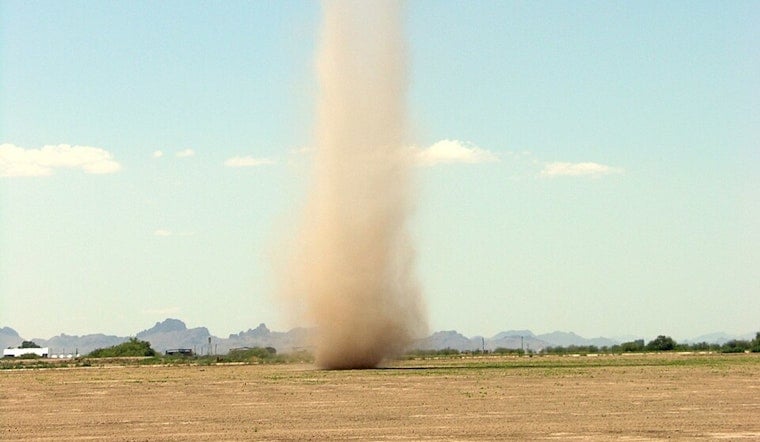
A dust devil twisted across an open field in San Antonio this week, a small but photogenic reminder of just how hard the sun has been hammering South Central Texas lately. The spinning column of dirt and debris formed under the kind of blistering, dry conditions that have defined the region's mid-August stretch, with daily highs climbing well past the seasonal norm.
The sighting was reported by KSAT meteorologist Sarah Spivey, who explained that dust devils are most likely to show up in open fields, where bare or lightly vegetated ground heats up faster than areas covered in grass or trees. That rapid heating is exactly what has been happening across the San Antonio area, where the National Weather Service has recorded daily highs of 100°F to 104°F in mid-August, well above the normal range of 96°F to 97°F for this time of year, with heat index values peaking as high as 111°F.
How the Ground Builds Its Own Miniature Storm
According to the station's report, the physics behind a dust devil are straightforward once the sun does its work. The ground absorbs solar heat and warms the air sitting just above the surface, and that warm air begins to rise, creating a small, localized pocket of low pressure near the ground. Surrounding air rushes in to fill that gap, and as it does, it starts to circulate — picking up loose dust and dirt along the way, which is what finally makes the swirling column visible to onlookers.
As long as the ground keeps heating up, the spin tends to keep going, per the same account. That mechanism is fundamentally different from how a tornado forms. The National Weather Service defines a dust devil as a small, rapidly rotating whirlwind that grows upward from the ground under clear, dry conditions, whereas tornadoes descend downward out of thunderstorm clouds. Dust devils also tend to form along boundaries where surface types contrast sharply, such as dark pavement next to dry soil or irrigated land beside a dirt road, since those temperature differences accelerate the rising air.
Small, Short-Lived, and Usually Harmless
Most dust devils are modest in scale. The National Weather Service notes that typical examples range from just 10 to 300 feet across and stand 500 to 1,000 feet tall, lasting only a few minutes before dissipating. San Antonio's dust devil fits the pattern KSAT described as usually harmless, and the article notes that these whirlwinds very rarely cause damage, with wind speeds that generally stay below 45 mph.
Stronger desert whirlwinds elsewhere can occasionally reach several thousand feet tall with sustained winds of 60 to 75 mph, according to the National Weather Service, and the UK's Met Office has documented rare instances of such powerful whirlwinds lifting unanchored bouncy castles, tearing off loose roofing, and toppling light structures. Nothing close to that intensity was reported with the San Antonio sighting, but the comparison shows how much variability exists within a phenomenon most people write off as a curiosity.
Real Risks Hiding in a Harmless-Looking Swirl
Despite their generally benign reputation, dust devils carry documented hazards in specific settings. The National Transportation Safety Board warned in a 2024 safety alert that dust devils, which can remain invisible until they pick up loose dirt, have been involved in more than 170 aviation accidents investigated since 1982, creating sudden low-altitude turbulence, uncommanded roll or yaw, and rapid loss of lift for aircraft. Similar caution applies on the ground: transportation officials advise drivers who encounter blowing dust to pull completely off the paved roadway, switch off their vehicle lights, set the emergency brake, and keep their feet off the brake pedal so trailing vehicles do not mistake them for a moving car and rear-end them, guidance Hoodline previously covered in connection with an Arizona dust storm warning.
Health officials have also flagged a subtler risk. The Centers for Disease Control and Prevention and the National Weather Service warn that blowing dust and soil-disturbing whirlwinds in dry regions can lift particulate matter and fungal spores such as Coccidioides, which can cause Valley fever when inhaled — a concern Hoodline detailed earlier this summer in coverage of a CDC alert for Phoenix.
A Stranger Cousin, Millions of Miles Away
The science behind dust devils extends well beyond backyard curiosities. NASA researchers reported in late 2025 findings, published in Nature, showing that triboelectric friction between swirling dust grains inside dust devils generates high-voltage static electricity strong enough to produce tiny electrical sparks and acoustic crackles — the same basic static buildup people feel after shuffling across a carpet before touching a doorknob. On Mars, NASA's long-term rover observations found that passing dust devils occasionally delivered natural cleaning events, sweeping accumulated dust off solar panels and boosting electrical output by as much as 70%, a phenomenon that helped extend the Spirit and Opportunity rovers' missions years beyond what engineers originally expected.
Back on Earth, San Antonio's brief whirlwind was never going to threaten planes, drivers, or rooftops. It was, by every account, a fleeting spin of dust across a hot field — a small visual payoff from a summer that has otherwise just felt relentless.





