

























































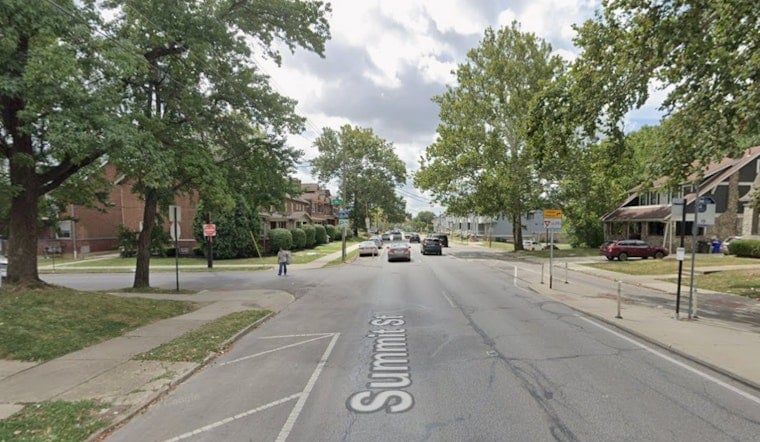
An e-bike rider was left in critical condition with life-threatening injuries after a van turning onto Summit Street struck him in Columbus's University District Thursday afternoon, throwing him from his bike. The crash happened at approximately 2:28 p.m. at the intersection of Summit Street and East 18th Avenue, where the rider was traveling northbound in the protected bike lane when a white 2010 Ford E-250 turning right to head southbound on Summit Street failed to see him and struck him.
The rider was initially transported to OhioHealth Grant Medical Center in stable condition but was later listed in critical condition, according to myfox28columbus.com. The outlet reports the Ford E-250 had been traveling eastbound on East 18th Avenue before the driver attempted the turn, and that the city's Accident Investigation Unit responded to the scene and opened an investigation. Anyone with information about the driver or vehicle is asked to call the Accident Investigation Unit at (614) 645-4767.
The crash occurred at a spot where Columbus's traffic engineering creates an unusual demand on drivers' attention. Summit Street carries motor vehicle traffic one-way southbound, but it also holds Ohio's first protected two-way cycle track north of 11th Avenue, meaning bicycles and e-bikes can legally travel both northbound and southbound along the street's east side. That design, built in 2015 to separate cyclists from car traffic, according to the Greater Ohio Policy Center, means a driver turning right onto Summit from a side street like East 18th Avenue must check for bike traffic moving against the flow of cars, not just with it.
What Ohio Law Requires of Turning Drivers
Under Ohio Revised Code § 4511.39, drivers making a turn across a bike lane or into an intersection are required to exercise due care and yield the right-of-way to bicyclists traveling through in either direction. It remains unclear whether the driver will face citations under that statute, and the seed report from myfox28columbus.com did not indicate any charges had been filed as of Thursday night.
The rider's e-bike class was not specified in available reporting. Under Ohio Revised Code § 4511.522, e-bikes with motors of 750 watts or less are legally treated as bicycles rather than motor vehicles, meaning riders do not need a license, registration, or insurance to use them in public bike lanes, per Sugarcreek Township. Ohio's three-tiered e-bike framework caps motor-assisted speeds at 20 mph for Class 1 and Class 2 bikes and 28 mph for Class 3 bikes, with Class 3 riders required to be at least 16 years old and wear a helmet, according to the Ohio Department of Natural Resources.
A Corridor Already Under the City's Microscope
The crash lands squarely amid a burst of municipal activity aimed at making Summit Street and its parallel corridor safer for people outside of cars. Just a week before the collision, the City of Columbus launched a quick-build test project at key intersections along Summit Street and 4th Avenue, deploying temporary traffic control tools meant to let engineers evaluate rapid safety changes before committing to permanent construction, according to Engage Columbus. Weeks earlier, on July 27, the city had opened its longest protected bike lane along the adjacent North 4th Street corridor, a project spanning more than two miles and funded largely by an Ohio Department of Transportation safety grant.
The two streets' high-speed, multi-lane layout traces back to the 1950s, when Summit Street and North 4th Street were converted into one-way thoroughfares during construction of Interstate 71 to move commuter traffic quickly through the area, according to the Short North Gazette. That configuration has fueled decades of community debate over vehicle speeds and pedestrian safety, with civic groups periodically pushing for traffic calming or a return to two-way streets.
Part of a Wider Pattern of Risk
Citywide data underscores why officials have focused resources on corridors like Summit Street. Vision Zero Columbus reports that half of all traffic fatalities in the city involve a vulnerable road user — a category that includes pedestrians, bicyclists, and motorcyclists. In 2024 alone, Columbus logged 115 traffic incidents in which a pedestrian or bicyclist was killed or seriously injured, based on Ohio State Highway Patrol data cited by O'Connor Acciani & Levy, with Franklin County consistently leading the state in such crashes.
The trend extends well beyond Columbus. Research published in April by Florida Atlantic University found that while total annual U.S. traffic fatalities have held roughly steady around 40,000 since 2000, pedestrian and bicyclist deaths nationwide have surged by 68 percent over that same period, with researchers pointing to commercial development along high-speed, multi-lane roads as a key factor elevating crash risk.



