

























































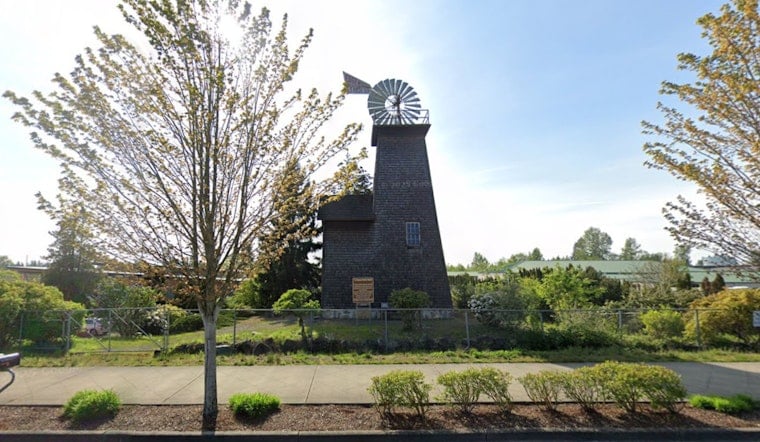
Construction crews have already poured a new foundation next to Edgewood City Hall, the first visible sign that the city's 124-year-old Nyholm Windmill is finally on the move. The four-story timber landmark, a fixture along Meridian Avenue East since Danish immigrant Peter Nyholm built it in 1902, is set to be lifted from its cramped current lot and relocated across the street by fall.
According to the News Tribune, the windmill currently sits at 2284 Meridian Ave. E, on a small lot with limited access and only a few parking spaces. The site work and foundation across the street are already finished, and the paper reports Edgewood is currently out to bid on a relocation contractor, with a selection expected in the coming weeks. Once the windmill is set on its new foundation, the city plans to begin re-siding work and finish concrete for a surrounding plaza.
Mayor Dave Olson, who took office in January 2024 under the city's strong-mayor governance model, personally negotiated Edgewood's purchase of the landmark, according to the City of Edgewood. Edgewood bought the windmill from the Edgewood-Nyholm Windmill Association, which had cared for and maintained the structure for four decades, per the News Tribune's report. The city paid $125 for it in 2024 — a price deliberately chosen to match what Nyholm himself paid for the windmill kit back in 1902.
A Sears Catalog Purchase Turned City Landmark
Nyholm arrived in Edgewood in 1895 after emigrating from Denmark, and bought property in the area a couple of years later, eventually building one of North Hill's primary dairy, hay, fruit, and vegetable farms, according to Airbnb's local historical summary. In 1902, he ordered a windmill kit through the Sears, Roebuck & Co. catalogue, complete with blades and gear assembly, and had the lumber for the tower milled locally, the News Tribune reports. Sears catalogs of that era devoted multiple pages to farm windmills, selling complete kits and wheels for $15 to $60 before rural electrification reached isolated farming communities, according to the Lowell Public Library.
The finished structure did more than pump water. It drew water up to a large holding tank at the top of the tower, which then supplied nearby homes, the News Tribune notes. The windmill originally stood near the intersection of Meridian Avenue and Jovita Boulevard, not far from where it sits today.
Saved Once Already, By a $5 Parade Permit
This will not be the windmill's first trip down the road. In 1980, locals moved the structure to its current location to save it from demolition, according to the News Tribune. Pierce County issued a $5 parade permit to allow the relocation, an arrangement that underscores just how grassroots the effort was at the time.
Since then, the tower has stood as Edgewood's first landmark and formal civic symbol, its silhouette woven into the city's identity. Edgewood itself did not incorporate as a city until February 28, 1996, growing from rural farmland into a municipality of 12,327 residents by the 2020 U.S. Census, per Wikipedia. The windmill predates the city itself by nearly a century.
State Funding and a Busier Meridian Avenue
The relocation is being financed in part by state money. Edgewood was awarded a $114,000 state grant in June 2025 to relocate and refurbish the windmill, the News Tribune reports, while separate research on Substitute House Bill 1216 shows the state capital budget designated $117,000 specifically for the Nyholm Windmill Relocation and Restoration project. The project scope covers the labor, materials, and equipment necessary for the move itself.
Part of the rationale for the move is simple traffic safety and access. Meridian Avenue East, also known as State Route 161, has been widened from two to five lanes over the years to handle growing South Sound commuter traffic, making it Edgewood's primary commercial thoroughfare. Shifting the windmill off that corridor and onto the City Hall campus is expected to provide more parking and easier public access than the landmark's current cramped lot allows, per the News Tribune.
A Plaza, a Buy-a-Brick Program, and Wind Power
Once the windmill is set on its new foundation, Edgewood plans to build a small plaza around it with benches and seating areas, according to the News Tribune, and the city intends to incorporate a buy-a-brick element into that plaza design. City officials expect the new site to support field trips for local students, photo opportunities, and general public viewing in a way the old, hard-to-reach location could not.
Olson said in a Facebook post that he has fielded plenty of questions about the construction activity next to City Hall, and is separately researching a wind-generated electricity station to power lights on the windmill itself, the News Tribune reports. Edgewood hopes to have the windmill physically moved by the end of September, with officials targeting fall 2026 for the actual relocation.



