

























































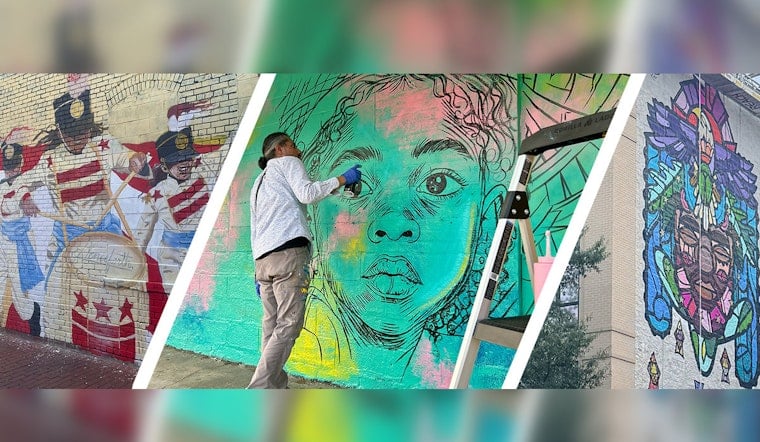
Washington's commercial corridors are getting a fresh coat of civic pride this summer, as new murals go up in all eight wards under a project tying the District's history to America's 250th anniversary. The initiative, called DC250, pairs eight D.C.-based artists with landmark walls from U Street to Southeast, each piece meant to connect a neighborhood story to the national milestone.
Mayor Muriel Bowser officially launched the DC250 Mural Project on July 13, 2026, commissioning one mural per ward as part of the District's lineup of events marking the 250th anniversary of the United States, according to Mayor Muriel Bowser's Official Website. The project is being highlighted by the DC Department of Public Works as connecting the city's story to the national celebration, with murals designed to feature neighborhood landmarks and local legends. NBC4's Tommy McFly has been offering viewers a closer look at the murals and the artists behind them as part of the department's public outreach.
Ben's Chili Bowl Gets a New Chapter
One of the most closely watched sites is Ben's Chili Bowl at 1213 U St. NW in Ward 1, assigned to artist Aniekan Udofia to depict themes of the American Dream and honor founder Ben Ali, an immigrant from Trinidad, per Secret DC. Udofia previously painted the restaurant's well-known 2017 mural featuring prominent Black cultural figures, making his return to the U Street landmark a continuation of that visual legacy rather than a clean break from it.
Other selected locations round out the ward-by-ward map: the Blagden Alley entrance in Ward 2, where artist Julia Kagan is working; Macomb Recreation Center in Ward 3, assigned to Demont Pinder; 5816 Georgia Ave. NW in Ward 4, given to Federico Frum, known as Mas Paz; Shrimp Boat Plaza in Ward 7; and the Southeast Tennis & Learning Center in Ward 8, according to the DC Department of Public Works. The spread of sites, from a historic downtown alley to a Southeast tennis facility, was designed to ensure artistic representation reaches diverse neighborhoods rather than clustering downtown.
How the Grants and Wall Donations Work
These installations fall under the umbrella of MuralsDC, the DC Department of Public Works program created in 2007 to deter illegal graffiti while beautifying commercial corridors. Since its founding, the program has facilitated the creation of nearly 200 public murals across all eight wards of the District, per Secret DC. Grant awards for individual MuralsDC projects range from $7,500 to $35,000 per installation, with funding levels determined by wall size and structural complexity, according to the DC Commission on the Arts and Humanities.
Property owners who sign release agreements donating wall space pay nothing out of pocket. The program provides full funding for design, equipment, supplies, and installation on eligible commercial or multi-unit residential buildings, the department explains, while artists retain creative control over execution based on community input.
A Program With Deep Civic Roots
MuralsDC has leaned on large-scale, politically charged projects before. In June 2020, the program completed #MuralsDC51, commissioning and executing 51 public murals across all eight wards in a single week to advocate for D.C. statehood and highlight social justice themes, timed to coincide with a U.S. House vote on statehood. Since 2007, the initiative has also engaged more than 200 youth apprentices and volunteers aged 14 to 23, who work alongside lead artists on site to learn aerosol painting techniques.
Local historians and community muralists have long argued that D.C. street murals function as accessible political speech and public education, meeting residents where they already are on city sidewalks, according to AWOL. That framing helps explain why organizers chose hyper-local landmarks like Ben's Chili Bowl and Shrimp Boat Plaza for the DC250 series rather than more generic downtown sites — the murals are meant to carry neighborhood memory as much as national commemoration.



