

























































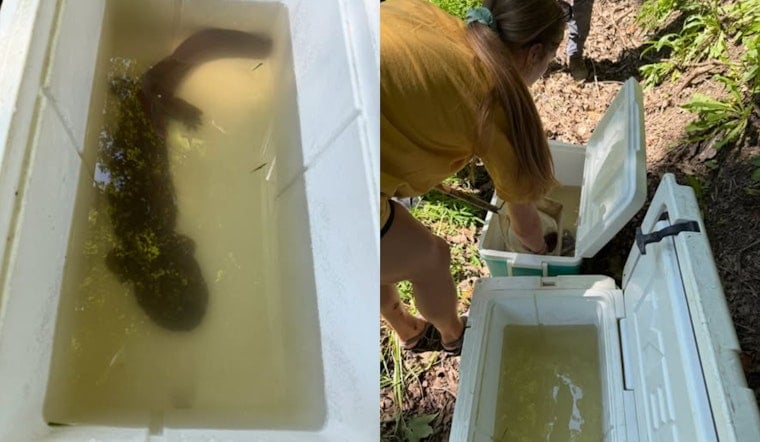
A road repair crew working on a retaining wall along the Ohio River in Belmont County had to down tools for two full days after an eastern hellbender, one of the nation's rarest and largest salamanders, wandered directly into the active job site. The endangered amphibian's unexpected appearance triggered a carefully coordinated rescue involving state wildlife biologists and, ultimately, the Columbus Zoo and Aquarium.
The discovery happened at an active retaining wall repair project in eastern Ohio, near the Ohio River and the West Virginia border, according to The Columbus Dispatch. Once the Ohio Department of Transportation crew spotted the animal, they stopped work and contacted the Ohio Department of Natural Resources Division of Wildlife for guidance on safely relocating it, per the same account. A team of experts needed two days and several failed attempts before they managed to capture the male hellbender.
That kind of work stoppage is not optional. The eastern hellbender is classified as a state-endangered species under Ohio Administrative Code 1501:31-23-01 and Ohio Revised Code Section 1531.25, according to the Ohio Department of Natural Resources, meaning public agencies and contractors must halt work and coordinate a relocation whenever a specimen turns up on a project site. Under Ohio Revised Code Chapter 1531, unlawfully taking, harming, or possessing a state-endangered animal is a criminal offense that can carry fines, jail time, and mandatory civil restitution to the state based on the animal's ecological value.
A Species on the Brink, Now Facing Federal Review
The stakes behind the pause go well beyond one construction schedule. Wildlife surveys conducted by state biologists found that Ohio's eastern hellbender population fell by an estimated 82% in relative abundance between the mid-1980s and late 2000s, driven largely by siltation, dam construction, and pollution, according to WOSU Public Media. The decline is not unique to Ohio. Across its 15-state eastern U.S. range, the U.S. Fish and Wildlife Service estimates that 41% of historical hellbender stream populations have been extirpated and another 36% are in decline, primarily due to sedimentation from land disturbance and river impoundments.
In December 2024, the U.S. Fish and Wildlife Service officially proposed listing the eastern hellbender as federally endangered range-wide under the Endangered Species Act, a move that reflects federal findings that habitat degradation has pushed the species toward extinction. If finalized, that federal designation would layer even stricter review and mitigation requirements onto future infrastructure work near eastern Ohio waterways, adding to the state protections already in force.
Ohio's Only Wild Breeding Population Lives Nearby
Belmont County carries outsized ecological weight for the species because it contains the Captina Creek watershed, an Ohio EPA Outstanding State Water that holds Ohio's only known wild breeding population of eastern hellbenders, according to the Captina Conservancy. Captina Creek's clean water and stable rock cover provide the conditions the salamanders need for natural nesting, which is part of why a stray hellbender on a nearby job site is treated as more than a curiosity.
After the rescue team finally captured the male hellbender, they turned it over to the Columbus Zoo and Aquarium, which will care for the animal until conditions are right for a possible return to its home waterway, the Dispatch reports. The Ohio Department of Natural Resources wrote that wildlife should be prioritized and that agency partnerships can accomplish strong results, according to the same report.
Head-Started Salamanders Are Breeding in the Wild
The Columbus Zoo has operated a hellbender recovery program for more than a decade, and along with The Wilds, has raised young hellbenders from eggs for more than ten years as part of the broader Ohio Hellbender Partnership. Established in 2011, the partnership collects wild eggs and hand-rears juvenile salamanders for three to four years at zoos before releasing them into eastern Ohio streams, a protocol detailed by the Columbus Zoo and Aquarium. Holding juveniles until they are larger dramatically improves their odds of surviving after release.
The partnership includes the Columbus Zoo, The Wilds, Ohio State University, other Ohio zoos, and additional academic and government organizations, and it leads the statewide recovery effort. Ohio has received more than 2,000 released hellbenders since 2012, and the Columbus Zoo alone released 116 eastern hellbender salamanders into protected eastern Ohio waterways in 2025. The Wilds returns its raised hellbenders primarily to streams in West Virginia, while Columbus Zoo places its animals in high-quality habitats in eastern Ohio.
During the 2023 field season, researchers confirmed for the first time that head-started, captive-reared hellbenders released into Ohio streams had successfully reproduced in the wild, a milestone that suggests the reintroduction program is building a self-sustaining population rather than simply propping up a shrinking one. Local schools have joined the effort too. Indian Creek High School in Wintersville operates a classroom rearing facility for juvenile hellbenders and is the only public high school in the partnership, according to The Herald Star.
What Makes a Snot Otter Worth Protecting
Nicknamed the snot otter for its thick mucus coating, the eastern hellbender is North America's largest amphibian and Ohio's largest salamander, typically measuring 11.5 to 20 inches long, though it can grow up to two feet in length. It prefers large, fast-moving streams with clean, oxygen-rich water, hiding under rocks during the day and feeding on crayfish, snails, minnows, insects, and worms. Because it is so sensitive to pollution, its presence or absence serves as an indicator of overall waterway health.
The species reproduces in August and September, when females lay as many as 500 eggs in nests males dig beneath flat rocks on the streambed, meaning this summer's rescue landed right in the heart of hellbender breeding season. Recovery teams monitor eggs in a laboratory until hatching, then hand-rear the young and tag them for tracking before eventual release. In Ohio, the species is found mostly in the southern and eastern parts of the state, with Belmont County's Captina Creek standing out as the last known refuge for natural wild breeding.
The Ohio Department of Natural Resources has leaned into the species' quirky profile as a way to build public interest in its conservation. To mark its 75th anniversary in 2024, the agency put a hellbender on a t-shirt bearing the slogan Hellbenders Are Real, a nod to the well-known Hell Is Real sign along Interstate 71 between Cincinnati and Columbus. The shirts have sold out and been reordered several times.





