

























































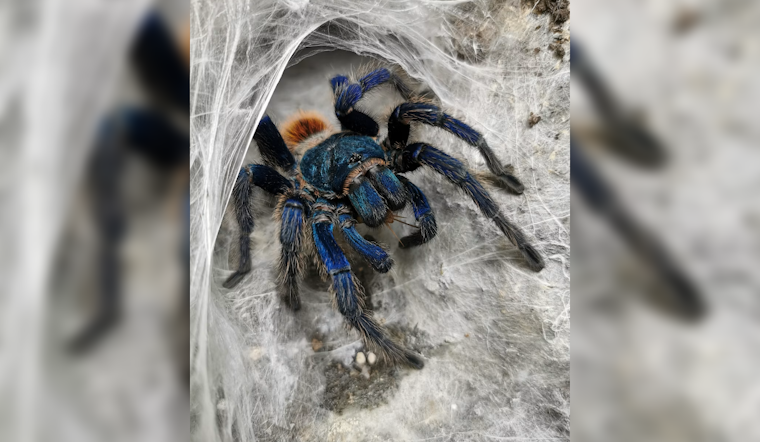
The butterflies fluttering around the Natural History Museum of Los Angeles County's outdoor pavilion have less than two weeks left before their enclosure gets a very different tenant. The Butterfly Pavilion, home to up to 30 species of the winged insects, closes for the season on August 23, and by September 20 the same tent in Exposition Park will be crawling with roughly 300 spiders instead.
The seasonal swap is a well-established rhythm at the museum, according to NBC Los Angeles, which reports that the Spider Pavilion runs through December 6 and will feature species including the bold jumping spider, the spinybacked orbweaver, and the green lynx spider. Visitors can also explore a spider den stocked with habitats, and museum docents and staff are on hand throughout the exhibit to answer questions, per the same report. The pavilion will be closed on Thanksgiving Day, and tickets are still available for Halloween, adult admission runs $10, and the exhibit requires separate tickets on top of general museum admission.
Museum members get first crack at the arachnids during preview days on September 18 and 19, ahead of the public opening.
Where the Spiders Go When the Season Ends
The orb weavers spinning webs freely inside the open-air tent are not permanent residents. When each Spider Pavilion season wraps up, museum staff carefully collect the roughly 300 free-roaming specimens and either return them to their native habitats or transfer them to partner institutions, according to a video from David Vaughn.
The timing lines up with more than just Halloween. The pavilion's autumn run coincides with Southern California's natural tarantula mating season, which stretches annually from August through November as male tarantulas roam regional open spaces in search of mates, according to Beverly Press & Park Labrea News. Native tarantulas are largely harmless to humans despite their intimidating appearance, the outlet notes. One of the pavilion's marquee species, the golden silk orb weaver, earns its name from natural yellow pigments in its silk that make its webs glow with a golden hue under direct light, according to the Fernbank Museum.
A Bigger Scientific Mission Behind the Seasonal Attraction
The Spider Pavilion is not just a Halloween-season novelty for the Natural History Museum. It ties into the museum's ongoing L.A. Spider Survey, through which community scientists across Greater Los Angeles have submitted more than 4,000 spider specimens, helping researchers catalog 217 distinct species across 36 families, according to the Natural History Museum. Residents send specimens directly to the museum's entomology department as part of the effort.
That community-driven research connects to a broader picture of urban biodiversity around Los Angeles. A July 2024 study led by researchers at USC and the museum, drawing on backyard sampling through the museum's BioSCAN initiative, found that arthropod biodiversity in L.A. backyards is primarily driven by proximity to mountains and year-round temperature stability, according to USC Dornsife.
Free Afternoon Admission and Other Fall Programming
Los Angeles County residents can get into the museum's standard exhibits for free Monday through Friday between 3 and 5 p.m., though the Spider Pavilion still requires a separate add-on ticket, per the Natural History Museum. General admission is also free daily for California teachers, active military members, and EBT cardholders, the museum notes.
The Spider Pavilion is one piece of a busier fall calendar at the museum, which also hosts the annual Haunted Museum family event featuring insect-themed scavenger hunts and direct interactions with museum scientists, according to Beverly Press & Park Labrea News. The museum has also expanded its physical footprint recently, opening the $75 million, 75,000-square-foot NHM Commons in November 2024, a community hub with a 400-seat theater and a glass-walled public plaza designed by Frederick Fisher and Partners with landscape by Studio-MLA, according to the Natural History Museums of Los Angeles County.
The museum first opened in 1913 as a Beaux-Arts landmark anchoring Exposition Park's 160-acre cultural grounds, according to Studio-MLA. Today it sits in a dense cultural corridor alongside the completed Samuel Oschin Air and Space Center space shuttle pavilion and the upcoming shuttle shrine next door, part of a park that draws heavy regional visitor and field trip traffic year-round.





