

























































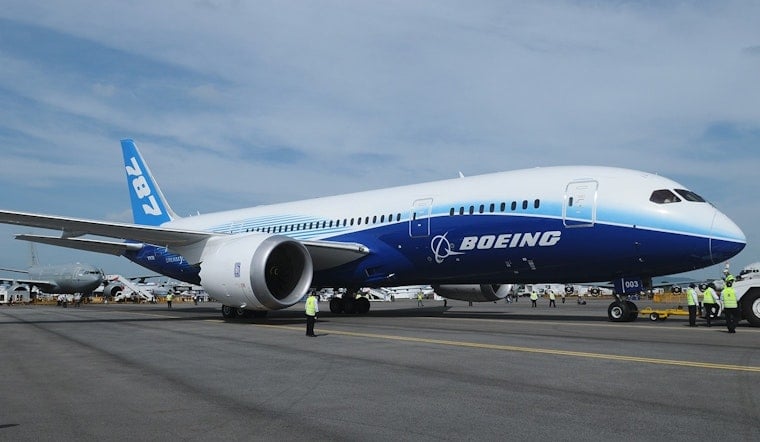
The Federal Aviation Administration has ordered inspections of certain structural components on some Boeing 787 Dreamliners after regulators warned that undetected fatigue cracks could grow and weaken the wing. The final airworthiness directive applies to 17 Boeing 787s operating in the United States and 77 worldwide, a small slice of Boeing's global 787 fleet of more than 1,100 aircraft.
The order, formally designated AD 2026-17-02, mandates repetitive ultrasonic and detailed visual inspections of lower side-of-body splice plates, rear spar terminal fittings, lower chords, front spar terminal fittings, and jack pads on affected 787-8, 787-9, and 787-10 jets, according to the Federal Register. The FAA followed a proposed inspection rule it issued in March 2026, as first reported by The Seattle Times. Per the FAA's directive, undetected cracks could prevent the primary wing structure from sustaining its design limit load, potentially compromising continued safe flight and landing.
The compliance costs are not trivial. The FAA estimates the inspections will run U.S. airlines up to $24,310 per cycle per aircraft, totaling as much as $413,270 per cycle across the 17 U.S.-registered jets, per Investing.com. United Airlines and American Airlines, along with the Foundation for Aviation Safety, both submitted formal comments during the FAA's public comment period that followed the March 2026 proposal, the outlet reports.
A Manufacturing Flaw Traced Back to Assembly Shims
The root problem, according to the same report, stems from assembly preload forces where gap-filling shims exceeded engineering tolerances, forcing assembly workers to apply excessive pull-up forces that created mechanical stress around fastener holes. A shim fills the space between aircraft parts before fastener installation, and a shim gap forms when mechanics join two aircraft parts together. Per the FAA's directive, Boeing's own investigation found that these high pull-up forces may cause fatigue cracks at fastener holes, with the investigation focused on the lower side-of-body splice plates near the wing skins.
Boeing first identified the shim-gap concern during a 2019 investigation, which found that some shim gaps exceeded the company's own engineering specifications. Boeing issued an Alert Requirements Bulletin to 787 operators in August 2025 addressing the shim gaps, which provided the technical baseline for the FAA's March 2026 proposed rule and this month's final directive, according to Air Data News. A Boeing spokesperson said the airworthiness directive is the next step in a process that began in 2019, and that the company has since corrected the shim-measurement issue in production.
Boeing Says Fleet Remains Safe
Boeing maintains its jets are safe and that airplanes in the global fleet may continue normal operations. A company spokesperson said Boeing supports making the guidance mandatory through the airworthiness directive and that Boeing had already worked with operators to update their inspection schedules, echoing language cited by The Seattle Times in reporting by Lauren Rosenblatt. Boeing separately says the 787 fuselage gaps pose no risk, and the company has previously addressed concerns about gaps in 787 structures, including a 2025 FAA inspection directive concerning paper-thin gaps in the aft pressure bulkhead — a defect the FAA said could create fatigue cracks that weaken the plane.
The shim-gap saga is not new to the 787 program. Improper shimming and fuselage gap issues have repeatedly disrupted the Dreamliner line, prompting the FAA to halt new aircraft deliveries from May 2021 to August 2022 and again briefly in early 2023, according to Simple Flying. In April 2024 testimony before a U.S. Senate subcommittee, Boeing quality engineer and whistleblower Sam Salehpour alleged that some 787 fuselage gaps at major joins exceeded engineering requirements, claiming workers forced misaligned fuselage sections together in ways that created gap-related stresses, as reported by The Guardian.
New Scrutiny Follows Restored Sign-Off Authority
This directive lands just weeks after the FAA restored Boeing's authority to perform final airworthiness sign-offs on newly built 737 MAX and 787 aircraft, following years of heightened federal oversight, as Hoodline detailed in its report on the FAA restoring Boeing sign-off power. That shift means Boeing now shoulders more responsibility for certifying its own aircraft even as regulators continue mandating repetitive inspections tied to manufacturing flaws first flagged years earlier.
The 787-9, the variant covered under this directive alongside the 787-8 and 787-10, remains a workhorse for carriers flying out of the Pacific Northwest and beyond. Hoodline has previously covered operational incidents involving the jet, including an Alaska Airlines 787-9 that made an emergency U-turn over the Atlantic and a United Airlines 787-9 hit by severe turbulence on a flight from Tahiti to San Francisco. Airlines including Alaska continue expanding 787-9 service from Sea-Tac, even as the fleet-wide inspection mandate moves forward.





