

























































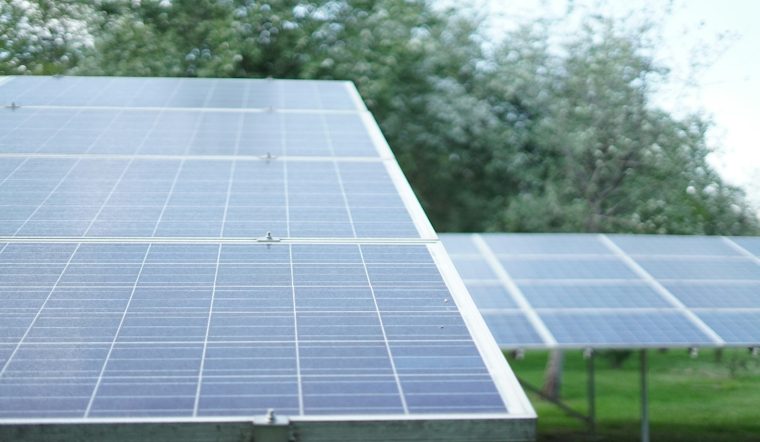
Fairfield Township's board of supervisors has unanimously approved plans for a 12-megawatt solar electric facility on a farm along Fort Palmer Road, clearing a local hurdle for Erie-based GreenKey Development LLC to build the project in four phases on land owned by Bertha V. Martin. The vote came after months of review under the township's 2024 solar power facility ordinance, the primary tool Fairfield uses to regulate energy developments since it has no comprehensive zoning ordinance governing land use.
The three-member board's approval, reported by TribLIVE, followed a public hearing held on June 30. Township supervisors had 45 days after that hearing to render a decision. Paul Altimus told supervisors the application was complete for the township, and officials ultimately selected a revised project plan that meets the requirements of the 2024 ordinance, which includes property-line setback rules.
The Bertha Solar LLC 1, 2, 3 and 4 project will sit on a 112-acre parcel that abuts Fort Palmer United Presbyterian Church, located at the intersection of Fort Palmer Road and Route 711, about seven miles north of Ligonier. While the solar array will span almost 50 acres of the property, GreenKey's actual land use for panels totals only about 13 acres. According to the same report, GreenKey submitted an earlier version of its plan to the county planning department in February before revising it in late March to reduce both land disturbance and tree clearing compared with the original design — a change officials say will also mean less earthmoving overall.
Water and Traffic Worries Dominate Public Comment
Residents who spoke up during the review process focused heavily on the township's lack of municipal water service, since Fairfield relies entirely on private wells. Kathi Becer raised concerns about impacts on residents' water supplies, and GreenKey may agree to test residential well water both before and after construction gets underway, per the TribLIVE report.
Ian Durham, GreenKey's senior land resolution specialist, said he did not believe drilling for panel posts would affect residents' water supplies. Durham also told township officials he would view the solar project as a good thing if it were happening in his own backyard.
Traffic concerns also surfaced repeatedly during the hearing. Russell Davies questioned the disturbance construction and trucks would bring to Route 711, and township records note that construction traffic — an estimated 80 trucks over the course of the project — would travel the gravel stretch of Fort Palmer Road from Route 711 to the Martin farm. Scott Boring, who is involved in maintenance at Fort Palmer United Presbyterian Church, raised his own concerns about vehicles using the church parking lot during construction.
Construction Timeline and Countywide Context
GreenKey plans to work on all four phases simultaneously once construction begins, with the build expected to take about four months. Crews would work 12-hour days on weekdays, possibly some Saturdays, and not on Sundays. The facility itself is described as well buffered from neighboring properties, and it is not connected to the multistate electric transmission grid — instead, the power generated is intended to serve the region.
Construction cannot be scheduled yet, however. Per Durham's own account, a start date remains unknown pending a required review by the Westmoreland County Department of Planning, which under the Pennsylvania Municipalities Planning Code can only begin its technical site plan evaluation now that Fairfield Township supervisors have completed their portion of the review, as detailed by TribLIVE. The Westmoreland County commissioners will also consider the application before the project can move forward.
Not everyone at the hearing was focused solely on water and trucks. Lynn McDermott said she worried the solar project could open the door to more development pressure in Fairfield Township down the road — a concern that echoes broader shifts happening across Westmoreland County, where unzoned rural townships have increasingly turned to solar-specific ordinances rather than full zoning to manage incoming projects.
GreenKey's Recent History With Local Solar Ordinances
Fairfield's approval arrives against the backdrop of GreenKey's rockier experience in neighboring East Huntingdon Township, where the company sued in April 2025 alleging the township's solar ordinance improperly restricted land use in municipalities without general zoning. That dispute ended in March 2026 through a court-approved consent order allowing GreenKey to proceed with solar farms on three East Huntingdon properties while preserving the township's ordinance, according to a report from TribLIVE. In Fairfield, the company instead worked within the existing framework, revising its site plan to fit local rules rather than challenging them.
The regional appetite for solar-specific rules has grown since a 134-acre array built by MN8 Energy in Cook Township began construction in late 2023 without any local zoning oversight, leaving permitting entirely to county conservation officials and prompting resident concerns over rural viewsheds. That experience pushed several unzoned Westmoreland County townships to adopt their own solar regulations under the state Municipalities Planning Code, a trend also visible in Murrysville, where the planning commission forwarded a draft ordinance in July setting 10-acre minimum parcel requirements for large-scale solar and energy storage projects.
Public agencies are getting in on distributed solar too. The Westmoreland County Housing Authority approved plans in November 2025 to lease space at the former State Correctional Institution Greensburg site in Hempfield Township, along with a warehouse rooftop, for a 1.0-megawatt solar facility aimed at cutting long-term electric costs. Those efforts unfold as the Pennsylvania Public Utility Commission voted in December 2025 to open formal rulemaking meant to modernize interconnection rules and ease queue delays for smaller local solar projects, part of a broader state push that included Governor Josh Shapiro's 2024 signing of bipartisan energy legislation featuring the Solar for Schools program amid rising regional electricity prices.





