

























































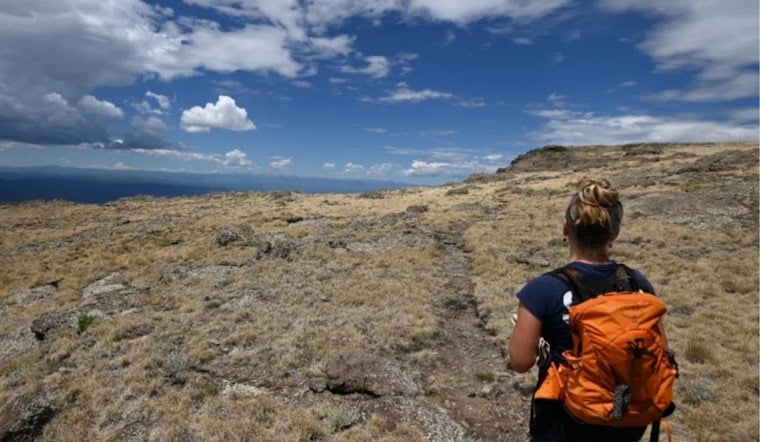
The final mile to the top of Fishers Peak is open again. Colorado Parks and Wildlife lifted its seasonal closure on August 1, restoring public access to the summit trail at Fishers Peak State Park after biologists confirmed that young peregrine falcons nesting on the mesa's cliffs had successfully fledged. The reopening returns hikers to a roughly 16-mile round-trip route with about 3,000 feet of elevation gain, one of the most demanding day hikes in southern Colorado.
According to Governor Jared Polis on Facebook, the falcons raised their young successfully for the fifth consecutive year before the trail reopened, a milestone the governor's office highlighted alongside a photo of the summit taken by Dean Miller of Colorado Parks and Wildlife. The closure itself is not optional or discretionary. Under state administrative regulations recorded by the Colorado Secretary of State, Colorado Parks and Wildlife must maintain a mandatory half-mile buffer around peregrine falcon nests every year from March 15 through July 31, shutting down the Stone Guard, Peak Approach, and Summit Loop trails for more than four months at a stretch.
A Narrow Window to Reopen the Trail
That same set of regulations requires a similar half-mile buffer around designated golden eagle nesting sites at the park, in effect from December 15 through July 15 each year, according to the Secretary of State's filings. Together, the overlapping windows show that peregrine protections are just one piece of a broader raptor conservation effort built into how Fishers Peak operates each year.
As reported by Kiowa County Press, Colorado Parks and Wildlife staff, regional trail specialists, and volunteers from La Veta Trails spent July 29 and 30 clearing encroaching brush and reinforcing rocky trail tread before the public reopening. The work reflects a tight turnaround: park staff and crews are bound by the same access restrictions as everyday visitors during nesting season, so trail maintenance could not begin until biologists had already confirmed the young falcons had fledged and the closure officially lifted.
A Young Park With Deep Ecological Stakes
Fishers Peak State Park itself is a relatively recent addition to Colorado's public lands. The park was created after the 19,200-acre Crazy French Ranch was purchased in February 2019 for $24.5 million through a partnership that included Great Outdoors Colorado, The Nature Conservancy, The Trust for Public Land, Colorado Parks and Wildlife, and the City of Trinidad, according to the Colorado Encyclopedia. Governor Polis officially opened it as Colorado's 42nd state park on October 30, 2020, making it the second-largest state park by land area in the state.
Rising to 9,633 feet, Fishers Peak is recognized as the highest geographical point in the United States east of the longitude line, per the Colorado Natural Heritage Program. The flat-topped basalt mesa looms over the city of Trinidad and has become an iconic backdrop for the region. A multi-year biological inventory conducted by the Colorado Natural Heritage Program in 2019 and 2020 identified 454 plant species, including 13 rare species such as Smith's draba, and more than 174 bird species within the park's boundaries, establishing the scientific baseline that now guides the park's management.
Federal Protections Still Apply
American peregrine falcons were delisted from the federal Endangered Species List in 1999 after their population rebounded from steep mid-20th-century declines tied to the pesticide DDT, but the species remains federally protected under the Migratory Bird Treaty Act, as reported by Newsweek. That continued federal oversight underscores why state closures like the one at Fishers Peak remain a standard, mandatory part of managing the park each year rather than a one-time precaution.
Even with the trail reopened, state regulations governing the park explicitly prohibit visitors from climbing, traversing, or rappelling on or from the summit rock formations, a rule intended to protect both public safety on the peak's vertical cliffs and the fragile nesting habitat those cliffs provide. With the closure lifted and trail crews finished with repairs, visitors can now make the full climb to the summit of Colorado's highest state park, joining what has become an annual rhythm of closing the mountain to protect its falcons and reopening it once the birds are ready to fly on their own.





