

























































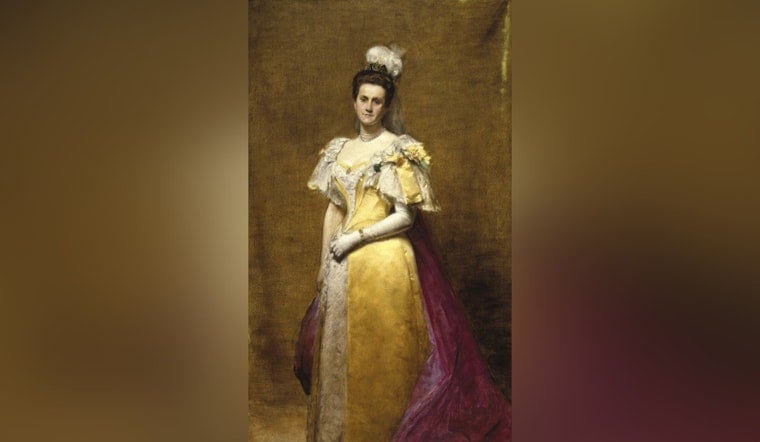
A woman took over one of the 19th century's most dangerous engineering projects with no formal training, kept it running for 11 years, and got almost none of the credit. Now her story has a stage in Fort Greene. The musical Brooklyn's Bridge, chronicling Emily Warren Roebling's secret leadership of the Brooklyn Bridge's construction, is running at The Space at Irondale through August 23.
Roebling was 26 when she stepped into the role and 40 by the time the bridge was finished, according to director Michael Simon Hall, as reported by Brooklyn Paper. She became de-facto leader of the project after her husband, chief engineer Washington Roebling, fell severely ill. He had developed severe decompression sickness in 1871 from working in the bridge's underwater supports, leaving him bedridden and unable to visit the construction site or supervise the work himself. Emily became his sole liaison with the site, ferrying information and instructions between her husband and the crews, gaining a working mastery of engineering and construction along the way, and fighting off efforts to push Washington out of his job entirely.
A Chief Engineer's Job Falls to His Son, Then His Wife
Washington Roebling hadn't planned on running the bridge at all. The original design was his father's, engineer John A. Roebling, who died of tetanus in July 1869 after a foot injury at the site, before construction officially began, according to the National Trust for Historic Preservation. That left Washington as chief engineer for a project that would ultimately take 13 years, starting around 1871, and cost the lives of at least 21 men, most of them immigrants, per Brooklyn Paper's reporting. Thousands of immigrants worked the construction crew overall, and the musical treats that labor force as central to the story rather than background detail.
Hall told Brooklyn Paper that the show's score is “gorgeous, lush, majestic, and soaring,” and described Brooklyn's Bridge as a tribute to the immigrants who helped build New York. That framing surfaces most directly in the number We Built the Bridge, sung by the show's working-class characters. The production features a cast of 10 and four onstage musicians, with Sarah Joyce making her New York City debut in the role of Emily Warren Roebling.
Staged Almost in the Round Inside a Civil War-Era Church
Brooklyn's Bridge is staged almost in the round, with seating on three sides of the performance space, and leans on platforms, scaffolding, and projections layered against Irondale's own architecture to conjure the bridge itself. That architecture carries its own history. The Space at Irondale is housed inside the landmarked Lafayette Avenue Presbyterian Church, built between 1860 and 1862 as an abolitionist sanctuary that hosted speakers including Frederick Douglass and Harriet Tubman, according to Writ Large. Brooklyn Paper notes the building predates the Brooklyn Bridge by roughly a decade, making it, as the paper describes it, an 1800s church contemporaneous with the very era the musical portrays.
The venue itself is a 6,000-square-foot flexible performance hall with 28-to-29-foot ceilings and wraparound balconies on three sides, seating up to 200 patrons, a space Hoodline detailed in its coverage of another production running at Irondale this month. That overlap has turned the Fort Greene church into something of a small theatrical hub this summer, staging two very different stories under the same landmarked roof.
A Long Road From Illinois Workshop to Florida Premiere
Brooklyn's Bridge didn't arrive in New York overnight. According to the Orange County Library System, the musical went through a 2019 workshop at Illinois State University, a 2021 presentation at Montclair State University, and a 2024 concert at Orlando's Dr. Phillips Center before writer Ray Roderick and composer Joseph Baker staged its first full production in Florida in February 2025. That production used 19th-century political cartoonist Thomas Nast, famed for exposing Tammany Hall corruption, as an onstage narrator framing the bridge's 1869-to-1883 construction against Gilded Age political scheming, per the Dr. Phillips Center.
The Brooklyn run has already found an audience: the show nearly sold out its first weekend of performances at Irondale, per Brooklyn Paper. Evening performances run Wednesdays through Saturdays at 7:30 p.m., with matinees Saturdays at 2 p.m. and Sundays at 3:30 p.m., and tickets start at $39.
The Real Emily Roebling's Long-Delayed Recognition
The musical arrives amid a broader reckoning with how history remembers Emily Warren Roebling. When the bridge finally opened, she was given the honor of being the first to ride across it, reportedly carrying a live rooster in her lap as a symbol of victory, according to Untapped New York. On opening day, May 24, 1883, more than 150,000 people crossed the span alongside President Chester A. Arthur and New York Governor Grover Cleveland.
Formal credit came much later. In 1951, the City of New York dedicated a bronze plaque on the bridge honoring Roebling, inscribed with the line that behind every great work is the devoted altruism of a woman. It wasn't until March 2018 that The New York Times published an obituary for her as part of its Overlooked No More initiative, formally correcting the historical omission and crediting her as the driving force who finished the bridge. Roebling herself kept building on the intellectual momentum from her bridge years, later earning a formal law certificate from New York University in 1899 and publishing essays advocating for women's equality.





