

























































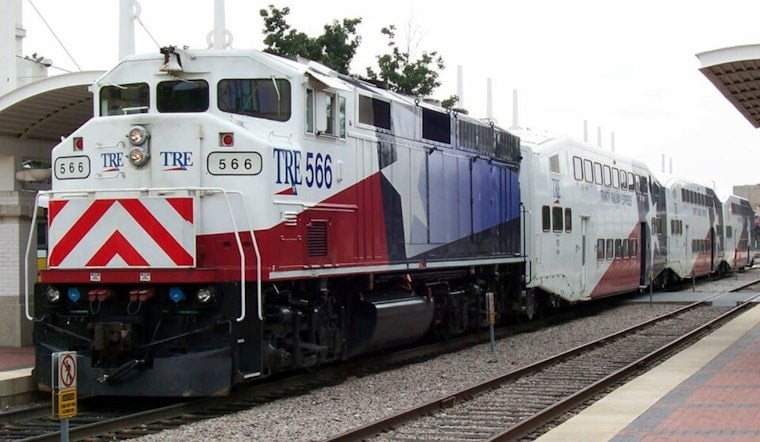
Construction crews are set to break ground next Monday on a $720,000 safety overhaul at the Trinity Railway Express crossing on Riverside Drive in Fort Worth, bringing pedestrian swing gates, new medians, sidewalks and curb ramps to a stretch of track that has seen at least one serious collision in the past. City staff briefed area residents on the plans during a preconstruction meeting on Riverside Drive at the TRE crossing on August 5, according to reporting by Tiffany Toru Johnson.
The project is funded through a combination of Fort Worth's voter-approved 2018 bond program and federal money, as detailed by the Fort Worth Report. That local funding traces back to a $399.5 million General Obligation bond package Fort Worth voters approved in May 2018, which set aside $5 million specifically for municipal railroad crossing safety projects citywide, according to The Business Press. On the federal side, the Texas Department of Transportation and the City of Fort Worth updated Advance Funding Agreement #057854-A2 in July under the Railway-Highway Crossings Program, increasing federal funding to cover 100% of construction costs, per city records.
What's Changing at the Crossing
The scope of work includes pedestrian swing gates, new medians, sidewalks, curb ramps, striping, signage and paving, along with dedicated railroad pedestrian crossings, the same Fort Worth Report account states. The swing gates are designed to give pedestrians an escape route near the tracks rather than trapping them. That design mirrors Federal Railroad Administration safety guidance specifying that pedestrian swing gates at grade crossings must open outward, away from the tracks, so people can pull them open to enter but exit freely if caught near an approaching train.
City officials say construction will wrap by December or early January, though the timeline is weather dependent, the preconstruction meeting update indicates. Residents with questions have been directed to project manager Paul Clutts, who can be reached at [email protected].
A Corridor With a History
The Riverside Drive crossing isn't a stranger to danger. Federal Railroad Administration incident reports document a collision there on January 28, 2020, when an eastbound TRE train struck a semi-truck trailer that had fouled the tracks — a reminder of the obstruction risks that at-grade crossings in commercial corridors face from large vehicles.
The upgrade is one piece of a broader push to modernize crossings along Fort Worth's TRE corridor. The city is concurrently advancing a companion $1.1 million safety improvement project at the nearby North Beach Street crossing, also funded through the 2018 bond and federal dollars and overseen by Clutts, according to city project documents. Both the North Beach Street and Riverside Drive crossings sit within Fort Worth's Council District 11.
Who Builds What
The division of labor on projects like this one splits along municipal and rail-industry lines. Trinity Metro board meeting records show that while the City of Fort Worth manages roadway and sidewalk construction at rail intersections, contractor Herzog Transit Services, Inc. designs and installs all track and signal modifications, with those costs fully reimbursed through TxDOT Section 130 funds. Herzog also operates and maintains both the TRE and TEXRail commuter lines for Trinity Metro, a relationship the agency's board extended in June 2025 through a 10-year, $324.3 million contract running through 2035, according to Community Impact. That deal is capped at $456.6 million including fuel allowances and covers daily dispatching and maintenance across both lines.
Why the Safety Push Matters Now
The Trinity Railway Express, jointly owned 50/50 by Trinity Metro and Dallas Area Rapid Transit, carried over 1.33 million total passengers in 2025 and averaged roughly 5,900 weekday riders in the first quarter of 2026. The 34-mile line connecting downtown Fort Worth and downtown Dallas across 10 stations was the first commuter rail line to operate in the American Southwest when it launched in December 1996. That steady ridership growth has put more foot traffic and vehicles through crossings like Riverside Drive, raising the stakes for physical barriers meant to keep pedestrians off active tracks.
The federal Railway-Highway Crossings Program that is funding the Riverside Drive work provides state transportation departments roughly $245 million to $250 million annually nationwide to eliminate hazards at public at-grade rail crossings, with funds distributed largely based on each state's total number of public crossings, according to the Federal Highway Administration. It remains to be seen whether the new swing gates and medians will be enough to curb pedestrian trespassing along the corridor as ridership keeps climbing, an open question tied directly to the safety concerns driving this round of upgrades.
Fort Worth's Wider Rail Safety Effort
The Riverside Drive project follows other recent rail investments and safety actions across Fort Worth's transit network. Hoodline previously reported on a $43.5 million double-tracking push in northeast Tarrant County and covered an emergency response drill at Fort Worth Central Station tied to World Cup preparations. In May, Hoodline also reported on a fatal crash at a Fort Worth crossing along the nearby TEXRail corridor that killed a 20-year-old, underscoring the risks that at-grade crossings continue to pose across the region even as agencies invest in new safeguards.





