

























































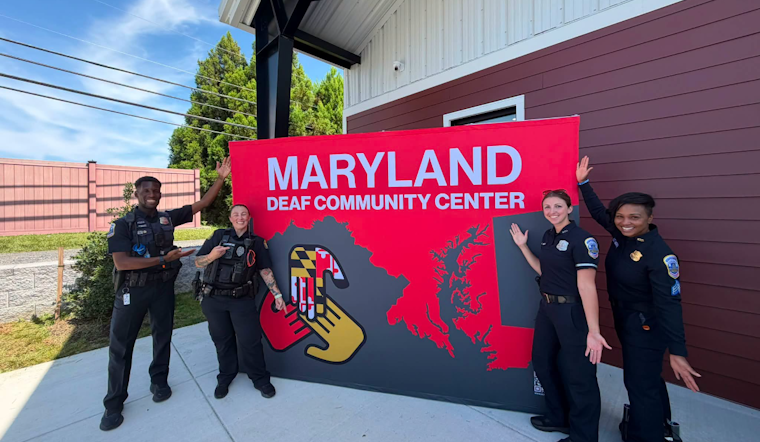
Frederick, Maryland is now home to the state's first Deaf Community Center, a newly built 11,000-square-foot facility that opened its doors last Friday after seven years of grassroots organizing. Community members, local leaders, and officers from Washington, D.C.'s police department gathered at the site on N. East Street to mark the milestone with a ribbon-cutting ceremony.
The event was documented in a Facebook post from the Washington Metropolitan Police Department, which described the opening as a historic milestone for Maryland's deaf and hard of hearing community. The post noted that the Maryland Deaf Community Center took seven years to reach its grand opening, and that MPD's Deaf and Hard of Hearing Unit joined community members and leaders in Frederick to celebrate. Photos from the event also showed a reserved, van-accessible parking area outside the building, marked with signage warning of a maximum fine of $500 for parking violations in the access aisle.
A Seven-Year Path From Town Halls to Groundbreaking
The project traces back to 2019, when 26 local deaf organizations convened to address a regional shortage of accessible meeting space, according to The Daily Moth. That effort led to the incorporation of the Maryland Deaf Community Center nonprofit in 2021 and a groundbreaking ceremony in December 2024. Survey feedback gathered during that period showed strong demand for centralized referral services and social activities spanning all age groups, the outlet reported.
Frederick was not chosen at random. The city has served as a regional hub for the deaf community since 1868, when the Maryland School for the Deaf was founded there. The school still operates a 68-acre campus in downtown Frederick, serving students from birth through age 21, according to background provided by the Maryland School for the Deaf.
Inside the New Facility
The 11,000-square-foot building sits on nearly two acres and cost approximately $6.2 million, with $3.5 million of that funded through combined grants from the State of Maryland, Frederick County, and the City of Frederick, per City of Frederick Economic Development. The remaining private capital was raised by the nonprofit through galas and tournaments. The site formerly held an unused house and produce warehouse, both demolished to make way for the new construction, per Frederick County Government.
Design priorities for the space were selected through community town halls, and the finished building includes office space, American Sign Language classrooms, a lounge, a video studio, a kitchenette, and a multipurpose gymnasium designed for community sports like pickleball and volleyball, according to the same city economic development account. Frederick County Government has also stationed its Senior Activities Program Manager directly inside the center to deliver ASL-based programming, including health workshops and administrative services for deaf seniors.
A Model Watched Beyond Frederick
An estimated 1.2 million Maryland residents are deaf or hard of hearing, with roughly 50,000 living in Frederick County and the surrounding area, and local estimates put about 3,000 deaf or hard-of-hearing residents within Frederick city limits itself, according to City of Frederick Economic Development figures. The presence of the Washington Metropolitan Police Department's Deaf and Hard of Hearing Liaison Unit at the opening reflects the center's regional reach. That unit, established in 2002 to provide sign language interpretation, assist investigations, and conduct community outreach, was among the nation's earliest specialized police teams trained in ASL, according to the department.
Behind the technical execution of the project was Anthony Maginity, a Deaf civil engineer with Kimley-Horn who served as project manager for site design and municipal permitting. Maginity, who communicates primarily in American Sign Language, navigated a two-year approval process with local authorities to get the facility built, according to Kimley-Horn. Statewide, the effort connects to broader work by the Maryland Governor's Office of the Deaf and Hard of Hearing, a specialized executive office established by state statute that fosters what it calls a Deaf Ecosystem encompassing more than 75 deaf-owned businesses across Maryland.





