

























































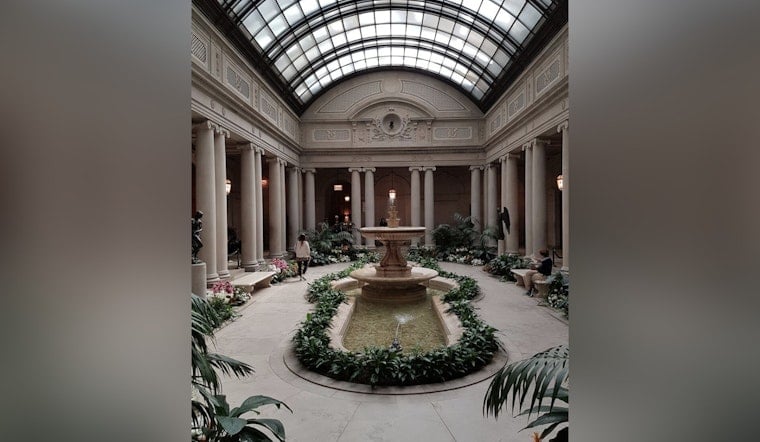
The Frick Collection has announced its 2026-27 concert season, and for the first time, visitors won't need a ticket to catch live music inside the Fifth Avenue mansion. New free pop-up performances will pop up in the Garden Court on November 14 and November 22, timed to the museum's Renaissance bronze exhibition, alongside a full slate of ticketed evening concerts featuring internationally known musicians, chamber ensembles and early-music specialists.
According to Time Out New York, the Garden Court pop-ups will be included with regular museum admission, with seating and standing room offered on a first-come, first-served basis. Each performance runs 30 minutes and is designed to be experienced either in passing or in stillness as visitors move through the galleries, according to The Frick Collection. The format marks a deliberate departure from the seated recitals that have defined the museum's concert tradition for decades.
A New Underground Stage, With Old Roots
Most of the season's ticketed concerts will take place in the Stephen A. Schwarzman Auditorium, a newly excavated 218-seat subterranean hall built beneath the museum's restored 70th Street Garden. The space features a curvilinear design and custom acoustics developed by Arup, part of the broader renovation led by Selldorf Architects, per the firm's own project materials.
The auditorium is the centerpiece of the Frick's return to Fifth Avenue after reopening on April 17, 2025, following a multi-year, $220 million renovation that also opened the mansion's historic second floor to the public for the first time — converting former Frick family quarters into permanent gallery space. Hoodline previously covered a nearby $14.9M co-op sale facing the newly reopened museum, and more recently noted a Fifth Avenue maisonette listed with views of the Frick's gardens.
Live music at the Frick actually predates the new auditorium by nearly nine decades. The institution's concert program debuted in 1938, three years after the mansion first opened as a public museum, and began airing live broadcasts on WNYC in 1939 — a tradition that helped establish the Frick as a venue for American debuts by European classical artists. Even earlier, the Garden Court itself hosted its first live performances in December 1936, with Sunday afternoon organ recitals played on the mansion's 1914 Aeolian organ and transmitted through a specialized sound system.
Bronze Sculptures Meet Sienese Polyphony
The November pop-ups are built around the special exhibition Siena: The Art of Bronze, 1450-1500, running October 15, 2026 through January 18, 2027, and featuring nearly 40 Renaissance bronze sculptures, many displayed outside Tuscany for the first time. The exhibition inspires two full weekends of programming in November, pairing sounds of 15th-century Siena with the period objects on view. Performers Jasper Snow, Richard Pittsinger, Joshua Cheatham and Georgia Burashko will perform surviving fragments of Sienese polyphony as part of the series.
Early-music ensemble Graindelavoix will present a program centered on Sena Vetus, a ceremonial motet honoring the Tuscan city. A separate program, Fire: Susanne de Court and the Art of Enamel, is devoted to the only known woman enamel artist of the French Renaissance, and will inspire performances by Twelfth Night and the Helicon Ensemble.
Big Names, a New Commission and a Book Preview
The season opens October 18 with Goya's Musical World, a program inspired by music surrounding Francisco de Goya, featuring works by Boccherini, Spanish folk music and contemporary composer Mauricio Sotelo. Countertenor Anthony Roth Costanzo returns to the Frick to preview his forthcoming book and album Countertenor, spanning baroque laments, traditional Hawaiian music, Klaus Nomi and Philip Glass's Einstein on the Beach.
Composer Matthew Aucoin will premiere a new Frick-commissioned work, performed by cellist Coleman Itzkoff, and will also curate two spring concerts. The roster of visiting artists includes pianists Paul Lewis, Alexandre Tharaud and Federico Colli — the latter making his Frick debut — along with French cellist Jean-Guihen Queyras, Tunisian-Canadian mezzo-soprano Rihab Chaieb, English tenor Ian Bostridge and violinist Francisco Fullana, who will perform with the Dolphins Quartet, Viano Quartet and guitarist Rafael Aguirre. Nineteen-year-old pianist Alexandra Dovgan will make her Frick debut as well.
Students from Juilliard415 and the Royal Academy of Music will give free lunchtime performances throughout the season, scheduled for October 22, December 17, February 4 and March 4.
Tickets, Pricing and How to Plan a Visit
Evening concerts in the Schwarzman Auditorium cost $80, while lunchtime concerts are priced at $35; Frick members receive 20 percent off. All concert tickets include museum admission for up to two hours before the performance. Tickets for October through December 2026 concerts go on sale September 8, 2026, with a Frick member presale beginning September 1. Tickets for the January through May 2027 performances go on sale December 15, 2026, with a member presale starting December 8.
The expanded season follows the museum's inaugural post-renovation lineup in 2025-26, which grew to 25 concerts — more than double the annual count offered before the renovation — and introduced the Frick's first-ever ensemble-in-residence, Sonnambula, according to Early Music America. The 2026-27 season receives support from the Howard & Sarah D. Solomon Foundation, Ayesha Bulchandani, Karen Z. Gray-Krehbiel, John H. Krehbiel Jr., Ravenel Curry and Jane Moss, per Musical America.
Beyond music, the Frick's broader 2026-27 cultural calendar includes a November installation by Canadian Indigenous artist Kent Monkman, inspired by Johannes Vermeer's Officer and Laughing Girl — part of the museum's continuing pattern of pairing historic masterworks with contemporary creative responses.





