

























































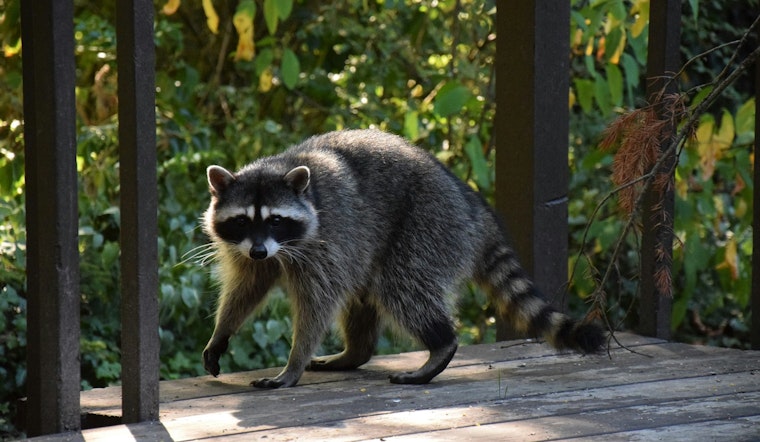
Seven people have been bitten by raccoons along Galveston's Seawall in the past two weeks, and every one of them has been referred for a round of preventive rabies shots. City officials say the colony living near the seawall's eastern edge has grown bold and aggressive after months of tourists and residents hand-feeding them snack food, and animal control is now weighing what to do about it.
According to Chron, Josh Henderson, supervisor of the City of Galveston Animal Services Unit, counted 21 raccoons near the eastern end of the seawall this week, though he believes the real number is likely higher. Henderson said he filled a 55-gallon trash bag with fast-food wrappers and leftover snack packaging pulled from the same stretch of rocks, evidence of just how much junk food the animals have come to expect from passersby.
Free Snacks Have Made a Wild Colony Bolder
The east end colony is made up of overweight animals accustomed to handouts, the outlet reports, and young raccoons in particular are growing up without learning to forage for grubs, insects, crawfish and fish in the tidal pools the way raccoons naturally would. Henderson said feeding turns the seawall into a buffet rather than a habitat, and that the animals have lost much of their innate wariness of people as a result. Signs already posted along the seawall ask visitors not to feed the raccoons, but Henderson said those signs alone haven't solved the problem.
Henderson has urged the public to secure food and trash and to view the animals from a safe distance rather than approaching them. He called it irresponsible to let the situation continue unchecked, and said he's now weighing additional options for addressing the colony beyond signage.
Seven Bites Mean Seven Rounds of Rabies Treatment
Any bite that breaks the skin has to be reported to local rabies-control authorities, per the Galveston County Health District, which is why all seven recent victims were referred there for evaluation. The treatment they're now undergoing is known as post-exposure prophylaxis, or PEP — a regimen the Centers for Disease Control and Prevention says should include wound cleansing, human rabies immune globulin and a four-dose vaccine series over two weeks for anyone bitten by a high-risk wild animal.
The stakes behind that protocol are real: raccoons are the third-most common rabid animal species confirmed in Texas this year, with 25 lab-confirmed cases statewide through July, trailing only bats and skunks, according to the San Antonio Express-News. None of the seawall raccoons involved in the recent bites has been confirmed rabid, but the mandatory testing and shot protocol exists precisely because rabies is almost always fatal once symptoms appear in humans.
Why the City Can't Simply Trap and Move Them
Galveston can't just round up the colony and haul it elsewhere. Raccoons are classified as a rabies vector species under Texas law, and the Texas Department of State Health Services says relocating them without authorization is a Class C misdemeanor, with any approved move limited to within a 10-mile radius of the same county. The city has no current plans to relocate or destroy the colony, and says it will rely on humane methods if removal ever becomes necessary.
Last summer, animal control did relocate several raccoons from the seawall colony to a mainland wildlife sanctuary as part of an earlier crackdown, after visitor videos had turned feeding the animals into an informal beach activity, KVUE-TV reported at the time. That effort offered only temporary relief, and a year later the same colony is back in the headlines.
A Push for Fines, Modeled on a Neighboring City
Henderson now wants stronger enforcement tools, including an ordinance that would let his office issue citations to people caught feeding the raccoons. Galveston already bars residents from keeping wild or exotic animals within city limits — a code the Houston Chronicle noted was enforced in 2022 when officers seized pet monkeys from island homes — but there's currently no citywide ban on feeding wildlife you don't own.
Nearby Seabrook has already gone that route: the city's Ordinance No. 2021-04 bans feeding any wild animal, citing risks of unnatural population density, aggression and bay pollution. That kind of enforceable rule is what Henderson appears to be angling for in Galveston, following the pattern of similar wildlife feeding warnings issued elsewhere along the Upper Texas Coast this year.
Wild Neighbors at the Edge of the City
The seawall's eastern terminus butts up against the 685-acre East End Lagoon Nature Preserve, a coastal prairie and salt marsh along Boddeker Road where the Galveston Island Nature Tourism Council says native raccoons naturally hunt crabs, small rodents and other prey. Raccoons are normally nocturnal, and alongside coyotes they play a genuine role in the coastal ecosystem, helping clean up sand dunes and salt marshes — a role Henderson says gets undermined every time someone hands one a Cheeto instead.
The City of Galveston says its Animal Services Unit, which operates under the City Marshal's Office and the Police Department and contracts shelter services through the nonprofit Galveston Island Humane Society, fields wildlife and bite calls daily. On Tuesday, the city posted a public warning telling residents and beachgoers to stop feeding the seawall raccoons, cautioning that a bite likely means a series of rabies shots. Henderson said he plans to keep closely monitoring the colony as the city decides its next move.





