

























































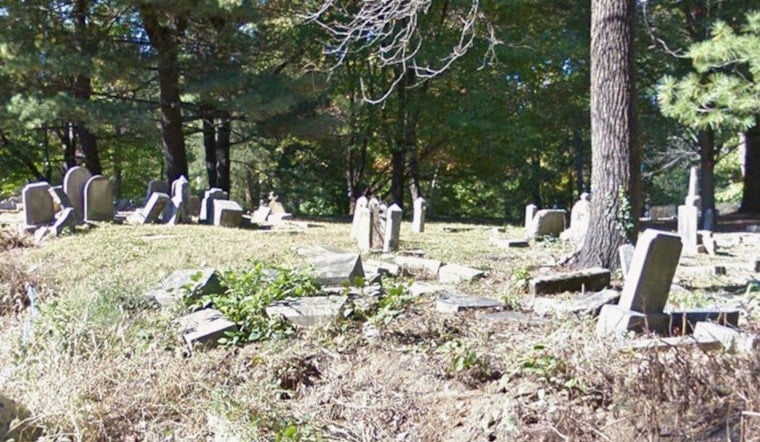
Seven potential graves lie roughly three feet below the ground bordering Mill Road and Lyons Mill Road in Georgetown, right where the District Department of Transportation staged heavy construction equipment for a drainage project meant to protect the very cemeteries beneath it. The Black Georgetown Foundation, which manages the historic burial grounds, says the District failed to properly protect and disclose those graves during the work — and that it only learned some details after waiting months and filing a public records request.
The dispute centers on a $1.6 million DDOT stormwater management project along 27th Street, Mill Road, and Lyons Mill Road, which was designed to stop runoff and soil erosion that has damaged the historically Black Mount Zion and Female Union Band Society Cemeteries for generations, according to NBC Washington. Mill Road and Lyons Mill Road directly border the cemeteries, and DDOT and its consultants used remote sensing to identify potential burial locations before construction began. A 2023 survey found five potential burials along 27th Street and Mill Road, and a follow-up 2025 survey identified two more potential burials along Lyons Mill Road, per the station's report.
Lisa Fager, executive director of the Black Georgetown Foundation, said DDOT did not notify her that potential burials had been found near the project, even though the discovery dated back to November 2025. Fager eventually filed a public records request after months of waiting, and NBC Washington obtained a copy of the unpublished 2025 report from her. That report recommended that work within 50 feet of an identified burial be specially monitored and protected during construction — yet DDOT applied a five-foot protection margin for the Mill Road project instead.
Equipment Parked Near Marked Burial Sites
According to the 2025 report, potential burial locations appeared on maps in areas where heavy construction equipment and vehicles had been positioned. DDOT has said no construction occurred on the cemetery grounds themselves, and Olivia Dedner, the agency's head of external affairs, said the five-foot protection policy was decided by an outside archaeological consultant rather than DDOT itself. Dedner also said the agency does not release reports before they are completed, which the foundation says contributed to the communication gap.
Dedner acknowledged mistakes during the drainage work, including failing to inform community members and storing construction materials on the cemetery grounds. Before a community town hall, DDOT removed all equipment from the site and constructed a curb intended to protect the land, the station's report notes.
Community Pushes Back at Town Hall
Concerns about the project reached a head on August 4, when the Black Georgetown Foundation hosted a town hall at the Georgetown Library, convening after remote sensing surveys had flagged shallow burial anomalies near the construction staging areas, according to the Black Georgetown Foundation. The session featured former Advisory Council on Historic Preservation chair Sara Bronin, William & Mary researcher Dr. Joseph Jones, and American University PhD candidate Delande Justinvil, who addressed DDOT's work, cemetery protection, and public access. Bronin, now a George Washington University law professor, has pointed out that the District of Columbia Historic Protection Act exists but lacks specific protocols for protecting graves during city-led construction.
That gap mirrors a national pattern. In March 2023, the Advisory Council on Historic Preservation, then chaired by Bronin, unanimously updated its national policy statement on burial sites, stressing that human remains and grave sites deserve dignity and protection from disturbance regardless of formal landmark status, according to the Advisory Council on Historic Preservation. The updated policy specifically recognized that Black, Indigenous, and minority burial sites face heightened risk of disturbance from infrastructure projects and climate impacts.
A Rare Site With Deep History
Mount Zion Cemetery, established in 1808 as the Old Methodist Burying Ground, and the Female Union Band Society Cemetery, founded in 1842 by a mutual aid society of free Black women, together form a 3.5-acre site holding an estimated 8,000 to 10,000 burials, according to PBS News. The two cemeteries are among only three intact, historically African American burial grounds remaining in Washington, D.C., alongside Woodlawn Cemetery and the Union Burial Society Cemetery, per the Executive Office of the Mayor. In 1975 the combined grounds were listed on the National Register of Historic Places, and in 2018 they were designated an official Site of Memory under UNESCO's Routes of Enslaved Peoples project, according to the National Park Service.
Ground-penetrating radar and remote sensing have become standard tools nationwide for detecting unrecorded Black graves, which often went unmarked because of 19th-century segregation laws and the resource constraints placed on Black communities, per Esri. Many antebellum burials used perishable wood markers or fieldstones that deteriorated over time rather than durable stone, leaving sites like Mount Zion difficult to fully map even with modern technology.
Funding Exists, But Protections Remain Thin
In February, D.C. Mayor Muriel Bowser awarded $125,000 to the Black Georgetown Foundation through the newly established Paul E. Sluby, Sr. Historic Burial Grounds Preservation Program to support site surveys, online mapping, and preservation work, according to the Executive Office of the Mayor. The grant reflects ongoing District government financial support for the cemeteries even amid friction over how DDOT handled the drainage project itself.
Federal law has similarly outpaced funding. Congress passed the African American Burial Grounds Preservation Act in late 2022 to create a National Park Service grant program for identifying and protecting historic Black cemeteries, but lawmakers have not yet allocated operational funding for it, per PBS News. Preservationists say that leaves local groups like the Black Georgetown Foundation to rely on public records requests, town hall organizing, and media scrutiny to press local agencies for transparency.
The demographic stakes underline why advocates consider the site irreplaceable. In the late 19th century, African Americans made up between 35% and 45% of Georgetown's total population, concentrated in the Herring Hill area, before 20th-century urban renewal, rising property values, and displacement sharply reduced the neighborhood's Black residency, according to the National Park Service. The 27th and Mill drainage project is set to wrap up by the end of the week, per the report, though questions about how the District protects what remains buried nearby are likely to persist well beyond its completion.





