

























































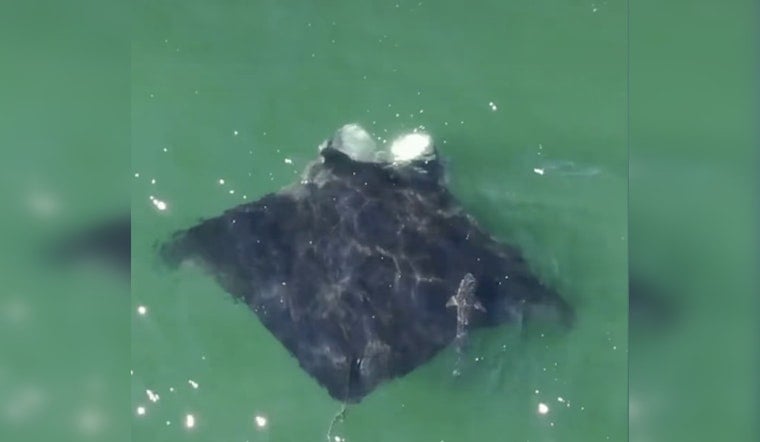
A giant oceanic manta ray, an animal that can weigh more than 4,000 pounds, was spotted feeding close to shore off Jones Beach State Park this week, offering Long Island beachgoers a rare glimpse of one of the ocean's largest and most unusual filter feeders. The sighting stood out not just for the ray's size but for how near the coastline it came to forage.
The New York State Department of Environmental Conservation shared video of the manta ray swimming off Jones Beach State Park, as reported by WABC-TV. The agency did not provide additional details about exactly when the animal was spotted, according to the station's report. Per the DEC, manta rays can forage for medium-sized fish in deeper waters, but when they move closer to shore, they typically consume large quantities of zooplankton instead.
A Threatened Species With an Outsized Presence
Oceanic manta rays are filter feeders that inhabit tropical, subtropical, and temperate regions around the world, and per the DEC they can be spotted in New York waters during warm summer months. The animals can weigh more than 4,000 pounds and live up to 40 years, per the same account. Fully mature individuals are the world's largest ray species, capable of reaching wingspans of 26 to 29 feet and weighing as much as 5,300 pounds, according to NOAA Fisheries.
Despite that massive scale, the species relies entirely on filtering micro-organisms from the water column to survive. NOAA Fisheries officially listed the giant oceanic manta ray as threatened under the Endangered Species Act in 2018, citing global commercial fishing pressure and international trade in the animals' gill rakers. In December 2019, the agency issued a formal determination declining to designate critical habitat for the species, finding that no specific physical or biological features within U.S. jurisdictional waters were essential to its conservation, according to the Federal Register.
Why Long Island Waters Are on the Migration Path
While giant manta rays are generally rare north of Cape Hatteras, North Carolina, federal marine records show they routinely migrate into deeper offshore waters around the Hudson Canyon off Long Island during warm summer months, according to NOAA Fisheries. That submarine canyon southeast of Long Island hosts rich marine biodiversity, which helps explain why an animal typically associated with tropical waters would turn up feeding near a New York beach.
NOAA Fisheries climate studies also report that rising sea surface temperatures and shifting offshore currents along the Mid-Atlantic are altering upwelling patterns and zooplankton concentrations, which can influence the seasonal feeding migrations of large filter feeders. Warmer summer ocean temperatures bring nutrient-rich thermal fronts closer to Long Island beaches, a dynamic that may be drawing more of these animals within sight of shore.
Not to Be Confused With Stingrays
Long Island's ocean beaches frequently see summer migrations of cownose rays swimming in large nearshore schools, but according to FOX Weather, cownose rays are far smaller than oceanic manta rays and carry venomous tail spines that manta rays lack. Manta rays are harmless to humans and feed exclusively on plankton, while stingrays and cownose rays tend to dwell closer to the sea floor.
The state's ability to document sightings like this one has been bolstered by expanded aerial surveillance. To enhance marine life tracking and beach safety along Long Island's South Shore, the New York Department of Environmental Conservation expanded its coastal drone fleet to 46 units for the summer season, according to FOX 5 NY. The drones were initially ramped up for shark monitoring but regularly capture footage of other marine megafauna passing through the area.
Why Scientists Want the Footage
Each oceanic manta ray has a completely unique pattern of dark spots on its ventral, or underside, belly, functioning like a fingerprint that allows researchers to identify and track individual animals through photo and video footage, according to Defenders of Wildlife. Global photo-identification databases rely on these spot patterns to map how individual animals move across ocean basins, meaning footage like the DEC's Jones Beach video can feed directly into scientific research.
That kind of individual tracking matters because manta rays reproduce extremely slowly. Biological research indicates females give birth to only a single live pup every two to five years and produce just four to seven offspring in a lifetime, according to the Guy Harvey Foundation. Because populations take decades to recover from disturbance, individual sightings carry outsized weight for biologists monitoring the species.
Manta rays also stand out biologically beyond their size and rarity. Per MarAlliance, they possess the highest brain-to-body mass ratio of any fish species studied to date and use a specialized vascular network to keep their brains warmer than the surrounding seawater, a trait scientists associate with complex social behavior and long-distance navigation. That advanced biology is part of what made the Jones Beach sighting a notable moment for both beachgoers and researchers tracking the species' movement along the Mid-Atlantic coast.




