

























































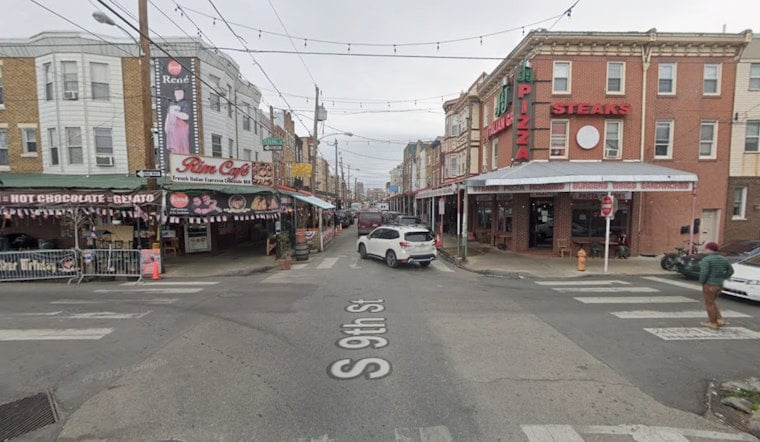
Nine glowing light boxes now line South 9th Street between Washington Avenue and Federal Street, each one telling the story of a family that keeps South Philadelphia's famed market running. The installations, unveiled as part of a project called Light Up the Market: Honoring the Workers of 9th Street, mark the latest phase of an ongoing effort to reframe the corridor long known as the Italian Market as the multiethnic hub it has actually become, home to Italian, Mexican, Jewish, Black, Central American, Irish and Vietnamese communities.
The light boxes were organized by Our Market Project, a community-building and public art initiative founded by South Philadelphia artist Michelle Angela Ortiz, according to WHYY. The market's official name is the South 9th Street Curb Market, and it was founded by an Italian immigrant, but as the station notes, the space has for decades held far more than one culture's history. Community members gathered for a free two-night celebration marking the installations' debut, according to the same report.
Vendors Tell Their Own Stories in Light
Each light box depicts stories from local business owners, focused on themes of family and community, per the station's account. One box honors Mole Poblano, designed in collaboration with owner Javier Ríos Sandoval, and depicts a mother's embrace while paying tribute to Sandoval's wife and children. Another, created for Mexibike, a local bike shop owned by Maria Carmen, shows Carmen and her children surrounded by monarch butterflies alongside the words “when you work hard for your dreams, they come true.”
Ortiz, who is the lead artist of Our Market Project, said the installations should encourage visitors to celebrate the people who keep the market thriving, the station reports. She has described experiencing isolation from neighbors because of her family's Latin heritage, and has said Our Market Project aims to build a space for people who might feel othered. Ortiz has said the tours and art help people learn that different community members are not very different from one another, and the project was planned through conversations with market neighbors about their wishes and needs.
Permanent Fixtures Alongside Temporary Art
Beyond the glowing boxes, permanent art fixtures now include revitalized produce stands that claim space that would otherwise be used for city parking, the station notes. Temporary artworks accompanying the celebration included repurposed produce scales displaying photos and interviews of community members, plus a movable push cart illuminating photos of past and current market workers. The light boxes themselves also provide increased safety for community members walking the corridor at night, per the same account.
The project has continued to expand its reach through Our Market Project Tours, operated through Beyond the Bell Tours, a Philadelphia company specializing in inclusive tours about marginalized groups and their histories. The roughly two-hour tours include storytelling and food sampling, and are designed to bring vendors and visitors together. Joey LeRoux, connected to the tour effort, said the tours educate Philadelphians and tourists alike about immigrant history, according to the station's report.
Visitors Notice What They Once Walked Past
Melissa Yong, a tour guide for Our Market Project, has led groups through the installations, and visitors have described the tours as revelatory. Mandy Perez, who moved to Philadelphia six years before the WHYY story published, said she had not noticed the light installations before taking a specialty tour, illustrating how easily longtime residents can walk past stories hiding in plain sight along the corridor.
The market's roots run deep: it traces back to the mid-1880s, when Italian immigrant Antonio Palumbo opened a boarding house on South 9th Street for incoming laborers, and vendors' pushcarts eventually evolved into the brick-and-mortar storefronts chartered as a business district by the city in 1915, according to South 9th Street Italian Market. In October 2007, the Pennsylvania Historical and Museum Commission dedicated an official state historical marker naming the site the South 9th Street Curb Market rather than the Italian Market, a deliberate choice meant to reflect its multiethnic immigrant history, as reported by the South Philly Review.
From Blight to 'Puebladelphia'
That layered history includes a more recent chapter. Starting in the late 1990s and 2000s, a major wave of Mexican immigrants, predominantly from the Mexican state of Puebla, revitalized the southern blocks of 9th Street after the Philadelphia City Planning Commission had certified that stretch as blighted in 2001, according to Hidden City Philadelphia. The demographic shift gave rise to the neighborhood's informal nickname, “Puebladelphia.”
Ortiz's own connection to the market runs personal. She has lived in South Philadelphia for more than 40 years, and her mother worked for 25 years as a cook and housekeeper for the Giordano family, which has operated a produce business on 9th Street since 1921, per the Philadelphia Inquirer. Our Market Project won $250,000 in December 2022 as one of three grant recipients in PHILADELPHIA250's “Leave a Legacy” competition, funding for multi-year public art and community programming that runs through the 2026 U.S. Semiquincentennial.
Ortiz has also worked with Mural Arts Philadelphia on a permanent series called Our Market Ancestors, installing artworks in 2024 and 2025 that honor historical figures including cheese shop founders Danny and Joe Di Bruno, florist Betty Ann Mongelluzzo, and Jewish immigrant Carl Samuel Redel. The murals incorporate decorative frames inspired by traditional paper-cutting techniques.
A Corridor Still Redefining Its Public Memory
The question of whose history gets memorialized on 9th Street has stirred debate before. In June 2020, Mural Arts Philadelphia and city leaders painted over the controversial Frank Rizzo mural at 9th and Montrose Streets following community protests, according to WHYY. Rizzo, a former mayor and police commissioner, had come to symbolize aggressive policing tactics that caused long-standing pain among Black and LGBTQ communities, opening space for the kind of public art now going up in its place.
Traditional Italian institutions remain part of the market's identity too. Ralph's Italian Restaurant, founded on South 9th Street by Francesco Dispigno in 1900 and named after his son, celebrated 125 years of continuous family operation in 2025 as the oldest family-owned Italian restaurant in the country, with fifth-generation family members currently running the business. Meanwhile, the annual South 9th Street Italian Market Festival each May, drawing thousands of visitors for traditions like the Procession of Saints and the Greased Pole Climb, continues to anchor the corridor's identity even as new murals and light boxes push its public story in a broader direction.





