

























































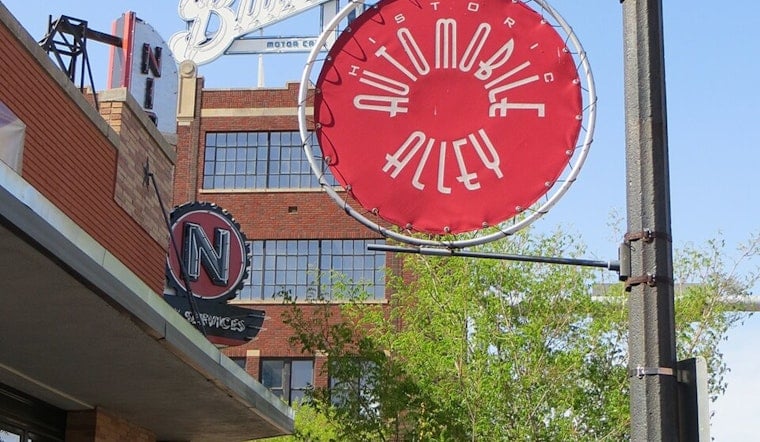
Four free-standing viewing stands called Echoscopes are headed to Broadway Avenue in Oklahoma City's Automobile Alley, bringing an old-school amusement of goofy dragons and a space-age futuristic skyline to the downtown corridor. The sculptures will be installed along Broadway between NW 4th Street and NW 10th Street, right in the heart of the historic auto district.
The optical illusion concept traces back to the 1904 St. Louis World's Fair, where similar viewing devices ranked among the top attractions, according to The Oklahoman, which first reported on the project in a piece by Steve Lackmeyer. That fair's famous Pike entertainment midway drew more than 19 million visitors and helped popularize stereoscopic cards and kinetic viewing stands as street-level entertainment, a tradition the Echoscopes now revive on a modern downtown sidewalk.
Why Automobile Alley, and Why Now
The four Echoscopes will land on a stretch of Broadway that just got a major physical makeover. In November 2025, the city completed its $5 million Better Broadway streetscape project between NW 4th and NW 11th streets, shortening pedestrian crosswalks from 75 feet down to 45 feet with curb bump-outs and adding 30 new parking spots, as detailed by OKC VeloCity. Hoodline covered the ribbon-cutting for that overhaul last November.
Those streetscape upgrades were themselves funded through a 2017 voter-approved bond and tax package, according to the Oklahoma City Free Press. The Better Streets, Safer City initiative included a 10-year, $967 million bond program alongside a temporary sales tax extension that raised $240 million for infrastructure across the city, targeting road resurfacing, sidewalks, and pedestrian safety improvements citywide.
A District Built for Wagons, Then Cars, Now Pedestrians
Broadway Avenue's unusually wide footprint dates back to 1889, when it was designed extra-wide so horse-drawn wagons could turn around, according to the Oklahoma Gazette. By the 1920s, that same width had made room for more than 50 vehicle dealerships in what became known as Automobile Alley, a district that once sold 95 percent of all cars in Oklahoma City. The street's generous dimensions later proved useful again, easing its conversion into a multi-modal, pedestrian-friendly corridor.
The district's modern identity as an arts destination didn't happen by accident. After the 1995 Alfred P. Murrah Federal Building bombing left Broadway's buildings structurally damaged, city leaders formed the Automobile Alley Association to steer historic preservation efforts, ultimately helping drive more than $30 million in private redevelopment into the area, per the Oklahoma Gazette. That nonprofit still operates today within downtown's Business Improvement District, offering grants between $1,000 and $3,000 to help local businesses install and maintain historic neon signage, according to its own account on the Automobile Alley website.
Part of a Bigger Public Art Push
The Echoscopes join a growing list of street-level art experiments in the district. Back in June 2020, the Automobile Alley Association launched its Door Tour, converting 21 service doors in alleyways off Broadway into a permanent outdoor gallery featuring vinyl artwork from 13 local artists, encouraging pedestrians to wander beyond the main strip.
Public art installations like the Echoscopes typically trace their funding back to Oklahoma City's 1% for Art Ordinance, adopted by the City Council in 2009 and administered by the Office of Arts & Cultural Affairs. The ordinance requires that one percent of construction budgets for municipal facilities, parks, and infrastructure projects be set aside for permanent public art, with a volunteer Arts Commission and resident selection committees guiding the process. That same funding mechanism recently backed a giant steel bird sculpture at Scissortail Park.
Investment Keeps Flowing Into the Corridor
The Echoscopes' arrival comes amid a wave of private investment along the same blocks of Broadway. In May, the 105-year-old, five-story Magnolia Building at 722 N. Broadway sold for $4.6 million to an investor planning a boutique hotel conversion, a sale Hoodline reported sits directly along the district's streetcar route.
Looking further ahead, draft urban planning strategies published by the city in August target quadrupling downtown housing by 2060, with plans to reconfigure North Broadway Circle in Automobile Alley into a pedestrian-first shared street extending directly to Campbell Art Park. Together, the streetscape overhaul, the Echoscopes, and the redevelopment activity reflect a district that has spent three decades reinventing itself from a car-dealership row into a walkable arts and housing corridor.



