

























































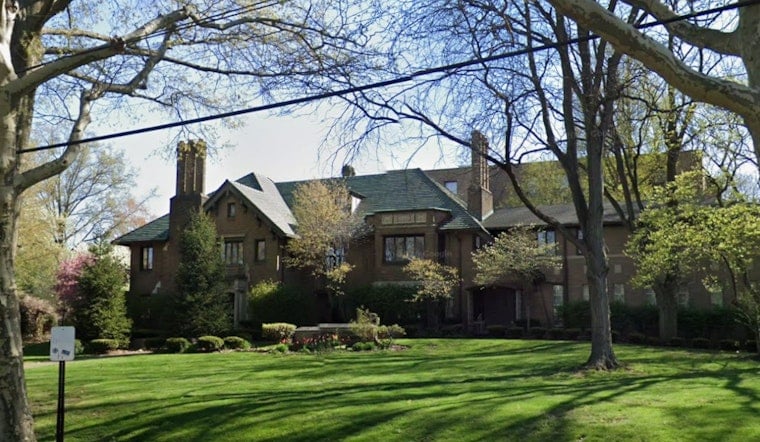
Grace House Akron, a small nonprofit that has spent less than four years caring for terminally ill people who have nowhere else to turn, is now the owner of a sprawling, century-old estate in Highland Square. The organization acquired the Lenora Hall property at 39 N. Portage Path for $2.7 million at auction in August 2026, according to the Summit County Fiscal Office, taking over a complex with more than 139,000 square feet of building space across a prominent corner lot.
The purchase, first reported by Cleveland.com, caps a competitive sales process that began when the property hit the online auction platform Ten-X in mid-July with a starting bid of just $700,000, according to Signal Akron. Grace House Akron says it did not actively seek out the acquisition opportunity, and that an anonymous donor made the purchase possible. Jen Boroff, speaking for the nonprofit, said she is grateful for that donor and believes the site has tremendous potential to strengthen Grace House Akron's mission and serve the broader community.
Grace House Akron is a nonprofit comfort care home that provides end-of-life housing and care for qualifying individuals, and it currently operates a single six-bed facility a few miles away. The organization says it is still determining how the Lenora Hall site can best serve the community, and it plans to conduct due diligence over the coming months to figure out the property's future use.
A Convent, a Mansion, and Nearly 80 Years of Service
The property Grace House Akron just bought carries almost as much history as the mission it now hopes to continue. The 10-bedroom Lenora Hall mansion was built in 1918 as a Tudor Revival estate for John Kerch, president of the Twentieth Century Furnace Company, before the Daughters of Divine Charity purchased it in 1946 to shelter working women and aging sisters, per background compiled by Progress Through Preservation. The mansion was later named for Sister Leonora Vurnik, who had the vision to create Lenora Hall and died the same year the order acquired the property.
Over the decades, the mansion served as a semi-independent home offering supportive living services for women, while the complex's five-story rectangular building, Francesca Residence, operated as independent living for older adults. Both buildings closed in December 2025 after the Daughters of Divine Charity notified residents the previous October that escalating repair and maintenance costs had made continued operation financially unsustainable, forcing dozens of elderly and disabled residents to relocate, according to Signal Akron's reporting on the closure notice.
From a Six-Bed Home to a Historic Complex
Grace House Akron was founded in 2016 by hospice nurses Holly Klein and Cindy Browning, and it opened its original 6,370-square-foot care home at 475 N. Howard St. in September 2022 on land donated by Summa Health, according to Akron.com. That project required a $3.5 million capital construction campaign to get off the ground. The nonprofit is one of only three organizations nationwide operating a free, non-barrier comfort care home specifically for terminally ill people who are unhoused, impoverished, or lacking family caregivers, a distinction noted by the Beacon Journal.
Demand for that care has been climbing. Grace House Akron served 42 terminally ill residents in 2024, up from 35 total residents during its first 18 months of operation through March 2023, per figures compiled by Cause IQ. The organization relies on paid staff supported by more than 100 community volunteers, and it has drawn both public and private funding, including a $50,000 state capital allocation from the Ohio General Assembly and a $42,799 general program grant from the Akron Community Foundation awarded last year.
Why Room and Board Remains the Hardest Gap to Fill
The systemic problem Grace House Akron was built to address helps explain why a property like Lenora Hall matters. Medicare and Medicaid cover hospice medical care, but healthcare regulations do not reimburse room, board, or 24-hour non-medical caregiver costs, according to Akron.com's earlier reporting on the nonprofit's fundraising efforts. Without residential care homes to fill that gap, terminally ill patients without housing or financial resources frequently die alone or in emergency care settings, per the same account.
Boroff said Grace House Akron intends to honor Lenora Hall's history and carry its spirit of love and service forward, though the nonprofit has not detailed how it will manage the upkeep of a complex whose repair costs proved too much for its previous religious stewards. The acquisition also lands in a Highland Square neighborhood that has been organizing around its own revitalization push. Property owners and municipal leaders established a Special Improvement District, approved by Akron City Council in February, to fund safety patrols, improved lighting, and public programming along the nearby West Market Street corridor, as Hoodline previously reported.



