

























































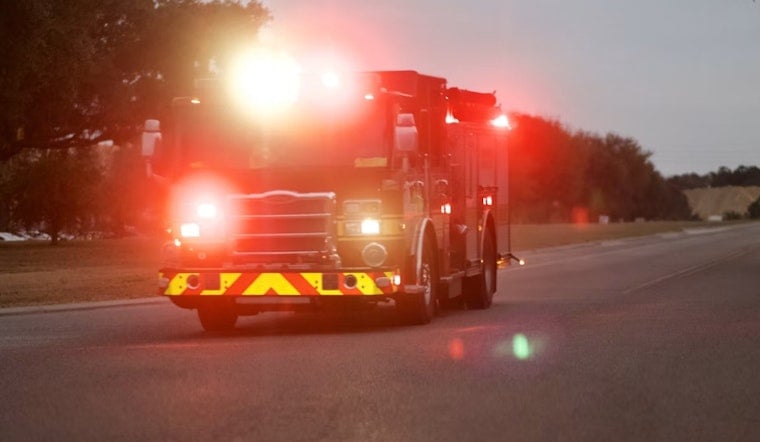
A suspected microburst tore through Greeley on Saturday afternoon, snapping power lines, splitting trees, and igniting a grassland fire that forced authorities to shut down one of Northern Colorado's busiest highway interchanges. By the time the wind settled, more than 3,100 customers were without power and fire crews were working a small blaze burning dangerously close to the roadway.
The National Weather Service told CBS Colorado that at least three separate outflow boundaries moved through the Greeley area within roughly a two-hour window Saturday, each one pushing a fresh pulse of turbulent wind across the region. A microburst, by definition, is a concentrated burst of sinking air that descends from a thunderstorm and slams into the ground, producing strong and sometimes damaging winds across a relatively small area, according to the outlet's report. Investigators believe one of those bursts is what knocked down and snapped multiple power lines while also breaking trees and branches across the city.
Wind gusts recorded at the Greeley airport ranged from 25 to 40 mph during several stretches Saturday afternoon, but CBS Colorado meteorologist Joe Ruch said some isolated gusts were likely stronger than that range suggests. The station's report notes that Xcel Energy's outage map showed 19 separate outages scattered around the Greeley area, with the utility estimating that power would be restored by 3:45 p.m.
Grass Fire Shuts Down Spaghetti Junction
The downed lines set off a grassland fire near the interchange of U.S. 85 and U.S. 34, an intersection known locally as Spaghetti Junction because it links Greeley, Evans, and Garden City and carries an average of 34,000 vehicles a day, according to the Colorado Department of Transportation. Traffic cameras operated by the agency showed a burn scar along U.S. 85 near the U.S. 34 junction, per the same account from CBS Colorado, while photos from the scene appeared to show significant smoke and a small fire burning in the nearby grass.
The Greeley Police Department confirmed the interchange was closed because of the grassland fire, with fire and police personnel working the area near the closure. As of the report, police said they had no estimate for when the lanes would reopen. The interchange had only recently undergone a $4 million safety upgrade completed by the Colorado Department of Transportation in June 2025, underscoring how disruptive any closure at that junction is for the surrounding communities.
Why Colorado Storms Spark Fires Without Rain
The National Weather Service explains that dry microbursts are especially common across the High Plains and Colorado's Front Range during summer, forming when rain falling from high-based cloud cells evaporates in hot, low-humidity surface air. That evaporative cooling increases air density and accelerates the downdraft toward the ground, producing intense wind blasts with little or no measurable rainfall reaching the surface. Under NWS meteorological standards, a microburst is a localized column of sinking air less than 2.5 miles in diameter that lasts under five to ten minutes but can generate straight-line winds exceeding 100 mph, roughly equivalent to an EF-1 tornado, with winds that push outward in all directions on impact rather than rotating as a tornado does.
Nationally, NOAA data show that non-tornadic straight-line winds and downbursts cause roughly $15 billion in property damage annually and account for about 40% of all storm-related wind damage, outnumbering tornado damage incidents by a 10-to-1 ratio. Those winds frequently snap utility poles and power infrastructure, which is exactly the kind of failure investigators suspect triggered Saturday's fire.
Dry Grass and High Winds Raise Fire Risk
National Weather Service fire weather guidance classifies Weld County's dry grassland fuels under High to Very High fire danger whenever afternoon relative humidity drops below 20% and wind gusts reach 20 to 25 mph, conditions that let a single spark spread rapidly across unburned ground. Grassland and wildfire emergencies within city limits fall to the Greeley Fire Department, which operates six active stations and maintains specialized brush trucks built for exactly this kind of urban-interface fire.
The incident also lands amid a broader statewide push to harden the power grid against wind-driven fire risk. The Colorado Public Utilities Commission approved Xcel Energy's $1.9 billion Wildfire Mitigation Plan for 2025 through 2027, which funds burying 50 miles of power lines, installing 120 AI-powered wildfire cameras and 100 weather stations, and deploying Enhanced Powerline Safety Settings designed to cut power the instant something contacts the lines. The commission also opened a formal rulemaking proceeding in January to set permanent statewide rules for public safety power shutoffs and fast-trip line settings, with hearings scheduled through early 2026 to weigh customer impacts against fire prevention.




