

























































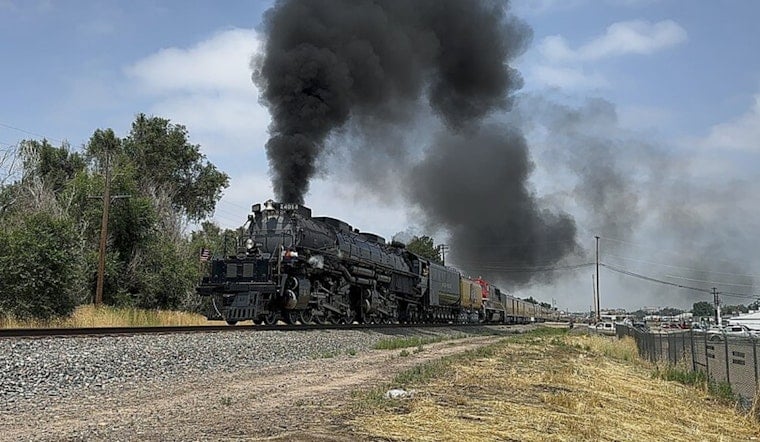
Trains rumble through Greeley's eastern edge dozens of times a day, and for people who live and work along the tracks, the horns that come with them are impossible to ignore. Roberto Belmont, who works at a tire shop just feet from the railroad, says the noise is sometimes deafening and hard to escape no matter where you are nearby. Now Greeley is working on a plan that could finally quiet those horns across a large stretch of the city.
According to CBS Colorado, the city is aiming to eliminate nearly all train horn sounds within its eastern city limits by establishing a federally recognized quiet zone. The proposed zone could run the entire north-south length of Greeley's eastern boundary, according to the outlet's report. Trains pass through the corridor roughly every 10 to 15 minutes, sounding their horns as early as 7 a.m. and as late as midnight, with 20 to 25 trains moving through Greeley on a given day.
Belmont told the station that people frequently use the railroad tracks as a shortcut, either crossing them or walking alongside them, which is part of why the horns blare so often near his shop. Greeley Public Works Director Seth Sorensen said reducing train noise could help attract residents and businesses to the area near the tracks, even as the railroad itself remains part of the city's history and its ongoing operations.
The Price of Quiet: Up to $2 Million Per Crossing
Silencing the horns isn't as simple as flipping a switch. Federal Railroad Administration rules require horns to sound between 96 and 110 decibels — comparable to a lawnmower — for 15 to 20 seconds before a train reaches any public crossing, a mandate meant to promote safety at those intersections. To legally stop that routine blasting, a quiet zone must stretch at least half a mile, and every public crossing inside it needs, at minimum, flashing lights and automatic gates, according to Federal Railroad Administration regulations.
Per CBS Colorado's reporting, Greeley is focusing its upgrade efforts on 13th Street and 8th Street, where safety improvements for drivers, pedestrians and commuters near the tracks are planned. Those upgrades include crossing gates, medians, curbs and gutters, and city officials say improvements at a single intersection could cost up to $2 million. Greeley cannot eliminate the sound of the train cars themselves moving along the rails — only the horns — and even if the quiet zone is approved, conductors would still be permitted to sound their horns whenever they judge it necessary.
A Decade-Old Effort With a Costly History
This isn't Greeley's first attempt at quiet. The city first tried to establish a quiet zone as early as 2010, but that effort stalled by 2014 after the price tag for upgrading eight crossings was estimated at around $4 million, compounded by unexpected freight traffic returning to formerly inactive short-line tracks, according to KUNC. Back in June 2021, the Greeley City Council had already detailed plans calling for the removal of Great Western Railway tracks at 5th, 8th and 10th streets, alongside quad gates or other approved safety measures at 8th, 10th and 13th streets.
The corridor carrying much of that freight traffic is the Union Pacific Greeley Subdivision, a line originally built in 1870 by the Denver Pacific Railway that still serves as a key north-south freight route between Denver and Cheyenne. Commercial rail through the city also includes an active interchange between Union Pacific and short-line operator Great Western Railway, which was acquired in 1986 as the founding railroad for OmniTRAX, per Trains Magazine.
Neighboring Cities Have Already Found Their Quiet
Greeley isn't alone in navigating this costly bureaucratic maze, and nearby communities offer a glimpse of what's possible. Longmont completed the first phase of its own quiet zone safety upgrades covering 14 public crossings along BNSF tracks, aided by a $4 million federal grant. The Town of Windsor, meanwhile, was nearing completion of compliance and signage adjustments in August 2026 needed to maintain its existing town-wide quiet zone status.
The Colorado Department of Transportation has also opened a broader study, launched in 2025, looking at whether some at-grade crossings shared by Union Pacific and Great Western Railway just west of Greeley could be eliminated. City officials frame the quiet zone push as an investment in current and future residents, tying it to Greeley's pursuit of growth on its eastern side. Sorensen and city leaders say the goal is ultimately to reduce the need for horns altogether while still keeping the crossings safe for the people who drive, walk and commute across them every day.
Safety Concerns Persist Along the Tracks
The push for quiet comes as rail corridor safety remains an active concern in Greeley. A collision between a train and a pedestrian at 7th Avenue and 5th Street in July temporarily blocked key downtown crossings, according to a report shared by the Greeley Police Department. Even with quiet zone status, federal rules would still allow horns to sound in situations where a hazard appears on the tracks, underscoring that a quieter corridor is not the same as a risk-free one.
Hoodline previously reported on the deadly consequences of quiet zones elsewhere, including a fatal train strike in a quiet zone in Cardiff earlier this year, a reminder that removing horn noise doesn't remove the trains. For now, Greeley's plan remains a work in progress, with public works officials continuing to weigh which crossings to prioritize as the city works toward a corridor where residents like Belmont might finally get some relief from the horns, even as trains keep rolling through 20 to 25 times a day.





