

























































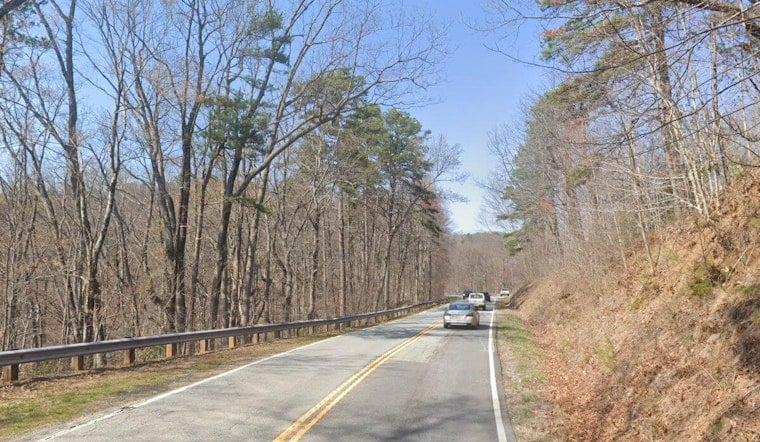
A 65-year-old man from Greenville died Friday after being struck while working as a flagman on a road crew west of Walhalla, near Stumphouse Tunnel Park, according to officials. South Carolina Highway Patrol troopers received the crash call at approximately 2 p.m., and the victim was pronounced dead at the scene, per the coroner.
The crash happened on Highway 28, known locally as Highlands Highway, near Yellow Branch Falls, according to the South Carolina Highway Patrol. The Oconee County coroner, who provided an update on the fatal crash, said the man died from blunt force trauma injuries. As reported by WYFF, the crash involved a pedestrian, and the victim was struck while working as a flagman, per officials. His identity had not been released as of Friday, pending notification of next of kin.
A Dangerous Stretch of Mountain Road
Highway 28 is a primary mountain arterial corridor in Oconee County that carries regional commuting and tourist traffic toward Stumphouse Tunnel Park, Yellow Branch Falls, and the North Carolina border, according to Blue Ridge Country. Two-lane mountain routes like this one often present limited shoulder room and restricted sightlines for temporary work zones, a factor that can complicate roadside safety setups.
Under South Carolina Department of Transportation maintenance procedures, temporary work zones must conform to Manual on Uniform Traffic Control Devices standards, including advance warning signage, designated flagger positions, and high-visibility apparel meant to make workers visible from 1,000 feet away. It remains unclear whether those standards were fully in place at the Highlands Highway work site at the time of Friday's crash.
What South Carolina Law Says About Work Zone Violations
South Carolina Department of Public Safety regulations state that roadside flaggers hold official traffic-control authority equivalent to regulatory signs, meaning drivers who fail to yield or follow a flagger's directions can be cited regardless of posted speed limits. Under South Carolina Code § 56-5-1535, operating a vehicle in a highway work zone in a manner that endangers workers carries mandatory fines between $500 and $1,000 when no injury occurs, fines up to $2,000 for physical injury, and criminal misdemeanor penalties if a worker suffers great bodily injury or death.
Whether the South Carolina Highway Patrol investigation into Friday's crash will result in charges under the state's worker endangerment statute remains an open question. It is also unclear whether contractor safety practices or automated flagger equipment were considered for the Highlands Highway project.
A Broader Pattern of Work Zone Deaths
South Carolina averaged 14 fatal work zone crashes and 26 serious injury work zone crashes per year between 2019 and 2023, with fatal collisions trending upward over that five-year span, according to the South Carolina Department of Transportation. A May 2024 statewide survey of highway contractors by trade association Carolinas AGC found that 77% of respondents had experienced at least one vehicle crash in an active work zone over the prior year, with 62% reporting five or more, per WLTX.
A Clemson University study commissioned by the South Carolina Department of Transportation found that dark lighting, excessive speed, and work zones on primary two-lane state routes were key factors increasing driver fault and worker injury severity in crashes statewide. Nationally, more than 100 workers die each year at road construction sites across the country, with pedestrian workers struck by passing vehicles accounting for nearly 25% of those fatalities, according to the National Work Zone Safety Information Clearinghouse. The National Institute for Occupational Safety and Health recommends that transportation departments adopt Automated Flagger Assistance Devices, temporary rumble strips, and stationary police escort vehicles with active blue lights to protect or replace human flaggers in high-risk zones.
The Friday crash near Walhalla comes just two days after Hoodline reported that the NTSB blamed a truck driver's inattention for an I-95 pileup that killed five people near Kenly. Nationwide work zone fatalities reached 850 in 2024, a 45% increase over 2010 levels, according to National Safety Council figures cited in that report.





