

























































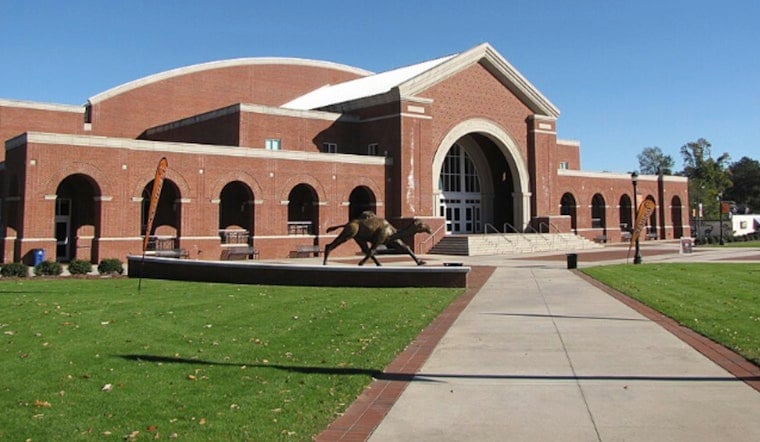
A 19-year-old former Campbell University student is facing a felony charge after investigators say he gathered a shotgun, 100 rounds of ammunition, explosive devices and a molotov cocktail while allegedly plotting a mass shooting on the private Buies Creek campus. Gabriel David Sharlow, of Greenville, was arrested Wednesday evening on the university's main campus and now faces a charge of communicating a threat of mass violence on educational property.
According to the News & Observer, Sharlow allegedly plotted the attack on Tuesday, with his stated goal, per the arrest warrant, being to kill everyone present except himself. The case was first reported by WRAL, which said Sharlow was arrested at Campbell's main campus in Buies Creek, North Carolina. An arrest warrant was issued Wednesday, the same day he was taken into custody.
Campbell University issued a campus safety notification after community members reported hearing concerning statements from Sharlow and shared those statements with campus safety officials, whose intervention led to his arrest before any attack could occur. The university has since dismissed Sharlow as a student and barred him from entering the Buies Creek campus, the outlet reported.
Bond, Charges, and What Comes Next
Sharlow posted a $100,000 secured bail bond Thursday and was released, with his next court date set for September. He is charged under North Carolina General Statute § 14-277.6, enacted by the state legislature in 2018 through Session Law 2018-72, which classifies communicating a threat of mass violence on educational property as a Class H felony.
Because the charge falls under that 2018 law, pretrial release conditions for Sharlow had to be set by a judge rather than a magistrate, following a mandatory review of his criminal history, under N.C. Gen. Stat. § 15A-534.7. It is unclear how Sharlow allegedly obtained the shotgun, ammunition and explosive materials, and whether federal charges could follow remains an open question, a path prosecutors have taken in other recent North Carolina campus threat cases.
Sharlow has not been convicted, and North Carolina law offers a potential diversion path for young defendants in his position. Under N.C. Gen. Stat. § 14-277.8, first-time offenders under age 20 convicted of the charge may be eligible for a conditional discharge after completing court-ordered probation, a rehabilitation option state lawmakers built into the 2018 statute for young adults without prior records.
Part of a Pattern Across North Carolina Campuses
Campbell University, founded in 1887 as Buies Creek Academy, is a private Baptist-affiliated school enrolling more than 5,000 total students, including roughly 2,500 undergraduates at its rural Harnett County campus. The arrest adds to a string of similar cases across the state this year that have tested the same 2018 threat statute.
In April, Durham County authorities arrested former Duke University employee Nathaniel Jerrell on the same Class H felony charge after he allegedly made online threats against former co-workers and campus facilities, a case Hoodline covered in Durham Man Held Without Bond. That same month, N.C. State University police arrested 24-year-old Luke Archer Hoover on an identical charge after social media threats triggered a multi-agency investigation involving federal task forces, detailed in Hoodline's NC State Threat Scare report.
Just days before Sharlow's arrest, campus police at N.C. State arrested a man armed with a rifle and pistol at the edge of that campus, an incident Hoodline covered in its report on a man caught strapped at the campus edge. That case, combined with Sharlow's arrest, situates the Campbell incident within a broader surge of firearm-related campus security alerts across central North Carolina in August. A 2019 case at High Point University offers an earlier parallel: 19-year-old freshman Paul A. Steber was arrested and charged with the same felony after classmates reported him and police recovered firearms and 100 rounds of ammunition from his dorm room, according to Newsweek.
State Push for Peer Reporting
Federal prosecution has followed similar threats elsewhere in the state. In June, a 19-year-old North Carolina resident was sentenced in federal court to 10 months in prison after pleading guilty to making mass shooting threats against three universities, according to the U.S. Attorney's Office for the Middle District of North Carolina.
The Campbell case also arrives amid a state campaign built around exactly the kind of peer reporting that led to Sharlow's arrest. In May, the North Carolina Department of Public Safety launched the NC S.A.F.E. for Schools initiative to promote safe firearm storage and community warning tools like the Say Something reporting app, an effort Hoodline detailed in its coverage of a loaded gun found at East Wake High. Campbell students who reported Sharlow's statements to campus safety officials echoed the same peer-intervention model the state has been urging schools to adopt.



.jpg)