

























































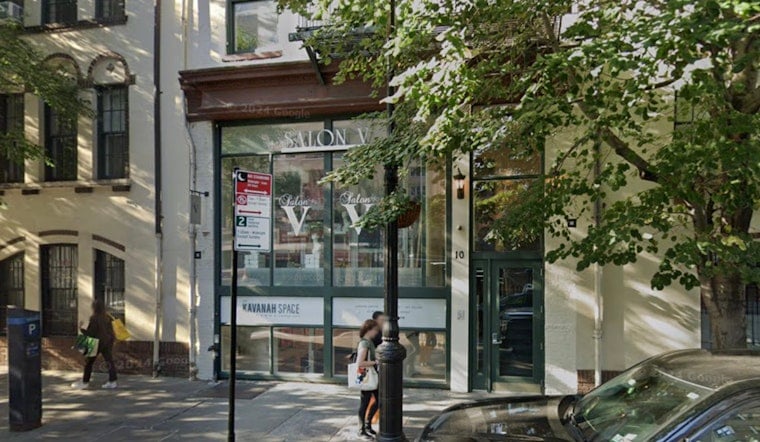
A small Chabad congregation that has anchored Jewish life in Greenwich Village for six years is fighting to keep its home at 10 East 8th Street, after its landlord moved to evict it from the ground-floor space it has occupied since 2021. Rabbi Jerry Bankhalter, known to his community as Rabbi Yakov, says he still has two years left on his lease. His landlord says he has no lease at all.
The dispute pits the rabbi against the Lynch family, who purchased the 9,000-square-foot pre-war rowhouse from New York University for $8 million in 2008, according to PropertyShark. The building, now assessed at roughly $9.375 million, houses three residential apartments and two commercial spaces above the historic town near NYU's campus. As first reported by the New York Post, the landlord filed a summary eviction case against Chabad Loft in Manhattan Housing Court in June, and the rabbi's attorney countersued in Manhattan Supreme Court in July, accusing the landlord of promissory estoppel, breach of contract, fraud, deceit and negligent misrepresentation.
Rabbi Yakov signed an original two-year commercial lease in 2021 that included a five-year option to renew running until mid-2028, per the Post's reporting. The landlord says that renewal option was never actually signed, leaving Chabad Loft as a month-to-month tenant paying below-market rent with no lease currently in effect. The rabbi disputes that account entirely, maintaining two years remain on his tenancy.
A $7,000 Rent That Never Changed
The commercial rent for the 2,800-square-foot Kavanah Space, spread across two levels beneath the building's residential units, has stayed at $7,000 a month since the start, the same figure the rabbi separately pays for his residential unit above the old Salon V storefront. The landlord's broker later asked for $12,000 monthly, and the family said it would not negotiate below $15,000, according to the Post's account. Those figures track with the broader Greenwich Village retail market, where ground-floor asking rents have historically averaged around $150 to $155 per square foot, based on data reported by The Real Deal — a steep climb from the $76-per-square-foot rate the building's ground-floor tenant Salon V locked in when it signed a 10-year lease back in 2014.
Angelo Bisceglie, the rabbi's attorney, said the landlord is trying to bully Rabbi Yakov out of the space. Bisceglie's Supreme Court filing alleges that Michael Lynch Sr. threatened the rabbi and repeatedly told him to leave the building, according to the complaint. Gregory Bougopoulos, the landlord's lawyer, offered a more measured framing, saying the dispute concerns the legal status and appropriate terms of a commercial tenancy. The landlord's side maintains it simply sought to resolve an expired lease and negotiate new terms reflecting years of below-market rent.
Michael Lynch Sr., who owns the building along with his sons Michael Jr. and Frank, suffers from dementia and now lives in a senior-care facility, per the reporting. Whether he personally issued the threats alleged in the complaint or whether family members acted on his behalf is not addressed in the available filings.
Six Years of Building Something From Nothing
Rabbi Yakov has spent around $30,000 of his own money on improvements to the space, covering floors, walls, kitchen counters and boiler parts, the Post reported. He lives above the Kavanah Space with his pregnant wife, mother-in-law and three young sons, and says Chabad Loft has no substitute location lined up if it loses the space immediately.
The congregation's roots in the building go back to a period when there was no in-person gathering at all. During COVID, the community operated online and used a nearby empty storefront to keep some presence in the neighborhood. Since then, the Kavanah Space has grown into what the rabbi's team describes as a kosher cafe, lounge and creative hub, hosting religious services and providing what Chabad Loft calls hospitality, meals, friendship, learning, spiritual connection and belonging for young people downtown.
That mission expanded further last year with Fins and Scales, a pay-what-you-wish kosher omakase sushi initiative launched in partnership with Chabad Friends, designed as an accessible entry point for less observant young residents, according to New York Jewish Week. This spring, Chabad Loft held a soft-opening brunch for its newly expanded Kavanah Cafe & Art Lounge, pitching the renovated space as a community third space with coffee, baked goods, art displays and a Judaica library, per Chabad Loft's own description of the project.
What Happens Next in Two Different Courtrooms
The case is now effectively being fought on two fronts. In Housing Court, the landlord is pursuing the summary eviction proceeding it filed in June. Under New York Real Property Actions and Proceedings Law Section 749, if a landlord prevails in that kind of holdover case, the court issues a judgment of possession and a warrant of eviction that a city marshal can only execute after required advance written notice, according to a legal explainer from Yassi Law PC.
Meanwhile, the rabbi's Supreme Court suit seeks to prove promissory estoppel, a claim that under New York law requires showing a clear and unambiguous promise, reasonable reliance on that promise, and an unconscionable injury if it's broken, per the New York State Law Reporting Bureau. That is a high bar in commercial leasing, since New York courts strictly enforce the Statute of Frauds for real estate agreements lasting more than a year, meaning an unsigned five-year renewal option faces real legal headwinds regardless of how firmly Rabbi Yakov believes it was promised to him.
One tool commonly used by commercial tenants in exactly this situation is a Yellowstone Injunction, a form of relief that can pause eviction cure periods while a Supreme Court case plays out, according to the Lasser Law Group. Whether Chabad Loft's legal team will pursue that route to block a lockout while the fraud and contract claims are litigated remains an open question in the case.
The standoff at 10 East 8th Street is not an isolated one. It echoes a pattern of citywide friction as property owners push long-term, below-market tenants toward prevailing rates, a dynamic reflected in a Manhattan retail market study that found asking rents declined across 82 percent of tracked commercial corridors over a three-year stretch, according to the West Side Spirit. Just days earlier, a separate Greenwich Village lease dispute forced restaurant chain Sarabeth's to shutter two Manhattan locations amid its own landlord battle, a reminder that legacy tenants across the neighborhood are facing similar pressure as commercial rents realign.





